



Currently in the Public Eye
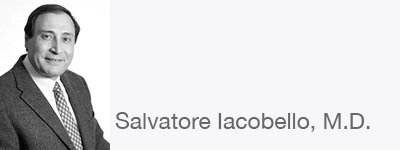
The ACO’s Case Presentation Series, A Different Kind of Psychiatry, continues with a free on-line webinar on Saturday, September 12, 2020, from 4:00 p.m. to 5:00 p.m. Salvatore Iacobello, M.D., will present “Does Traditional Psychiatry Help Our Patients?” Following the presentation, Dee Apple Ph.D., will moderate the discussion, during which you will have the opportunity to ask questions via on-line chat.
Dr. Iacobello, what prompted your patient’s parents to bring him to you for treatment?
Dr. Iacobello: “This is the story of an adolescent who’d been caught in a cycle of angry outbursts and despair leading to multiple hospitalizations and ongoing psychological and behavioral deterioration. During one of his hospitalizations when I met with Mark and his parents, I was very aware of his characterological and biophysical presentations. His body posture was rigid and he did not make direct eye contact with anyone. I saw an opportunity to undertake a different approach to treatment instead of one based on the standard psychiatric evaluation.”
“I explained to Mark and his family that the therapy I perform in my private practice focuses on emotional and physical work and evaluation, which cannot be used in a hospital setting where the scope of my responsibilities is limited to medication management. Fortunately, his parents expressed the desire to have their son continue treatment with me once he was discharged from the hospital.”
What was your therapeutic approach and what did the patient gain from the therapy?
Dr. Iacobello: “When Mark and his family came to my office, I focused on rapidly gaining Mark’s trust so that we could have a strong therapeutic relationship. To this end I made sure I didn’t criticize him or tell him what to do. I focused on his body language and general emotional expression, helping him connect his physical demeanor with what he was feeling.”
“As an example, I had him slowly move his neck as he looked around the room. He told me that just the act of doing this helped him feel calmer and brought him a sense of relief.”
“As I gained Mark’s cooperation, he became less guarded, not putting up his ‘wall’ with all its behavioral manifestations. Over time, Mark responded well to this approach and ultimately developed an ongoing therapeutic relationship with me. He continued to make an effort in therapy, showing more feeling and a desire to get better.”
What do you hope people will take away from your presentation?
Dr. Iacobello: “I would like participants to see the unique aspects of medical orgone therapy (MOT), which utilizes an approach to mental health care that is centered on the patient’s bio-emotional functioning instead of the traditional psychiatric approach that uses a list of symptoms and dysfunctional behaviors. Emotional energy needs to be released in the full expression of emotions if one wants to obtain a lasting therapeutic response. Working with Mark was a wonderful experience because of the changes I witnessed using this approach.”
“Nowadays, effective individual therapy is seldom practiced during psychiatric hospitalizations. It is frustrating seeing patients approached in a mechanical and standardized manner, knowing there is another way to handle mental health care. I would like to see MOT utilized more as a primary treatment form in the future. It is my feeling that when using this kind of treatment, more can be achieved to help patients like Mark.”
The webinar will be facilitated by Zoom and will last approximately one hour. Attendance is free. Registration is required. Save your seat by registering today: https://us02web.zoom.us/webinar/register/WN_CWd403WjQh6Ylm0Ys_-pJw
For more information call (732) 821-1144 or email the ACO
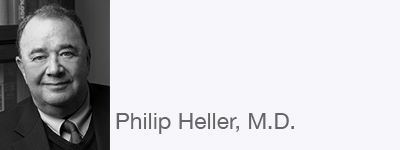
The ACO’s Case Presentation Series, A Different Kind of Psychiatry, continued with a free on-line webinar on Saturday, August 15, 2020, from 4:00 p.m. to 5:00 p.m. Philip Heller, M.D. presented “Psychotherapy: A Place to Complain Productively.” Following the presentation, Peter A. Crist, M.D. joined Dr. Heller for a discussion, during which the online audience the opportunity to ask questions via on-line chat.
Dr. Heller, why did you choose to speak on this topic?
Dr. Heller: When stress becomes intolerable people may respond destructively, which can disrupt and damage relationships. With the stress of the COVID-19 pandemic, anxiety and depression can be heightened, causing an increase in negative emotions and behaviors. I wanted to demonstrate that when destructive behaviors are kept within the boundaries of the psychotherapeutic relationship, negative consequences can be avoided.
What was your therapeutic approach and what did the patient gain from the therapy?
Dr. Heller: I began by helping the patient featured in my presentation see that a problem existed and I helped her determine the function of that problem. She thought that complaining to and criticizing her husband would reduce her anxiety. Instead, it resulted in her husband becoming more distant from her. This, in turn, brought back her anxiety.
Over time, her being able to discharge negative feelings and behaviors in her therapy kept the criticism and complaining away from her husband. This proved quite helpful for her marital relationship and for her other symptoms, which I’ll discuss at the webinar.
What do you hope people took away from your presentation?
Dr. Heller: When the therapist understands the emotional structure of the patient and the function of their complaints, the discharge of underlying negative emotions and behaviors can safely help the patient move ahead within the therapeutic relationship. This can also provide relief of the patient’s symptoms as well as improve his or her relationship with others.
For more information about the ACO and its activities, contact the American College of Orgonomy. Phone 732-821-1144; Email: aco@orgonomy.org
Living in the New Reality
We are pleased to share with you an interview with Peter A. Crist, M.D. that was published in a special Health & Fitness issue of US1 Newspaper on Wednesday, June 24, 2020.
After being sequestered in our homes since late March, summer is upon us and some restrictions are being lifted: retail stores are opening; restaurants are offering out-door seating; hair salons are accepting limited customers. How do we transition to what many are calling the “new normal?”
Peter A. Crist, M.D. president of the American College of Orgonomy (ACO), says, “I don’t particularly like the term ‘the new normal.’ My problem with it goes back to my experience with patients over the years. They’ve often asked, ‘Am I normal?’ and my response has been, ‘No—thank goodness you’re not normal. Just look at how messed up the ‘norm’ is!’”
He adds, “‘Normal’ doesn’t adequately distinguish between healthy and unhealthy in how we’re handling things. Instead of getting lost defining a new or old ‘normal,’ it’s better to talk about finding how to live with a new reality.
“Orgonomy, the science of man’s relationship with nature, is all about approaches to objectively observing reality. In medical orgone therapy we try to help people live with the emotional reality of who they are and the way the world is, as they find the most satisfying, healthy ways to handle their emotions. With the COVID-19 pandemic, there’s no way to know for certain our future reality, just as many of the predictions at the beginning of the pandemic were way off the mark. Uncertainty always leads to anxiety but orgonomy offers knowledge to help handle it that can show better ways to live given the actual realities of our circumstances. The key in our functional approach is to differentiate observations from conclusions—basing conclusions on facts as well as real observations derived from our senses rather than on assumptions or preconceptions.”
Dr. Crist says, “For example, you may plan to eat at a restaurant. What was once no big deal is now fraught with anxiety and uncertainty. When you enter, observe the distance between tables. If they look closer together than feels safe and you feel anxious, don’t just dismiss your anxiety. Trust your instincts. You can ask that the tables be further separated or simply order take-out. It’s also important to evaluate whether your anxiety is rational and directly related to the immediate reality or colored by internal, neurotic anxiety that has come to the surface. But no matter what, you have to find ways to go ahead and live while finding ways to calculate risks.”
Physical distancing and wearing masks are protocols in place now. Asked about masks, Dr. Crist notes, “The point of wearing a mask is to prevent infection by exchange of respiratory droplets carrying coronavirus. So, it’s crazy for people to wear masks when they’re not in direct contact with other people. Rather than thinking functionally about them, there’s been magical thinking that somehow a mask will protect you even in situations where there’s no risk of exposure. I’ve even seen people driving down the road wearing masks alone in their cars. The scientific information clearly shows that the risk of infection is greater when you are in close proximity to people in an enclosed space for extended periods of time. Outdoors there’s no rational reason to wear a mask in an area with few people who aren’t within six to ten feet of you.”
The ACO focuses on social as well as individual emotional health as manifested by its training programs in both medical and social orgonomy. Social problems have been on people’s minds since the beginning of the COVID-19 pandemic. They’ve exploded in public awareness in the last few weeks since the killing of George Floyd. Dr. Crist notes, “The protests and social unrest that have degenerated into riots and looting at times, are undoubtedly fueled by pent up energy from centuries of unresolved frustration and rage further complicated by everyone being shut in the last few months. The situation is terribly complicated, but we can only find our way through it by differentiating rational political action from irrational, neurotic acting out of destructive impulses. Orgonomy is all about distinguishing healthy impulses from neurotic ones. That’s crucial in how people handle the COVID-19 pandemic; it’s crucial in how people handle injustice and political problems.”
For more information about the ACO and its activities, contact the American College of Orgonomy. Phone 732-821-1144; Email: aco@orgonomy.org
-Hilary S. Kayle
This article is also available on the US1 website.
Scroll down for more articles by Dr. Crist regarding the pandemic.
Podcast Offers Behind-the-Scenes Therapy Mentoring Session
We are pleased to share with you an article that was published in a special Health & Fitness issue of US1 Newspaper on Wednesday, June 24, 2020.
Since July 2019, the American College of Orgonomy (ACO) has been offering the ACO's InContact Podcast series which presents an inside view into medical orgone therapy, the unique form of psychotherapeutic treatment taught at the ACO. Their most recent podcast: “A Mentoring Session,” https://adifferentkindofpsychiatry.blubrry.net/2020/05/28/a-mentoring-session/ features an extraordinary conversation between therapist Susan Marcel, D.O. and her psychotherapy mentor, Peter A. Crist, M.D. discussing a complicated patient she is treating.
One of the key aspects of the ACO’s therapists that sets them apart from their peers is that they have frequent mentoring/tutorial sessions to discuss problems that arise in their work ranging from dealing with complex patients to handling professional situations in which their own characters may come into play. This particular podcast reveals how the patient’s character manifests physically and emotionally; how the therapist needs to understand the healthy nature or core of their patient; and the best way to monitor the effect of an intervention.
Other podcasts of particular interest during this trying time include “Pandemic Perspectives” https://adifferentkindofpsychiatry.blubrry.net/2020/04/18/pandemic-perspectives/ in which a range of ACO psychotherapists discuss how they and their patients are dealing with COVID-19 and “A Pandemic of Panic” https://adifferentkindofpsychiatry.blubrry.net/2020/04/02/a-pandemic-of-panic/ featuring Peter A. Crist, M.D., president of the ACO, sharing his observations and thoughts about the current global pandemic. He provides a fresh overview of the situation and clarifies some of the confusion contributing to our anxiety as the virus pandemic moves across the world. He explains how functional thinking is a tool that can help individuals as well as governments clarify how anxiety manifests and spreads through all levels of society. As Dr. Crist puts it, “We cannot be ostriches hiding our heads and not looking nor be in a panic where we are looking but not seeing. We must all have courage, stand our anxiety, and follow our perceptions.”
The podcast series also offers an inside view of several specific case presentations. InContact Podcast host, Chris Burritt, D.O., notes, “The remarkable thing about our podcasts is that they tell stories and highlight how the doctors see their patients. Our training and the way our doctors treat patients differentiates the ACO from other institutions and forms of treatment. If you think of orgonomy as the science of man’s relationship with nature, that describes how we as medical orgone therapists look at our patients—helping them handle the nature inside themselves and in their environment. If something is off, we help them re-establish a satisfactory relationship with themselves, their loved ones and the world around them.”
Regarding what people can get out of the podcasts, Dr. Burritt says, “It could be helpful for a listener just to sit back and absorb the doctors’ perspectives. There’s a lot of confusion in the world we’re living in these days. Even if you’re not in therapy, it can reduce stress levels to get clarity about what’s going on.”
Visit the podcast series website https://adifferentkindofpsychiatry.blubrry.net For more information about the ACO and its activities, contact the American College of Orgonomy. Phone 732-821-1144; Email: aco@orgonomy.org
-Hilary S. Kayle
This article is also available on the US1 website.
"Dealing with Pandemic Panic: The Fresh Approach of Medical Orgone Therapy"
Free webinar about common emotional reactions to the coronavirus pandemic presented by Peter A. Crist, M.D. on Saturday, April 18, 2020 is now available on our YouTube channel. Dr. Crist is joined by Chris Burritt, D.O. for discussion and Q&As. Watch on our YouTube Channel.
"Social Distancing: What's in a Word?” thoughts by Peter A. Crist, M.D.
When I first heard the term “social distancing” less than two weeks ago, my immediate thought was, What the hell is that? Then I learned it meant keeping at least six feet between me and someone else. The term somehow didn’t seem right and nagged at the back of my mind until a conversation this past week with someone whose office in Center City Philadelphia had been closed down because of decisions regarding the coronavirus pandemic.
He said, “When one of my employees left the office, she said, ‘Social distancing doesn’t have to mean social isolation.’”
In that moment it dawned on me exactly what had been bothering me about the term “social distancing.” What is needed is physical distancing not social distancing. The risk of spreading the coronavirus increases with physical proximity but there’s no evidence that it is affected by people’s social closeness. Social distancing is a misnomer that confuses functional realms.
We are social animals and under stress need social contact with others. It’s deep in our biology. A group of chimpanzees under external threat or after experiencing internal conflict will gather in a group and hug each other. At other times, when relaxed, they also maintain physical closeness with grooming.
In the current circumstances with the coronavirus it seems wise to take precautions of maintaining physical distance until we know more exactly the magnitude of the risk of coronavirus spread. In the meantime, we need to do our best to maintain social closeness while maintaining physical distance.
For years I’ve heard people remark how ironic it is that social media is called that because its actual effect is often to distance people from each other socially. This is a perfect time, however, to use social media constructively rather than destructively. To prevent viral contagion, we need physical distancing not social distancing. In fact, especially now, we need to practice social closeness with family, friends and other loved ones in whatever forms we can find.
-Peter A. Crist, M.D.
Dealing with Pandemic Panic
We are pleased to share with you an interview with Peter A. Crist, M.D. that was published in a special Doctor's Day issue of US1 Newspaper on Wednesday, March 25, 2020
The coronavirus pandemic has left us living with tremendous uncertainty. How contagious is this virus? Will I fall ill? Will my loved ones? Can I be treated if I do? Will I die? Is it safe to have contact with my loved ones? Is it safe to leave my house? How long will this siege last? Will I lose my job? What will happen to our economy? To our society? To the world? That’s enough to put anyone in a panic.
Peter A. Crist, M.D., president of the American College of Orgonomy (ACO) a Princeton area non-profit, educational institution, says, “We are living in uncertain times and anxiety is a natural, emotional reaction to uncertainty. What matters is how we handle our anxiety. Some people tune out and don’t engage, like ostriches who stick their heads in the sand. Others jump to conclusions without adequately looking. In some people the anxiety builds, they lose perspective and the anxiety tips into blind panic. We are in the midst of pandemic panic—panic about the coronavirus pandemic and a pandemic of panic itself.”
Dr. Crist adds, “It’s hard to find people with voices of reason walking the fine, but crucial line, between ostriches dismissing the significance of the coronavirus pandemic and those becoming panicky and hysterical about it. Ostriches don’t look and panickers can’t see. A healthy response in the face of uncertainty is to stand our anxiety and use our powers of observation and perception until we can see the best course to follow. At the ACO we teach a functional scientific method, which we can apply to our own lives: perceive, perceive, perceive until a conclusion spontaneously comes to you. It’s essential to see the difference between conclusions and observations to be sure our conclusions are based in reality rather than coming from misperceptions driven by emotions and blind panic. We need factual observations on which to base decisions.”
Dr. Crist notes, “One of the difficult things with any epidemic, any pandemic, is that it’s not just a medical problem; it’s not just a problem of understanding the biology of this particular infectious agent; it’s also a social problem.”
The ACO offers a multidisciplinary, functional approach in training doctors and others to look at the big picture and integrate that with details within disparate fields that include medicine, sociology and biology. Dr. Crist points out, “The process of functional thinking, which allows thoughts to spontaneously come up that mirror an actual process in nature, and, as taught at the ACO, can apply to any discipline. This is in contrast to thinking mechanistically, as if nature and people function like machines or thinking mystically, as if nature is unknowable and happens by magic. At the ACO we teach a key functional principle that keeps us rooted in reality especially in social interactions: what matters is not what is said or the intentions behind it but the actual effect of what is said or done. All too often, with the best of intentions, people act on decisions that have disastrous effects.”
Dr. Crist says, “We desperately need functional thinking during the coronavirus pandemic. A good example happened recently at US Customs points of entry for people returning from Europe. It made sense to try to identify and separate out potentially infected individuals from those who were not infected. But the way that policy was implemented did not take into account the sociology of how groups of people move in an airport. As a result, screening stations at multiple busy airports interrupted the natural flow of pedestrian traffic, creating huge lines and crowds of people congregated in close proximity, defeating the very purpose of the screening in the first place.”
Dr. Crist says, “A social orgonomic perspective helps us see that in a pandemic of panic, anxiety in one person triggers the latent anxiety in another, much as one startled bird can send the whole flock in flight. That’s a natural response that protects the birds both individually and as a group, as long as they keep their eyes open and their perceptions sharp to avoid flying into each other or crashing into a tree. What a contrast with what happens in human mass hysteria.
“Another mass emotional response often happens when people are frightened and vulnerable. Again, it all depends on how people handle their anxieties and fears. Most people suffer personally with them. But some people cannot tolerate their own anxiety and fear and manage their own feelings by controlling their environment and everyone in it in ways that end up destructive. We call this an emotional plague reaction. Because this is the person’s unconscious means to manage their own anxiety, they are usually unaware of their true motives and rationalize their destructive actions with plausible explanations such as that they are for the protection of others. The term emotional plague is apt because the destructive, controlling tendency in one person can trigger it in another who is trying to lessen their own anxiety by controlling what’s in their environment—much as the infectious nature of anxiety. The ACO education in social orgonomy underscores the importance of understanding and diagnosing the emotional plague in society.
“Many of the extreme measures presented with great certainty as essential to control the coronavirus pandemic have hallmarks of an emotional plague reaction, especially in the ways they have affected life, liberty and the pursuit of happiness. The reality is that without more definitive information about the biological, medical and sociological aspects of the pandemic we don’t know what’s truly necessary. It’s hard to resist the impulse to act on premature conclusions; we need to gain a clear-eyed understanding of what’s actually happening and avoid unintended consequences. Again, without thinking functionally and seeing the broader picture, the long term social effects of the medical quarantine may be more devastating than the pandemic itself—the cure worse than the disease. In medicine we are taught ‘first do no harm.’ We need to think medically about social interventions as well.”
It’s important to note that the ACO-trained medical orgonomists approach to anxiety differs from much of the psychiatric and psychological community. Dr. Crist says, “We see anxiety as a signal that a feeling or impulse is blocked rather than a pathological symptom that must be medicated or meditated away. Anxiety is what people experience when a feeling or impulse is excited but lacks a satisfying outlet. In individual therapy, we help people tolerate feeling their anxiety so that they can overcome their blocks and get through them to something more satisfying.”
Asked about general advice to help people deal with this difficult time, Dr. Crist says, “For individuals it all comes down to managing uncertainty and handling anxiety. Everyone is different, so each person needs to do whatever they’ve found that helps them. Basic, commonsense hygiene of hand washing is advisable with any viral infection as is maintaining physical distance from anyone suspected of being infected, both of which also serve to reduce uncertainty about spreading the virus. Exercise is valuable for most people to discharge energy. Without outlets, pent-up energy will fuel anxiety. Dr. Wilhelm Reich who first developed orgonomy said, ‘Love, work and knowledge are the wellsprings of our life. They should also govern it.” We need to put our energy into contact with loved ones, productive work and gaining genuine knowledge about ourselves and our social world. That will all help manage the panic. We are social animals. Now more than ever we need contact with others. I’ve never liked the term, ‘social distancing.’ It’s a misnomer that confuses functional realms. To prevent viral contagion, we need physical distancing not social distancing. In fact, especially now, we need to practice social closeness with family, friends and other loved ones in whatever forms we can find.”
As a precaution, the ACO has postponed all of its events through the end of April. Dr. Crist adds, “The office is functioning, and we are still taking calls for referrals to medical orgonomists. We unfortunately had to postpone a social orgonomy presentation and suspend our monthly case presentation series, which is free and open to the public for anyone to learn more about our approach to therapy. But we’ve turned a number of those presentations into podcasts, which are available at the ACO podcast series (https://adifferentkindofpsychiatry.blubrry.net/). Our website and book store also have a trove of knowledge on all aspects of orgonomy (https://www.orgonomy.org).” 4/30/2020 Update: Our Case Presentation Series is now being offered as webinars. See our Events page.
-Hilary S. Kayle
This article is also available on the US1 website.
We are pleased to share with you an interview with Dr. Chris Burritt, host of our “ACO InContact: A Different Kind of Psychiatry” Podcast, which appeared in a recent issue of U.S. 1 Newspaper. Dr. Burritt discusses the focus of the podcast and offers insights into what makes the ACO’s therapeutic approach different from others.
InContact Podcast: Revealing a Functional Approach to Therapy
Focusing on its new monthly case presentation series, the podcast, “ACO InContact: A Different Kind of Psychiatry” gives listeners the opportunity to hear about how ACO-trained medical orgone therapists treat specific patients — often without medication. Chris Burritt, DO, a clinical associate at the ACO, hosts the new series, which he also edits, produces, and helps to promote.
“The ACO is one of the best kept secrets in the Princeton area and in general. We have a lot to offer but we’ve had difficulty connecting with the larger public. Yet we have patients who go to great lengths to come to therapy, driving for hours or flying in from the west coast. The remarkable thing about our podcast is that it tells a story and highlights how the doctors see their patients — that it’s something different from the typical psychiatrist.”
Dr. Burritt notes that people don’t have to experience a clinical depression or have crippling anxiety to benefit from therapy. “There used to be a lot of stigma about therapy but that’s changing. For example, I don’t know if people think of seeing a psychiatrist for evaluating their love relationships or how they’re feeling about their work life. That’s something that differentiates our doctors and the ACO from other institutions and other forms of treatment. If you think of orgonomy as the science of man’s relationship with nature, that describes how we as medical orgone therapists look at treating our patients — helping them handle the nature inside themselves and also in their environment. If something is off, we help them re-establish a satisfactory relationship with themselves or the world around them.”
Dr. Burritt offers additional insight into what makes the ACO’s therapeutic approach different from others. “First is having a good sense of what the patient is looking for, what the patient is about and what they want out of life. It’s not about ‘What are your symptoms and how can we make them go away?’ The first thing that we psychiatrists do is get a sense of what’s going well and what’s not satisfactory in someone’s life, and that doesn’t always involve a discreet, specific symptom, like panic or insomnia.”
Asked how he became interested in orgonomy, he notes, “I was drawn to post-graduate training with the ACO because of medical orgone therapy’s focus on the emotional lives of patients and it’s unique ability to help alleviate problems without the use of medication. There’s also something very profound about how the therapy addresses psychological and physical blocks that cause symptoms and interfere with patients’ feeling satisfied with life.”
Regarding what people can get out of the podcasts, Dr. Burritt says, “It could be helpful for a listener just to sit back and absorb the doctors’ perspectives. There’s a lot of confusion now about work relationships and families in the rushed chaotic world we’re living in these days. Even if you’re not in therapy, it can reduce stress levels to get clarity about what’s going on.”
— Hilary Kayle Crist
This article can also be found on US1 online.
Visit our podcast website to listen. Subscribe today and share with your family and friends.
Listen to our podcast InContact with the ACO to hear host Dr. Chris Burritt's interview with Dr. Peter A. Crist about his book-in-progress All People Great and Small. Dr. Crist gives his thoughts and feelings about the doctor-patient relationship, how his medical training changed him, and how he has handled his sensitivity to the people and things around him. The interview also touches on what distinguishes medical orgonomists from other psychiatrists and therapists.
The third in a series of readings covering entirely new material from Dr. Crist's book-in-progress, All People Great and Small, took place on Saturday, February 1, 2020 at the American College of Orgonomy (ACO) campus in Princeton, NJ. A reception followed.
SECTIONS

Movie Night featuring "Beautiful Boy"
Problems with Marijuana: An ACO Sponsored Forum
Movie Night featuring "Generation Found"
Legalized Pot: What are the Consequences?
Half-Day Introductory Laboratory Course
Clearing the Air: Facts & Fictions about Marijuana
A New View of Society & How We Relate: What is Social Orgonomy?
Personal Relationships in the Digital Age
Movie Night featuring "Chocolat"
Is the Doctor Really In? - Making Each Visit Count
Movie Night featuring "The Art of Getting By"
Making a Good Connection: The Precursor to Successful Therapy
Symptomatic Relief of Adolescent Depression
Right from the Start: Pregnancy, Birth & Emotions
Problems with Marijuana: An ACO Sponsored Forum
A Functional Look at Alcohol & Drug Addiction
Is the Doctor Really In? - Making Each Visit Count
Armored Culture, Armored People
Movie Night featuring "Screenagers"
Are Children's Books Just for Kids?
Treating Patients During the Pandemic: A Medical Orgonomist's View - Interview with Howard Chavis, M.D.
The American College of Orgonomy is hosting a new free webinar on Saturday, May 16th from 4:00PM to 5:00PM (EDT) (see link at the bottom of this email to register). Howard Chavis, M.D. will talk about how his patients are coping with the Coronavirus Pandemic and what it is like to use FaceTime as a means of therapy. He will be joined by Susan Marcel, D.O. for discussion and a Q&A session following his presentation. Dr. Chavis offers some thoughts about this upcoming event.
How did you decide to choose this particular topic?
Dr. Chavis: I was originally scheduled to talk about eating disturbances but my colleagues and I decided that talking about the pandemic and treating patients during this time would be of far greater interest.
What is it like for you to be use FaceTime as a tool for therapy?
Dr. Chavis: The interesting thing is that some years ago, I was treating a young woman in my New York City office, and then she went off to college but wanted to continue therapy. We decided on FaceTime and I “saw” her using that method for several years. I was surprised at just how effective these could be, so I’m not absolutely new to having virtual sessions and for now I only do FaceTime sessions.
How do your patients respond to this new way of doing therapy?
Dr. Chavis: Some of them had a certain amount of reluctance to begin with, but within seconds or minutes, they found that it works. I don’t want to tout my capacity for contact, but what I bring to my patients—whether it’s in the office or through FaceTime—is a quality of emotional, energetic contact that moves the patient and moves the treatment forward.
You have an office in New York City as well as in Scarsdale. How did you handle having an office in the epicenter of the virus?
Dr. Chavis: In addition to adolescents and adults of all ages, I see infants and young kids—with their parents, of course— and at some point I decided with “an abundance of caution,” using the term that was used early on, to no longer see my patients in person. I thought I might be putting them at risk and also myself. Within hours I decided to do the same in Scarsdale because the issue was the same: since many people who have been exposed to the virus are asymptomatic, I was not going to put them at risk or myself.
What do you hope people who participate will take away from your presentation?
Dr. Chavis: By hearing about patients in treatment, I’d like those who “zoom in” to have a clearer perspective on the pandemic and themselves during this challenging time. To see that under stress and duress people have characteristic reactions unique to themselves. That with the computer-generated predictions of the severity of this pandemic, especially the threat of death, we couldn’t know the reality so anything was possible. Now we know that the risk of death is actually extremely low and what you don’t hear in the media—for the most part—is a more accurate perspective about the threat. If you’re in your 70s or 80s and have a chronic medical condition such as high blood pressure, diabetes, or respiratory or heart problems, you’re at greater risk, but for everyone else the risk is significantly less. What we see from a sociopolitical perspective is there is an advantage for some to stir up panic and fear, whether they are aware of it or not, rather than focusing on the scientific advances and knowledge that we now know about this virus.
What is your message for participants who are not familiar with medical orgone therapy?
Dr. Chavis: For people who’ve never been in therapy before or don’t know about medical orgone therapy, I think this will help them understand that because the usual outlets that people have are now curtailed or constrained they may feel more anxious, or irritable, short with people or with their significant other or their kids, sad, depressed, low energy. And some of what they feel is totally reasonable and a response to this terrible, challenging circumstance that we are all living through. So, having a routine, maintaining structure, being active, stretching, walking, physically working out are all important. However, and this is key: It’s not just a mechanistic idea of "keeping busy," but rather having, as an orgonomist sees it, pleasurable bioenergetic discharge.
Register today: https://us02web.zoom.us/webinar/register/WN_rTIzR6q0RxeCi-yUNfa1Tw
You will be able to participate from a PC, Mac, iPad, iPhone or Android device. There will also be a dial-in only option provided in your registration e-mail if you prefer to listen only.
If you're unfamiliar with Zoom, you may want to visit their tutorial before the meeting, watch the short video, and download the correct Zoom app for your device: https://support.zoom.us/hc/en-us/articles/201362193-Joining-a-Meeting
Also there are some Webinar specific tips here you may find useful to review: https://support.zoom.us/hc/en-us/articles/115004954946-Joining-and-participating-in-a-webinar-attendee
About Howard Chavis, M.D.
Dr. Chavis has a private practice in Manhattan and Scarsdale, New York. He is board- certified in psychiatry, neurology and medical orgonomy. He received his MD from the Albert Einstein College of Medicine. He is Associate Editor of the Journal of Orgonomy and Secretary of the Board of Regents of the American College of Orgonomy.
About Susan Marcel, D.O.
Dr. Marcel is board-certified by the American College of Osteopathic Family Physicians as well as by the American Board of Psychiatry and Neurology, and is a Clinical Associate of the American College of Orgonomy. She received her DO from the Philadelphia College of Osteopathic Medicine. She is in private practice as a psychiatrist in Philadelphia, PA and is a voluntary faculty member and instructor at Thomas Jefferson University Hospital, currently teaching first year Jefferson Medical College medical students.
The Third in a Series: All People Great and Small
American College of Orgonomy: The Vital Doctor-Patient Relationship | US1 Article
Depression and Antidepressants: Life Without Medication
All People Great and Small: Readings by Peter A. Crist, M.D.
Watch our in depth video with Dr. Crist for the backstory on his California trip and presentation "Are You Satisfied with Your Work Life?," on Saturday, December 8, 2018 in Venice California. For more information about our upcoming events please visit our Event page.
Special West Coast Event: "Are You Satisfied with Your Work Life?"
Movie Night featuring "The Pursuit of Happyness"
Special Event - All People Great and Small: Readings by Peter A. Crist, M.D.
Workshop on Work-Related Topics
Burned But Not Forgotten Event & Banned Books Week
Are You Satisfied with Your Work Relationships?
Are You Satisfied with Your Work Life?
Conversations with an Orgonomist - Improving Work Relationships
Fathers: A Forgotten Natural Role
Fathers: A Forgotten Natural Role - Follow Up
Fathers: A Forgotten Natural Role - Princeton Sun Article (July 2012)
Is the Doctor Really In? - Making Each Visit Count
New Attacks on Wilhelm Reich & Orgonomy
Personal Relationships in the Digital Age
A Different Kind of Psychiatry | ACO Clinical Case Presentation & Discussion | "Treatment of Two Cases of Panic Attack Without the Use of Medication"
Movie Night featuring "Lincoln"
The French Revolution: An Example of the Emotional Plague
Revolutionary Ideas in Biology
A Nine-Year-Old Boy with Anger and Nausea
American College of Orgonomy: The Vital Doctor-Patient Relationship | US1 Article
Movie Night featuring "Modern Times"
Movie Night featuring "To Kill a Mockingbird"
Conversations with an Orgonomist - Difficult People
Difficult People: Using Gut Feelings as a Guide in Relationships
Movie Night featuring "A Little Romance"
Movie Night featuring "Into the Woods"
Emotions Speak Louder Than Words
Symptomatic Relief of Adolescent Depression
Movie Night featuring "Danton"
"On the Shoulders of a Giant: Fictional Conversations Between Sigmund Freud and Wilhelm Reich"
Movie Night featuring "Screenagers"
American College of Orgonomy: The Vital Doctor-Patient Relationship | US1 Article
"Right from the Start: Pregnancy, Birth and Emotion"
Movie Night featuring "Beautiful Boy"
Movie Night featuring "The Pursuit of Happyness"
Movie Night featuring "Generation Found"
At Anchor House in Trenton with "Generation Found"
Movie Night featuring "Dear Frankie"
Movie Night featuring "28 Days"
Movie Night featuring "Lincoln"
Movie Night featuring "The Young Victoria"
Movie Night featuring "America, America"
Movie Night featuring "A Little Romance"
Movie Night featuring "The Artist"
Movie Night featuring "Chocolat"
Movie Night featuring "Gravity"
Movie Night featuring "Into the Woods"
Movie Night featuring "The Art of Getting By"
Right from the Start: Pregnancy, Birth & Emotions
Movie Night featuring "28 Days"
Movie Night featuring "The Artist"
Movie Night featuring "The Young Victoria"
Depression and Antidepressants: Life Without Medication
Problems with Marijuana: An ACO Sponsored Forum
Medical Orgone Therapy for Children and Teens: Treating Emotional and Behavioral Problems
The Importance of Parental Support in the Treatment of a Child
The French Revolution: An Example of the Emotional Plague
Personal Relationships in the Digital Age
Reich & Freud Revisited: Conversations with Dr. Charles Konia
Other:
My Eleven Years with Wilhelm Reich by Dr. Elsworth F. Baker
Interview with Substance Abuse Expert, Richard Ryan, M.A.
Past Interviews
Special Event
Saturday, February 1, 2020, 4:00pm to 6:00pm
The Third in a Series: All People Great and Small, Readings by Dr. Peter A. Crist
Psychiatrist and writer, Dr. Peter A. Crist, will share excerpts from his book-in-progress, All People Great and Small. The third in a series of readings, covering entirely new material, will take place on Saturday, February 1, 2020 from 4:00PM to 6:00PM at the American College of Orgonomy (ACO) campus in Princeton, NJ. A reception will follow. The book's title, an homage to James Herriot's several volumes of compelling accounts of life as a country vet, reflects Dr. Crist’s open-hearted view of people. Dr. Crist's writing is a window into what it was like to be a child entranced by the natural world and inquisitive about how people relate to each other. It also provides an in-depth view of the impact his medical training and work as a doctor caring for patients has had on the course of his life. The selections for this year’s event include stories from his childhood, college years, medical training and time as a professor of psychiatry at UMDNJ-Rutgers Medical School that together give a sense of how he became the kind of doctor he is today. This year, in recognition of 2020 as an election year, he has included two stories, one from early adulthood and one from childhood, that reflect a unique view of sociopolitics based on his observations of growing up in an authoritarian era with non-authoritarian parents. Discussion will follow each of the readings.
Dr. Crist graduated from UCLA with an AB in Zoology and an MD degree. He is board certified in psychiatry, internal medicine, and medical orgonomy. He is in private practice in central New Jersey where he treats infants, children, adults, couples, and families. Dr. Crist is also president of the ACO, a non-profit, educational and scientific organization. He is on the faculty of the ACO training program for medical orgonomists and is chairman of their social orgonomy training committee and on its faculty. Dr. Crist has spoken in the US and abroad on a wide range of topics and has published numerous articles in the Journal of Orgonomy.
The cost to attend is $45. Seating is limited, registration required. Purchase in advance by calling (732) 821-1144 or securely via PayPal using the button below. Attendance is complimentary for ACO Patron and Sustaining Level Member Donors. Learn about becoming a Member Donor on our Support page.
Watch our new video for a sample of Dr. Peter A. Crist's stories from his book All People Great and Small. The video includes excerpts from Dr. Crist's 2019 book reading.
Listen to our podcast InContact with the ACO to hear host Dr. Chris Burritt's interview with Dr. Peter A. Crist about his book and upcoming event.
"Making a Good Connection: The Precursor to Successful Therapy
Presented by Jackie Bosworth, M.D. | Joined by Philip Heller, M.D.
Saturday, January 11, 2020 4:00PM to 5:00PM
ACO Campus, 4419 Route 27, Princeton, NJ.
Rayna, a 49-year-old female with a manic depressive character, was working as a professional entertainer when she was first treated by Dr. Bosworth in a medication-only clinic setting. She was also seeing another therapist at the time. Rayna exhibited signs of debilitating depression with simultaneous anxiety and said she had never felt so overwhelmed. Over several months of sessions with Dr. Bosworth, as well as frequent phone calls in between visits, Rayna's medications were adjusted, gradually tapered, and finally discontinued. She was doing well and transferred her care to an outside therapist.
Months later, Rayna reached out to Dr. Bosworth for medication, traveling a great distance to see her. Dr. Bosworth listened to her latest account of events and to how she was feeling emotionally. She decided to prescribe the starting doses of her previous medications. While Rayna could have chosen any number of psychiatrists or physicians for medications, she reached out to Dr. Bosworth because of the strong therapeutic relationship that was previously established between them.
Please join us to hear more about the characteristics of emotional contact between this patient and Dr. Bosworth and how it grew into a sustaining therapeutic relationship.
The series is free to attend.
"Symptomatic Relief of Adolescent Depression" Presented by Salvatore Iacobello, M.D. | Joined by Chris Burritt, D.O. Saturday, November 16, 2019, 4:00PM to 5:00PM, ACO Campus, 4419 Route 27, Princeton NJ The series is free to attend. For more information about our upcoming events please visit our Event page.
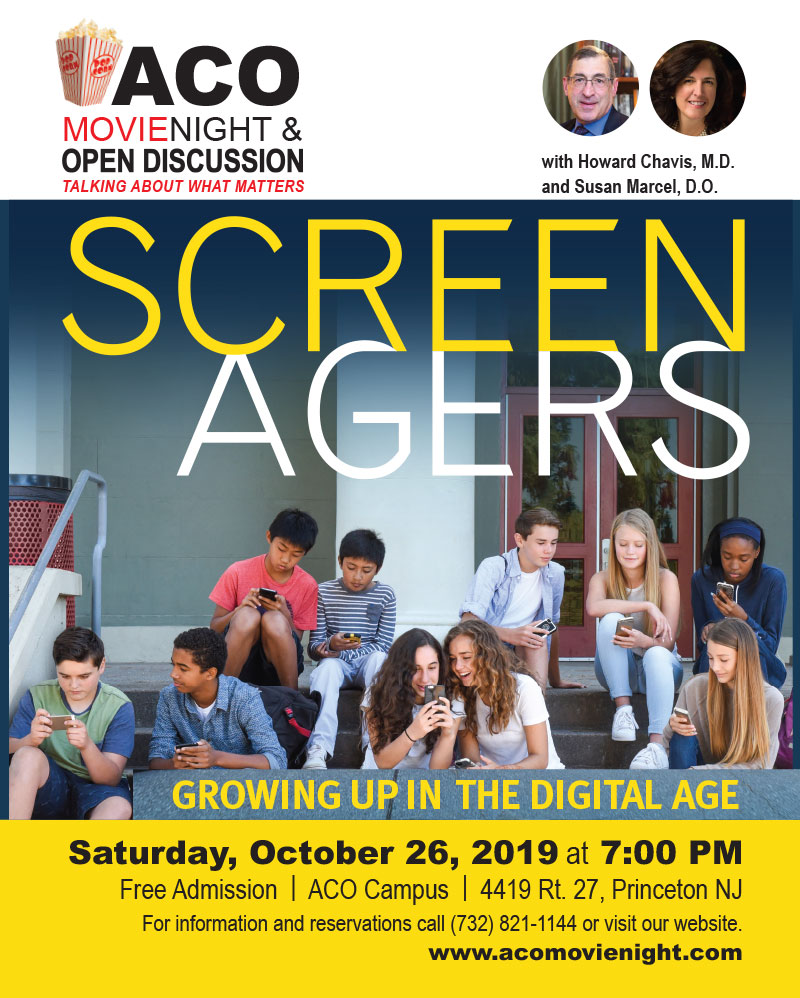 On Saturday, October 26, at 7:00PM at the ACO Campus in Princeton, NJ, ACO Movie Night & Open Discussion featured Screenagers, a documentary by physician and filmmaker, Delaney Ruston. Dr. Ruston takes a deeply personal approach as she probes into the vulnerable corners of family life, including her own, to explore the impact of social media, video games, academics and internet addiction on relationships. Through poignant, and sometimes unexpectedly funny stories—along with surprising insights from authors, psychologists and brain scientists—Screenagers reveals how tech time affects a child’s development and offers solutions on how adults can empower kids to best navigate the digital world and find balance.
The discussion following the film explored the healthy and unhealthy effects of screen time on the emotional and social functioning of the young people in your life. Howard Chavis, M.D. and Susan Marcel, D.O. lead the discussion.
Admission to Movie Night is free. For more information about our upcoming events please visit our Event page.
"A Nine-Year-Old Boy with Anger and Nausea"
Presented by Philip Heller, M.D.|
Joined by Chris Burritt, D.O.
Saturday, September 21, 2019, 4:00PM to 5:00PM, ACO Campus, 4419 Route 27, Princeton NJ
Dr. Heller shares some insights about his presentation:
"Frequently, children present to a physician with symptoms of abdominal pain. Sometimes the "belly" complaints can be a direct result of unexpressed or inadequately expressed emotions. The history and treatment of this nine-year-old boy, whose parents were concerned about his anger as well as his complaints of nausea, shows how these problems may be addressed and resolved with psychotherapy without the use of medication."
- Philip Heller, M.D.
Presented by Peter A. Crist, M.D. |
Joined by Jackie Bosworth, M.D.
Saturday, August 17, 2019, 4:00PM to 5:00PM, ACO Campus, 4419 Route 27, Princeton NJ
Dr. Crist shares some insights about the story of a young girl he began seeing for therapy at the age of six. This is a new memoir story from his book-in-progress, All People Great and Small.
Dr. Crist, what prompted your patient's parents to bring her to you for treatment?
Dr. Crist: "She is a smart, precocious, and perceptive child who the parents described as, 'Bright, creative, delightful and charming. But she can also be a terror if things don't go her way.' She had previously been seen by another therapist whose behavioral approach had not been effective. It was important to identify and recognize that behind her rigid behavior was terror. Trying to change her behavior without helping her handle the terror in her, brought more fear to the surface and intensified her behavior. Before her behavior could change, we needed to understand its function in managing her emotions. The story I will present gives the audience an intimate look into the world of using a different approach to help a remarkable child."
Were your patient's parents involved in her therapy?
Dr. Crist: "Yes, her parent's role in understanding and supporting their child's needs has been extremely important."
What do you hope people will take away from your presentation?
Dr. Crist: "Medical orgone therapy is a different way to treat emotional and behavioral problems that can be especially effective with children. But it's not just about resolving symptoms. In today's crazy world, ongoing therapeutic support to help children maintain their talents and health and cope with life's challenges is more important than ever.
Jackie Bosworth, M.D., joined Dr. Crist as discussant.
Dr. Crist will also offer a Readings Event on February 1, 2020 at the ACO Campus in Princeton. This will be his third reading from his book-in-progress All People Great and Small. Please mark your calendars.
"The Importance of Parental Support in the Treatment of a Child"
Presented by Virginia Whitener, Ph.D. |
Joined by Alberto Foglia, M.D.
Saturday, June 1, 2019, 4:00PM to 5:00PM, ACO Campus, 4419 Route 27, Princeton NJ
Dr. Whitener shares insights about her presentation:
"In the current social climate with emphasis on chemical imbalances, status and structure of the brain, medications, and PC protocol and political policies, it is important to get back to the basics regarding children. Fundamental to the health of children and our future society is the role of parenting - the connection and contact between parents and their children." - Virginia Whitener, Ph.D.
The series is free to attend. For more information about our upcoming events please visit our Event page.
After six years and twenty movies, ACO Movie Night has taken the “show on the road!” Orgonomists Dr. Peter Crist and Dr. Susan Marcel along with ACO Executive Director Debra Sansanelli participated in a historic ACO Movie Night at Anchor House in Trenton, New Jersey. Anchor House, founded in 1978, takes homeless and runaway youths off the street and reunites them with their families. Anchor House provides shelter, school outreach, transitional and supportive housing. Teens and Anchor House staff members attended the movie, Generation Found, a documentary about an alternative recovery high school for sober teens. Afterward, there was a lively and touching discussion about what matters to young people coping with drug addiction, sobriety and emotional health. It was heartening to make this kind of connection outside of our usual audience and we hope to do more programs like this in the nearby community.
For more information about scheduling an ACO Movie Night and discussion for your organization, please contact us at (732) 821-1144 or aco@orgonomy.org
"Right from the Start: Pregnancy, Birth and Emotion"
Presented by Susan Marcel, D.O. | Joined by Chris Burritt, D.O.
Saturday, May 11, 2019, 11:00AM to 12:00PM, ACO Campus, 4419 Route 27, Princeton NJ
On Mother's Day weekend, Saturday, May 11, from 11 a.m. to noon at the ACO Campus in Princeton, NJ, Dr. Susan Marcel told about Anne, a patient who came to her for a second opinion after her previous psychiatrist gave her the devastating news that she could never have children. He had warned Anne that her anti-depressant medications could potentially cause birth defects. After several years of working with Dr. Marcel in psychotherapy, Anne was better able to manage her emotions and developed some stability. She and Dr. Marcel decided that she could be weaned from most of her medications and changed to one safe enough for her to consider getting pregnant. Find out what happened with Anne at Dr. Marcel's presentation, "Right from the Start: Pregnancy, Birth and Emotion," about the vital importance of the emotional care of pregnant women, infants, and expectant fathers during the prenatal, birthing and postnatal experiences.
Dr. Marcel addressed the ways midwives and obstetricians handle their emotionally difficult work environment. Dr. Chris Burritt joined her as discussant and shared his experience both as a psychiatrist and new father.
The series is free to attend. For more information about our upcoming events please visit our Event page.
Special Event: The Second in a Series - All People Great and Small: Readings by Peter A. Crist, M.D.
Saturday, April 6, 2019, 4:00PM to 6:00PM, ACO Campus, 4419 Route 27, Princeton NJ
Psychiatrist and writer, Dr. Peter A. Crist, shared excerpts from his book-in-progress, All People Great and Small. The second in a series of readings, covering entirely new material, took place on Saturday, April 6, 2019 from 4:00PM to 6:00PM at the American College of Orgonomy (ACO) campus in Princeton, NJ. A reception followed. The book's title is an homage to James Herriot's several volumes of compelling accounts of life as a country vet. Dr. Crist's work is inspired by his medical training, his experiences caring for patients, his unique observations about growing up in an authoritarian era with non-authoritarian parents and his love of nature. The selections for this event included stories from his childhood, college years, medical training and time as a professor of psychiatry at UMDNJ-Rutgers Medical School that together give a sense of how he became the kind of doctor he is today. Dr. Crist's writing is a window into what it was like to be a child entranced by the natural world and inquisitive about how people relate to each other, as well as an in-depth view of the impact his medical training and work as a doctor has had on the course of his life. Discussion will follow each of the readings.
Dr. Crist graduated from UCLA with an AB in Zoology and an MD degree. He is board certified in psychiatry, internal medicine, and medical orgonomy. He is in private practice in central New Jersey where he treats infants, children, adults, couples, and families. Dr. Crist is also president of the American College of Orgonomy (ACO), a non-profit, educational and scientific organization. He is on the faculty of the ACO training program for medical orgonomists and is chairman of their social orgonomy training committee and on its faculty. Dr. Crist has spoken in the US and abroad on a wide range of topics and has published numerous articles in the Journal of Orgonomy.
Read the US1 March 27, 2019 article with the ACO's views about the doctor-patient relationship - "American College of Orgonomy: The Vital Doctor-Patient Relationship"
Dr. Crist talks about his book, his 2018 reading and the upcoming event in our new video.
Dr. Crist will also offer a Readings Event on February 1, 2020 at the ACO Campus in Princeton. This will be his third reading from his book-in-progress All People Great and Small. Please mark your calendars. For more information about this and other upcoming events please visit our Event page.
We are pleased to share with you an article with the ACO's views about the doctor-patient relationship which appeared in US1 on March 27, 2019 | "American College of Orgonomy: The Vital Doctor-Patient Relationship"
John suffered for years with manic depressive illness. At one point, suicidal feelings escalated so intensely he experienced an uncharacteristic panic attack. He scheduled an emergency session with his psychiatrist, Dr. Philip Heller, during which he revealed a secret he’d kept for years. Having finally found someone he could trust with his hidden thoughts, John discovered that telling them released a flood of emotions. Hear more about John on Saturday, April 13, from 4 to 5 p.m. when Dr. Heller presents, “Turning a Psychiatric Emergency into an Opportunity for Positive Change,” joined by Dee Apple, Ph.D. as discussant. This is the next in the American College of Orgonomy’s (ACO’s) “A Different Kind of Psychiatry” monthly case presentation series open to the public for free at the ACO campus near Kingston, NJ..
On Mother’s Day weekend, Saturday, May 11, from 11 a.m. to noon. Dr. Susan Marcel will tell you about Anne, a patient who came to her to for a second opinion after her previous psychiatrist gave her the devastating news that she could never have children. He had warned Anne that her anti-depressant medications could potentially cause birth defects. After several years of working with Dr. Marcel in psychotherapy, Anne was better able to manage her emotions and developed some stability. She and Dr. Marcel decided that she could be weaned from most of her medications and changed to one safe enough for her to consider getting pregnant. Find out what happened with Anne at Dr. Marcel’s presentation, “Right from the Start: Pregnancy, Birth and Emotion,” about the vital importance of the emotional care of pregnant women, infants, and expectant fathers during the prenatal, birthing and postnatal experiences. She’ll also address the ways midwives and obstetricians handle their emotionally difficult work environment. Dr. Chris Burritt will join her as discussant and will share his experience both as a psychiatrist and new father.
The significance of personal relationships in addressing emotional problems will be brought out the following month when Virginia Whitener, Ph.D., presents “The Importance of Parental Support in the Treatment of a Child” on Saturday, June 1, from 4 to 5 p.m. with Alberto Foglia, M.D. as discussant. (For details about this and other upcoming presentations, follow the “Event” page at: www.orgonomy.org.)
The ACO’s series of case presentations and discussions offers the unique opportunity to learn about actual cases involving people helped by ACO-trained doctors (See “The Vital Doctor-Patient Relationship”). Upcoming events that showcase this functional approach to human emotional problems cover the gamut from a specific psychiatric crisis to the universal reality of childbirth to the relationship between child and parents.
Depression, anxiety and other psychiatric and emotional problems are intimately connected with how people handle their feelings and are not merely biochemical disorders that can only be treated with medications. The ACO offers this series to inform the public about a different approach to psychiatric and emotional problems that helps people live with their emotions in more satisfying ways. (Also, see “A Different Kind of Psychiatry” in the Winter Wellness, January 16, 2019 issue of US1.)
For more information about the ACO’s events, therapy referral service and training programs, contact the American College of Orgonomy. Phone 732-821-1144; Email: aco@orgonomy.org; Websites: www.orgonomy.org and www.adifferentkindofpsychiatry.com
This article is also available on the US1 website.
We are pleased to share with you an article with the ACO's views about the doctor-patient relationship which appeared in US1 on March 27, 2019 | "American College of Orgonomy: The Vital Doctor-Patient Relationship"
In today’s world, many people, including children, adolescents and adults of all ages are more stressed out, anxious and depressed than ever. Many are detoured by apparent quick fixes without knowing that lasting solutions are available.
The board certified doctors affiliated with Princeton’s American College of Orgonomy (ACO) know that to achieve long-term effects requires time — time to develop a relationship of genuine trust between doctor and patient. Together they can then address painful emotional problems. ACO-trained doctors work with their patients to help them face the causes underlying their symptoms. With this kind of focus and approach, patients can lead fuller, more satisfying lives.
In an effort to share how ACO therapists work, the College is hosting a monthly series of hour-long presentations with open discussion that showcase a doctor’s work with specific patients. These are free of charge and open to the public. The next meeting, on Saturday, April 13, features Dr. Philip Heller’s treatment of a patient who experienced a psychiatric emergency that was turned into an opportunity for positive change. On Mother’s Day weekend, Saturday, May 11, Dr. Susan Marcel will focus on the vital importance of the emotional care of pregnant women, infants, and expectant fathers during the prenatal, birthing and postnatal experiences. She will also address the ways midwives and obstetricians handle their emotionally difficult work environment. (For more information about these presentations, see “Ride the Emotional Rollercoaster.”)
To understand the different approach offered by ACO therapists, visit the website: www.adifferentkindofpsychiatry.com. If you are interested in finding a therapist in your area or want to learn about the process of becoming a therapist, you will find that information, as well.
For a more personal view of one therapist, Dr. Peter Crist, president of the ACO, will offer readings from his memoir in progress, All People Great and Small, during a special event at the ACO campus on Saturday, April 6 from 4 p.m. to 6 p.m. His selections will include stories from his childhood, college years, medical training and time as a professor of psychiatry at UMDNJ-Rutgers Medical School that together give a sense of how he became the kind of doctor he is today. Admission for this presentation is $45. Reception will follow.
Board certified in internal medicine and psychiatry, Dr. Crist notes: “Many of my patients bring up their medical problems during their psychotherapy sessions. I realized it’s a rare uninterrupted block of time for them to talk to a physician they trust. It’s a sad reflection on the current state of medicine in which primary care physicians lack the time to really listen to their patients. For several thousand years the doctor-patient relationship has been one of the most significant as well as intensely emotional and intimate of all human bonds. At the ACO, we continue to train doctors in the tradition of the sacred, healing relationship between doctors and patients that dates back to Hippocrates and before.”
For more information about the ACO’s events, therapy referral service and training programs, contact the American College of Orgonomy. Phone 732-821-1144; Email: aco@orgonomy.org; Websites: www.orgonomy.org and www.adifferentkindofpsychiatry.com.
This article is also available on the US1 website.
Based on the best-selling memoirs from father and son David and Nic Sheff, Beautiful Boy chronicles the heartbreaking and inspiring experience of survival, relapse, and recovery in a family coping with addiction.
ACO Movie Night & Open Discussion explored the vital emotional contact and courage needed to face the deadly disease of addiction. Dee Apple, Ph.D. and Susan Marcel, D.O. led the open discussion after the film.
Admission to Movie Night is free. For more information about our upcoming events please visit our Event page.
"Marijuana: Parents Matter" presented by Dee Apple, Ph.D. | Discussant: Edward Chastka, M.D.
Saturday, January 19, 2019, 4:00PM to 5:00PM, ACO Campus, Princeton NJ
Dr. Apple shares his insights about his presentation:
“There’s a lot of confusing data and confused opinions out in the media and in the world about whether marijuana is harmful or not. But research shows two things that are absolutely clear: High THC levels in cannabis absolutely disrupt adolescent development. And the younger an adolescent is when he or she uses, the more seriously their brains and nervous systems are disrupted and delayed, and their capacity for contact with themselves and the world compromised. This sets them up for problems as they mature and take on harder challenges in life, making things worse as time goes on.
Whether cannabis is legalized or not, how parents address these difficult issues with their child is crucial.
We cannot completely prevent our children’s exposure to marijuana, as, for example, it is present in most schools. Social development is important, and as your child hangs out with their friends, exposure is likely going to occur. There’s no way around that, and how parents deal with that challenge and threat to their child’s health is critical.
My presentation was of interest to parents of teenagers or pre-teens. I showed the full range of responses to how specific parents handled their child’s interest in or use of marijuana, from parents who are clear and firm with their kids to parents who have difficulty acting like parents, who do not want to take charge or go up against their children in what is a very challenging situation.
This presentation led into a discussion about unique situations that arise in addressing the current problems with marijuana. There were lots of great questions from parents and I appreciated getting feedback about how they have dealt with their own children. -- Dee Apple, Ph.D.
The series is free to attend. For information about the series, visit our Events page.
Dr. Chastka
A Different Kind of Psychiatry | ACO Clinical Case Presentation & Open Discussion | Marijuana: Saying No
On Saturday, December 15, 2018, Edward Chastka, M.D. presented "Marijuana: Saying No."Joining Dr. Chastka was Philip Heller, M.D., as the discussant. 4:00PM to 5:00PM, ACO Campus, 4419 Route 27, Princeton NJ.
Dr. Chastka's presentation was an opportunity to go behind the scenes and learn how one medical orgone therapist makes a difference in treating young people with emotional problems and cannabis abuse. Dr. Chastka discussed a young man's transformation from using marijuana to escape life's problems to trying to commit to stay clean and sober.
The series is free to attend. For more information about our upcoming events please visit our Event page.
Dr. Crist
A Different Kind of Psychiatry | An Adolescent Comes Out of the Fog of Marijuana
The first event in the ACO's new monthly series of clinical case presentations and discussions on Saturday, November 17, 2018 from 4:00PM to 5:00PM at the ACO campus in Princeton was "An Adolescent Comes Out of the Fog of Marijuana" by Peter A. Crist, M.D. Joining Dr. Crist was Dale Rosin, D.O. as discussant. Dr. Crist shares his insights about the new series and the upcoming case presentation.
 Dr. Crist, what was the inspiration for this series?
Dr. Crist: "Medical orgone therapy can treat a wide range of conditions. Unfortunately, the type of therapy we do is not as well-known as we would like it to be. Dr. Rosin suggested that one way to spread the word would be to host a regular series open to the public where the ACO medical orgonomists could present cases they have treated. We decided monthly presentations would be a good way to inform people about what we do and tell family, friends and other new people about it."
The first three presentations in the series were marijuana related cases. Why is that?
Dr. Crist: "We had such a great response to our recent ACO-sponsored forum, Problems with Marijuana, that we wanted to continue the discussion and offer the public the opportunity to hear first-hand from therapists in the trenches about how medical orgone therapy makes a difference in treating problems related to marijuana use. Subsequent presentations have explored the treatment of other emotional difficulties."
Why did you choose the particular case you presented on November 17?
Dr. Crist: "The case that I presented is one that I wrote up for the Journal of Orgonomy in 2002 about an adolescent I treated who had problems with marijuana. What strikes me about the case is that the basic problems it illustrates are just as true now as they were then. In fact, it's almost as if it could have been written today. It shows what's happening with young people, especially kids who have a lot of heart. They don't know how to live in the world we're in and, as this case clearly shows, medical orgone therapy can help young people find different ways to tolerate their feelings and live with them, which is the basic goal of therapy."
Did your patient have other problems in addition to marijuana use?
Dr. Crist: "The patient's basic problem was what we refer to as people 'going out of contact' as a way of handling unpleasant emotions, which is really what all drug-related problems are--the person trying to handle intolerable feelings by using the drug to go out of touch with them. Marijuana has been referred to as the "care-less" drug because it can put the user in a state of feeling fine and not being bothered by anything. My patient's attitude about his family, school and life in general was '"who cares?"'--and it became clear to me as treatment progressed that marijuana mimicked his character attitude."
What was your approach with him?
Dr. Crist: "The case illustrates using the character analytic approach (an approach to therapy in which we deal with the person's typical defenses, or the typical way they handle their emotions). Rather than dealing with his use of marijuana as a moral issue, I worked with him to help him see how he used the drug to reinforce his usual attitude, and to learn how to tolerate his feelings without smoking pot. As he began to tolerate feeling more as we dealt with his tendency to not care, it became clear that he cared a great deal, which is why things were so difficult for him. He was actually a sensitive and caring young man. He showed many of the features of other young people with drug and alcohol problems who I've treated."
What did parents learn?
Dr. Crist: "The case shows how important working with the young man's mother was, and I was excited about sharing with parents a new perspective about how to deal with marijuana use other than seeing it as something they just have to allow their kids to do, or be hard-assed about. Neither tactic works with young people. Young people need guidance but will resist people telling them what to do. The approach I used with my patient was to help him come to see things for himself rather than tell him what to see or do. It takes patience.
I think adults in general got a lot out of this case because it offers hope. Many people have a 'doom and gloom' attitude about young people today, and I want to open people's perspectives so that they can see that young people have good hearts and can find ways to live in the world with who they are and what they feel."
The series is free to attend. For more information about our upcoming events please visit our Event page.
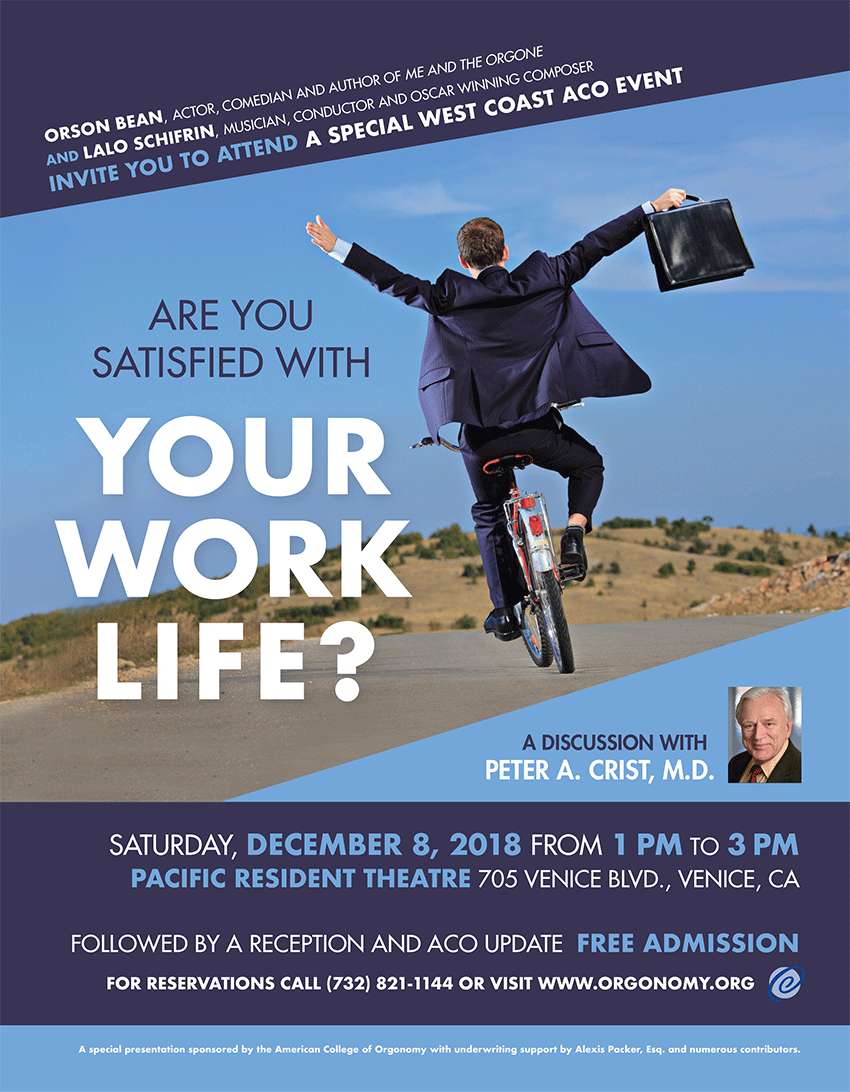 Special West Coast Event - Social Orgonomy Series Presentation: "Are You Satisfied with Your Work Life?" | Presented by
Peter A. Crist, M.D. | Saturday, December 8, 2018 | Pacific Resident Theatre, 705 Venice Blvd., Venice, CA, 1:00PM to 3:00PM. Free to attend.
Special West Coast Event - Social Orgonomy Series Presentation: "Are You Satisfied with Your Work Life?" | Presented by
Peter A. Crist, M.D. | Saturday, December 8, 2018 | Pacific Resident Theatre, 705 Venice Blvd., Venice, CA, 1:00PM to 3:00PM. Free to attend.
Watch our video for a sample of some of the unique insights Dr. Crist shared at this presentation.
Watch our in depth video with Dr. Crist for the backstory on his presentation and California visit and event.
Watch our video to hear Dr. Crist tell about how he helped an employee discover his work life satisfaction.
Find Joy in Your Work
Thanks to the generosity of Orson Bean, renowned actor, comedian and author of Me and the Orgone, and encouragement from Lalo Schifrin, musician, conductor and Oscar award winning composer, Peter A. Crist, M.D. presented “Are You Satisfied with Your Work Life?” on Saturday, December 8, 2018 from 1:00 PM to 3:00 PM at the Pacific Resident Theater, 703 Venice Blvd., Venice, CA. The presentation was followed by a reception and short update by Dr. Crist on the ACO and our progress over the last several decades.
Dr. Crist’s background in psychiatry and business consulting underlies a distinctive, functional approach to work that can be used by anyone—actors, doctors, lawyers, businesspeople and corporate employees—whether you are self-employed or part of a company. He notes, “Identifying an individual’s specific work nature is important for helping them find satisfaction in work that suits them.”
The approach used by Dr. Crist can also help organizations function more productively and profitably with genuine expansion—the organizational equivalent of individual satisfaction and joy.
Dr. Crist is president of the ACO. He received his AB in Zoology and MD degree from UCLA. He is board certified in psychiatry, internal medicine, and medical orgonomy. He is in private practice near Princeton NJ and is president and CEO of ergonexus LLC, a business consulting practice with a functional approach to organizational problems, work relationships and consulting with individuals from executives to staff.
While in California, Dr. Crist also arranged private, work-life consulting sessions from Sunday, December 9 through Wednesday, December 12. If you are interested in more information, including his fees, contact him at peteracrist@comcast.com.
Interview with Peter A. Crist, M.D. | A Different Kind of Psychiatry: Monthly Series - ACO Clinical Case Presentations & Discussions | "An Adolescent Comes Out of the Fog of Marijuana"
The first event in the ACO’s new monthly series of clinical case presentations and discussions was held on Saturday, November 17, 2018 from 4:00PM to 5:00PM at the ACO campus in Princeton is “An Adolescent Comes Out of the Fog of Marijuana” by Peter A. Crist, M.D. Dr. Joining Dr. Crist was Dale Rosin, D.O. as discussant. Dr. Crist shares his insights about the new series and his case presentation.
Dr. Crist, what was the inspiration for this series?
Dr. Crist: “Medical orgone therapy can treat a wide range of conditions. Unfortunately, the type of therapy we do is not as well-known as we would like it to be. Dr. Rosin suggested that one way to spread the word would be to host a regular series open to the public where the ACO medical orgonomists could present cases they have treated. We decided monthly presentations would be a good way to inform people about what we do and tell family, friends and other new people about it.”
The first three presentations in the series are on marijuana related cases. Why is that?
Dr. Crist: “We had such a great response to our recent ACO-sponsored forum, Problems with Marijuana, that we wanted to continue the discussion and offer the public the opportunity to hear first-hand from therapists in the trenches about how medical orgone therapy makes a difference in treating problems related to marijuana use. Subsequent presentations will explore the treatment of other emotional difficulties.”
Why did you choose the particular case you will present on November 17?
Dr. Crist: “The case that I presented is one that I wrote up for the Journal of Orgonomy in 2002 about an adolescent I treated who had problems with marijuana. What strikes me about the case is that the basic problems it illustrates are just as true now as they were then. In fact, it’s almost as if it could have been written today. It shows what’s happening with young people, especially kids who have a lot of heart. They don’t know how to live in the world we’re in and, as this case clearly shows, medical orgone therapy can help young people find different ways to tolerate their feelings and live with them, which is the basic goal of therapy.”
Did your patient have other problems in addition to marijuana use?
Dr. Crist: “The patient’s basic problem was what we refer to as people ‘going out of contact’ as a way of handling unpleasant emotions, which is really what all drug-related problems are--the person trying to handle intolerable feelings by using the drug to go out of touch with them. Marijuana has been referred to as the “care-less” drug because it can put the user in a state of feeling fine and not being bothered by anything. My patient’s attitude about his family, school and life in general was ‘“who cares?"’—and it became clear to me as treatment progressed that marijuana mimicked his character attitude.”
What was your approach with him?
Dr. Crist: “The case illustrates using the character analytic approach (an approach to therapy in which we deal with the person’s typical defenses, or the typical way they handle their emotions). Rather than dealing with his use of marijuana as a moral issue, I worked with him to help him see how he used the drug to reinforce his usual attitude, and to learn how to tolerate his feelings without smoking pot. As he began to tolerate feeling more as we dealt with his tendency to not care, it became clear that he cared a great deal, which is why things were so difficult for him. He was actually a sensitive and caring young man. He showed many of the features of other young people with drug and alcohol problems who I’ve treated.”
Why should young people come to these presentations?
Dr. Crist: “I encourage young people to come so they can see a different way to handle their emotions and also find out that there are people who can help them deal with their feelings without needing to use drugs or alcohol to manage them.”
What will parents learn?
Dr. Crist: “My case also showed how important working with the young man’s mother was, and I’m excited about sharing with parents a new perspective about how to deal with marijuana use other than seeing it as something they just have to allow their kids to do, or be hard-assed about. Neither tactic works with young people. Young people need guidance but will resist people telling them what to do. The approach I used with my patient was to help him come to see things for himself rather than tell him what to see or do. It takes patience.
I think adults in general--whether they are parents or not--will get a lot out our upcoming presentations because it offers hope. Many people have a ‘doom and gloom’ attitude about young people today, and we want to open people’s perspectives so that they can see that young people have good hearts and can find ways to live in the world with who they are and what they feel.”
The series is free to attend. Seating is limited and advance registration is recommended. Visit our Events page for information about upcoming presentations.
The ACO Meets the Press
Last year the ACO’s Social Orgonomy Series presentation by ACO Clinical Associate, Dee Apple, Ph.D. on “Legalized Pot: What are the Consequences?” on October 7, 2017 was not without controversy. In attendance was an outspoken, pro-marijuana legalization lobbyist with whom Dr. Apple engaged. He deftly turned what could have been a negative confrontation into a constructive discussion between two opposing viewpoints.
The ACO felt that although controversial, the problems with marijuana use was a good topic to expand on to bring our unique view to the world. So the following year, on October 6, 2018, the ACO held the “Problems with Marijuana” forum at Rutgers University in New Brunswick, NJ which tackled the abundance of misinformation about marijuana and marijuana use by young adults. The forum featured a nationally recognized expert with many years of research experience who had consulted with the New Jersey legislature on the subject; two mothers representing internationally renowned websites promoting marijuana education; and ACO therapists presented cases involving individuals who lives were disrupted by the drug. In addition, the audience had the rare opportunity to hear how one drug-free teenager manages a world where marijuana use by her peers in and outside of school is common; and from another young person willing to share details about her recovery from substance abuse.
Prior to the forum, Mr. James Nash, the New Jersey statehouse reporter for Gannett News (The Record and USA Today Network) interviewed Edward Chastka, M.D., ACO Clinical Associate and co-coordinator of the forum. In a story about groups opposed to legalization which was published on September 24, 2018, Mr. Nash mentioned the ACO and the forum, and quoted Dr. Chastka.
On Oct. 6, another group opposed to legalization, the American College of Orgonomy, is hosting a workshop at Rutgers University titled "Problems with Marijuana."
The Princeton-based group, a niche medical organization devoted to the study of bioenergy as a solution to psychological disorders, contends that marijuana impairs brain function and causes psychosis in a segment of users.
"Is marijuana a safe substance to use recreationally?" said Dr. Edward Chastka, a Pennsylvania psychiatrist and addiction specialist who will speak at the Oct. 6 forum. "We have decades of experience showing us that it is not." Read story.
Mr. Nash attended the forum as did Mr. Nick Muscavage, another reporter from the same news service. Mr. Muscavage subsequently wrote an article which contained inaccuracies and distortions about the forum and the ACO which was published on October 9, 2018 in the Courier News. Read article.
In response to this article, Dr. Apple, co-coordinator of the forum, wrote a letter to the managing editor of the Courier News to provide the facts and set the record straight, which the paper published on October 17, 2018. Read Dr. Apple’s letter.
Another article appeared on the front page of the Rutgers University newspaper, The Daily Targum, on October 11, 2018. Written by news editor Mr. Ryan Stiesi, the ACO was incorrectly referred to as an “anti-marijuana legalization group,” and the article stated that the work of Wilhelm Reich has been labeled a pseudoscience by the scientific community. Dr. Apple wrote a letter in response to the editor in chief of the Targum, who responded by suggesting he instead submit an op-ed piece. Dr. Apple did so, but it was not published. Further, on October 16, 2018, the Targum published a pro-marijuana editorial, again referencing the ACO as an anti-marijuana group, which is most likely the reason neither Dr. Apple’s letter or op-ed submission was published.
Read Dr. Apple’s unpublished letter and op-ed piece.
Read the Targum’s pro-marijuana editorial.
Finally, after reading the Targum's pro-mariuana editorial, Dr. Apple wrote one final as yet unpublished letter to the Targum. Read letter.
With legalization still on the horizon in New Jersey, the ACO recognizes that continuing the discussion about marijuana and young people is more important now than ever before. The ACO’s new monthly series of clinical case presentations which began in November has featured presentations on the subject by Dr. Peter Crist and Dr. Edward Chastka. Coming up on Saturday, January 19, 2018 Dr. Apple will be presenting “Marijuana: Parents Matter” which focuses on the crucial role of parents.
We hope you will join us in the New Year for this event as we continue to focus on a topic that remains both timely and controversial.
Doctors and other professionals working in the trenches with drug addiction tackled the abundance of misinformation about marijuana and marijuana use by young adults. “Problems with Marijuana: An ACO Sponsored Forum” featured a variety of speakers from different walks of life who offered their perspective on the subject. The event took place on Saturday, October 6, 2018 at Rutgers University Conference Center in New Brunswick, NJ.
Keynote speaker, Dr. Theodore Petti, is a nationally recognized expert with many years of research experience who has consulted with the New Jersey legislature on the subject. He is Professor of Psychiatry at Rutgers-Robert Wood Johnson Medical School and President of the American Society of Adolescent Psychiatry. Dr. Petti has spoken across the globe on issues related to cannabis in adolescents and emerging adults.
Representatives from two internationally renowned websites promoting marijuana education—Julie Schauer, founder of Parents Opposed to Pot, and Kimberly Hartke representing Moms Strong—offered their views on marijuana use by young people.
ACO president Peter A. Crist, M.D. introduced the program, and therapists Dee Apple, Ph.D., Edward Chastka, M.D. and Dale Rosin, D.O. presented cases involving individuals whose lives were disrupted by marijuana.
There was also a rare opportunity to hear how one drug-free teenager manages a world where marijuana use by her peers in and outside of school is common; and from another young person willing to share details about her recovery from substance abuse. A question-and-answer section allowing the audience to interact with the presenters concluded the program.
Visit our Events page for information about our new ACO Clinical Case Presentation & Discussion Series where on Saturday, November 17, 2018 Peter A. Crist, M.D. will present "An Adolescent Comes Out of the Fog of Marijuana." The series is free to attend. Mailer.
Forum co-coordinators and presenters, Dr. Dee Apple and Dr. Edward Chastka talk about the forum in our new videos on the ACO Youtube Channel.
On Saturday, July 21, 2018, at 7:00PM at the ACO Campus in Princeton, NJ, ACO Movie Night & Open Discussion featured The Pursuit of Happyness, starring Will Smith and his son, Jaden, who bring to life the true story of Chris Gardner, a single father struggling to step up from the bottom rung of the ladder while valiantly protecting and providing for his young son in 1980s San Francisco.
When Chris’ wife leaves him, he has no job, no home and a five-year-old son to care for. Their salvation may lie in an unpaid internship at a prestigious brokerage firm where Chris hopes to secure a job at the end of six months, but meanwhile the pair must survive by living in homeless shelters. Chris pushes himself to the breaking point trying to create a better life, all the while focusing on nurturing his son and keeping him from knowing the direness of their situation.
Peter A. Crist, M.D. and Susan Marcel, D.O. led the open discussion after the film.
Drs. Crist and Marcel talk about "The Pursuit of Happyness" and ACO Movie Night & Open Discussion in our video.
We are pleased to announce that ACO Clinical Associate, Susan Marcel, D.O. was interviewed on the web series The Cunningham Piano Show. The piano is a daily refuge and a source of healing for Dr. Marcel, and in the video she talks about the art of listening and the therapeutic benefits of making music. Dr. Marcel also performs. Watch on YouTube
Saturday, March 24, 2018 | ACO Movie Night & Open Discussion featuring the documentary Generation Found | A powerful documentary that tells the story of one community coming together to ignite a youth addiction recovery revolution in their hometown. | ACO Campus, Princeton NJ, 7:00PM. Free Admission.
Devastated by an epidemic of addiction, Houston, Texas faced the reality of locking up its young people at an alarming rate, or burying them. So in one of America’s biggest cities, people from all walks of life came together to build the world’s largest peer-driven youth and family recovery community.
Generation Found, independently filmed over the course of two years, takes an unprecedented and intimate look at how a system of treatment centers, sober high schools, alternative peer groups and collegiate recovery programs can exist in concert to intervene early and provide a real and tested long-term alternative to the “War on Drugs.” It is not only a deeply personal story, but one with real-world utility for communities struggling with addiction worldwide.
Dee Apple, Ph.D. and Susan Marcel, D.O. led the open discussion after the film. Dr. Apple is a clinical psychologist with over forty years on the front lines working with adults, adolescents, and young people who have battled substance abuse problems. Dr. Marcel is a psychiatrist with 25 years experience treating adults and adolescents suffering with depression, anxiety, psychosis and substance abuse.
Watch our new video with Drs. Apple and Marcel discussing the film. A more in-depth discussion video is also available. For more information about our upcoming events please visit our Event page.
On Saturday, February 3, 2018, business consultant and psychiatrist, Dr. Peter A. Crist read from his book-in-process, All People Great and Small, at the American College of Orgonomy campus in Princeton, NJ. The book's title is an homage to James Herriot's books of compelling stories about life as a country vet. Dr. Crist's work is inspired by his medical training, his experiences dealing with patients who have come and gone throughout his life, and his unique observations about growing up in an authoritarian world with non-authoritarian parents. The selections he read spanned from childhood to adulthood and from personal to professional. Dr. Crist's writing is a window into what it was like for him growing up as a sensitive child entranced by nature and inquisitive about how people relate to each other, as well as an in-depth view of the impact his medical training and work as a doctor caring for people had on the course of his life. Discussion of the experiences followed each selection.
Dr. Crist graduated from U.C.L.A. with an A.B. in Zoology and an M.D. degree. He is board certified in psychiatry, internal medicine, and medical orgonomy. Dr. Crist is in private practice in central New Jersey where he treats infants, children, adults, couples, and families. Dr. Crist also is president and CEO of ergonexus LLC, a business consulting practice with a functional approach to organizational problems, work relationships and individuals from executives to staff. In addition, he is president of the American College of Orgonomy (ACO), a non-profit, educational and scientific organization. He is on the faculty of the ACO training program for medical orgonomists and is chairman of their social orgonomy training committee and on its faculty. He has spoken in the U.S. and abroad on a wide range of topics and has published numerous articles in the Journal of Orgonomy.
Dr. Crist talks about his book in our new video
For more information about our upcoming events please visit our Event page.
On Saturday, December 2, 2017, ACO Movie Night & Open Discussion featured Lion, a tale of loss and heartache as well as hope and love. Alberto Foglia, M.D. and Susan Marcel, D.O lead the open discussion after the film. Watch Drs. Foglia and Marcel talk about this film and the powerful impact of loving relationships in our video.
Watch our video with Dee Apple, Ph.D. discussing marijuana and his upcoming Social Orgonomy presentatation, "Legalized Pot: What are the Consequences?"
Watch our video of a discussion about marijuana led by Dr. Dee Apple. Joining him are ACO Clinical Associates Susan Marcel, D.O., Chris Burritt, D.O. and Alberto Foglia, M.D.
For more information about our upcoming events please visit our Event page.
 On Saturday, July 15, 2017, ACO Movie Night & Open Discussion featured the delightful and moving independent drama, Dear Frankie. Set in Scotland, the film features Emily Mortimer as Lizzie, mother of Frankie (Jack McElhone), a deaf and highly intelligent 9-year-old. Constantly uprooting themselves and relocating from town to town, Lizzie and Frankie are on the run from Frankie’s abusive father, a fact unknown to the boy, who believes his dad is a seaman who lovingly sends him letters about his travels to exotic lands. In fact, Lizzie has been writing these letters and is faced with a challenge when Frankie discovers the ship he believes his father is on will be docking nearby. A desperate Lizzie hires a kind, handsome stranger (Gerard Butler) to play Frankie's dad, creating bittersweet situations in this simple, understated film that has great depth and emotional impact. At Movie Night we xplored the vital relationships children and adults need in order to feel safe and allow themselves to be vulnerable and open to love. We also discussed how we communicate and connect with words and actions that go beyond words. Susan Marcel, D.O. led the discussion.
For more information about our upcoming events please visit our Event page.
Dr. Susan Marcel discusses Relationships in Dear Frankie
Dr. Susan Marcel discusses Communication and Perception in Dear Franke
On Saturday, June 3, 2017, the American College of Orgonomy offered a Half-Day Introductory Laboratory Course at the ACO Campus in Princeton, N.J. Dr. Dee Apple, director of the course, shares some insights about this unique opportunity to learn about the science of orgonomy.
Why did the ACO decide to offer a new Half-day Introductory Laboratory course this year?
Dr. Apple: “The idea originated out of the success of the Lab Open House the ACO held last spring. It was a fun day for everyone, and there was a lot of interest expressed in the lab course. We decided to offer a half-day course this time to reach out and offer an opportunity to people eager to learn about the science of orgonomy. This was something new, a bit of an experiment in itself for the ACO, and as we put things together we were excited about how it was taking shape.
We had new students along with long-time students and ACO supporters who wanted another chance to experience the lab course. It was a great opportunity for people to get a taste of what we have to offer and hopefully be hungry for more. We also had a few students who already took the longer course that we offer and are excited to get into the lab again not just for a refresher, but because they genuinely enjoyed the lab experience the first time.”
How were you able to condense so much into just a half day course?
Dr. Apple: “When we conduct our full two to four day lab course, we frequently stress the importance of observations and perceptions and not just making assumptions about things or jumping to conclusions. So, our half-day lab course, like all our lab courses, concentrated on the importance of hands-on experience and experiential learning without the more cognitive lecture components of the more extensive course.
We also decided to give the students advance online access to materials from lectures and readings so that they came into the course already prepped and primed to learn. One other outcome has been that the college has now created a very attractive and useful webpage for students, which will work well for future lab courses as well. Rather than hearing lectures during this lab course, the students were more focused on observing, seeing, feeling and experiencing - making real contact with - the experiments and demonstrations during the lab course.
They looked into microscopes; seeing how Wilhelm Reich discovered bions; experienced the Reich Blood Test; observed the energetic atmosphere and learned to use the DOR Index to quantifying their observations. Students saw firsthand how an orgone energy accumulator is constructed, and experienced the accumulator for themselves. They also observed Reich’s important To-T experiment, a “bombshell in physics,” and observed and used the electroscope, which Reich considered a most sensitive tool to changes in orgone energy and weather conditions.
Visit our Lab Course page for information about our Introductory and Advanced Laboratory Workshops.
US1 Interview with Peter A. Crist, M.D. | American College of Orgonomy: A Different Kind of Psychiatrist | Reprinted from the March 29, 2017, "Doctor's Day" issue of U.S. 1 Newspaper
For most, the word "psychiatrist" conjures up a doctor who prescribes medications for a biochemical mental disorder.
Dr. Peter A. Crist, president of the American College of Orgonomy (ACO) in Princeton, says his organization has a different perspective about mental and emotional health. “We train physicians in a form of therapy that integrates Freud’s talking cure with a new approach of understanding where people hold emotions in their body. This therapy enables people to tolerate anxiety, find a healthy outlet for their feelings, and live with the full intensity of emotions with little or no medication.”
A key difference between typical therapists and the ACO doctors is their training program in which physicians are trained to be keen observers of how their patients communicate. Notes Dr. Crist: “We’re focused on what we call ‘character’ — the underlying ways people handle their emotions. Our doctors are skilled in observing their patients — how they express themselves verbally or with body language. The three tools we may use to treat emotional problems include character analysis, addressing how a person breathes, and direct work on muscle tension. Our doctors learn how to observe and understand what’s happening emotionally with patients, far beyond words.”
Because of its non-verbal aspects, the therapy has great success with young children. The youngest patient Dr. Crist ever treated was a 13-month-old little girl. Her dad’s seizures required the mom to be the major breadwinner, but her absence distressed the little girl. “They brought their daughter to me after she stood at the top of the stairs hitting herself in the head saying, ‘No, no, no!’ The girl was anxious and clingy with her mother and once on the treatment couch, she clenched her jaws and closed her eyes. I got the girl’s attention by having her follow a penlight. Then I gently held her mouth open and she let loose crying — a huge voice of miserable sadness. After the first session, she started talking more than she ever had. To contain her misery, she’d held back everything.”
Another patient, in his mid-20s, diagnosed with ADHD as a child, took prescription drugs for years. After an episode of anxiety caused him to be hospitalized, he heard about Dr. Crist working physically with patients to improve perceptions. Says Dr. Crist: “We started working on his ability to literally look around the room and see things more clearly. After these exercises, he said, ‘Every time I do them I get the same feeling I got taking ADHD drugs. They focus me and calm me down but without the medications.”
This approach to therapy is based on the work of Dr. Wilhelm Reich, a student and colleague of Freud’s. Dr. Crist notes, “Reich said all of psychopathology can be boiled down to the fear of the spontaneous. Tolerating spontaneous emotions is what we’re about. The word ‘courage’ comes from the French word for ‘heart.’ It’s taken on the narrow meaning of living from one’s heart in the face of fear. I prefer its original meaning of living fully from our hearts with who we are as human beings. That’s what true courage is. At the ACO we’re are all about helping more people live from their hearts.”
For more information about the ACO’s therapy referral service and training programs, contact the American College of Orgonomy. Phone 732-821-1144; E-mail aco@orgonomy.org; or visit http://orgonomy.org/therapy.html
This article can also be accessed on US1's website
Susan Marcel, D.O. Discusses 28 Days for the ACO Movie Night & Open Discussion | March 18, 2017
28 Days is a dramatic comedy that takes a serious look at the problem of substance abuse and its consequences, starring Sandra Bullock starring as Gwen, a woman caught up in a lifestyle of hard partying with alcohol and drugs that is destroying everything, including herself. Forced to go into rehabilitation by the court, she rebels against the program until she gets a wake-up call and finally sees what addiction is doing to herself and to others. Raymond Mero, D.O. and Susan Marcel, D.O. led the open discussion following the film. Visit our Events page for information about future Movie Nights and other upcoming events.
Saturday, February 4, 2017 - Social Orgonomy Series Presentation - "A Functional Look at Alcohol & Drug Addiction" by Edward Chastka, M.D., Princeton NJ Addicts can often feel helpless but they do not have to feel hopeless. There are better ways to treat people with substance abuse histories that improve their chances for success. As part of the ACO's Social Orgonomy Presentation Series, Dr. Edward Chastka presented "A Functional Look at Alcohol and Drug Addiction." The presentation drew on Dr. Chastka's twenty years of experience treating drug addicts and alcoholics and took place on Saturday, February 4 at the Paul Robeson Center for the Arts in Princeton, NJ.
"The current treatment for addicts is often a revolving door," states Dr. Chastka. "Modern medical and psychiatric training does not adequately prepare doctors to treat addiction. Patients are detoxified from their drugs, receive some medication and counseling, and are then released to outpatient programs where they frequently relapse. The underlying social, family and emotional causes of the addiction are rarely addressed. Patients in early recovery often suffer overwhelming guilt and pain but have lost the coping mechanisms most of us use to defend ourselves. This leads back to depression and anxiety, which the patient seeks to escape with more drugs or alcohol." Medical orgone therapy breaks this cycle.
"Addiction invades life like a cancer and gradually replaces social and emotional connections; at the same time it destroys our natural character defenses against stress and anxiety. Once the drugs are withdrawn in a supervised manner, the medical orgonomist helps strengthen the patient by helping them rebuild their natural defenses. The addict learns to acknowledge how destructive the addiction is for themselves and their loved ones. Their ability to think and feel has been damaged by the substance abuse and with appropriate therapy, they can learn to tolerate emotions and express them appropriately." Dr. Chastka says, "One of the key components to recovery is the rebuilding of social support and an acceptance of rational authority. 12-step support groups such as Alcoholics Anonymous provide the patient with both a sense of belonging and a group of peers who help each other stay clean and sober. They encourage the addict to develop a spiritual connection with a higher power which helps re-establish authority in their lives."
Dr. Chastka graduated from the University of Virginia with a B.A. in Drama and an M.D. degree and is board-certified in psychiatry. Dr. Chastka is in private practice in Wyomissing, Pennsylvania where he treats children, adolescents, adults, and families. He has consulted for the past 16 years at Caron Treatment Center in Wernersville, Pennsylvania, founded a dual-diagnosis clinic for indigent patients at The Reading Hospital in Pennsylvania, and is currently supervising family practice residents in psychiatry and addiction from Lancaster General Hospital, Reading Hospital, and Lehigh Valley Hospital. He is a Clinical Associate of the American College of Orgonomy (ACO) and coordinator of the ACO Sociopolitical Orgonomy Course. He has also spoken on a wide range of topics as well as published numerous articles in the Journal of Orgonomy. This interview appeared in US1's Winter Wellness Edition on January 18th.
ACO Movie Night & Open Discussion on Saturday, December 3, 2016 featured Lincoln starring Daniel-Day Lewis. Alberto Foglia, M.D. and Susan Marcel, D.O. discuss Lincoln in the video below .
Posted November 22 - Lincoln's Thaddeus Stevens
Posted November 7 - Lincoln's Heart, Lincoln's Mind
Posted October 19 - Discover Lincoln
Interview with Dr. Charles Konia and Dr. Virginia Whitener re: Reich & Freud Revisited: Conversations with Dr. Charles Konia
On Saturday, October 1, 2016, the American College of Orgonomy presented Reich & Freud Revisited: Conversations with
Dr. Charles Konia at the Paul Robeson Center for the Arts, 102 Witherspoon Street, Princeton, NJ. Dr. Konia and Dr. Virginia Whitener (editor, director and producer of the 2014 staged reading of Dr. Konia’s work On the Shoulders of a Giant on which this presentation is based) both share some insights about the event.
Dr. Whitener, you worked very closely with Dr. Konia on the 2014 production of On the Shoulders of a Giant. Please tell us your thoughts about it and the history behind it.
Dr. Whitener: “On the Shoulders of a Giant written by Dr. Konia is of profound importance. It is a story of two men, two giants, who persevered against incredible odds and the social conditions of their time to study human problems and work to improve social ills and alleviate human suffering. The clip seen on YouTube of Freud's last public spoken words, and the only known recording of his voice, is moving. He begins, “I started my professional activity as a neurologist trying to bring relief to my neurotic patients” and ends with “the struggle is not over.” This was December 7, 1938. He had fled to England to escape the Nazis, had incurable, painful jaw cancer, and a year later, at his request his doctor gave him a lethal dose of medication. He was 83.
Reich began as a student of Freud while in medical school, meeting him in Vienna in 1919. They had a vital and lively working relationship. Reich made many important discoveries, developed and introduced new procedures and innovations to psychoanalysis until parting with Freud under philosophical and clinical differences. There was political intrigue within the psychoanalytic community as well as severe, threatening events on the European continent because of and in the aftermath of World War I, social unrest and disaster, and the subsequent rise of communism and Nazism. Reich left Europe for Norway and then emigrated to the US, literally on the last boat. His books and published works, 6 tons of them, were incinerated by the FDA in New York in 1956, the only government-initiated book burning in American history. He died amidst government persecution in 1957 at age 60.”
Dr. Konia, we were very excited about you discussing your work On the Shoulders of a Giant on October 1st. Would you give us some of your thoughts about the event?
Dr. Konia: “I very much enjoyed sharing with the public an appreciation of the importance of Reich and Freud as well as knowledge about these two great individuals and their relationship. I think their relationship is of central importance because people don’t usually know of the close association between them. Sadly, there has been a strong attempt by some to deride, ignore and evade the significance of these two scientists. In fact, Reich and Freud both had a profound effect in directing the course of our society, and that’s something that I wanted to make people aware of.”
Dr. Whitener, what do you think in general about the quality and accuracy of information that is available on the Internet or that has been published about Reich and Freud and their relationship?
Dr. Whitener: “There is much misinformation about Reich and Freud, individually and collectively, about their relationship, their viewpoints and their position in history. Some of the material presented in On the Shoulders of a Giant is not readily or easily available and is not typically known, and some has only recently come to light.
Dr. Konia's script is of historical importance. The work chronicles clinical issues, past and present, and includes valuable clinical insights regarding the evolution and development of psychoanalysis, character analysis and the current practice of medical orgone therapy. Also included are particular social concerns of Reich and Freud, both what they agreed on and what they had vastly differing viewpoints on, and which ultimately played a part in the disruption of their personal face-to-face and organizational relationships. Despite the differences between them, however, their perspective of our times is particularly valuable and relevant to understanding social problems today—in psychiatry, the mental health field, and our society—as we see the transformation of an authoritarian order into a more chaotic anti-authoritarian social structure.
The script uses the vehicle of two men, Reich and Freud, getting together, sitting down and talking. This imagined meeting, set in modern times, occurs about 80 years since they last saw each other. And, of course, having died, they have to come back to life and look at this very different world we now live in.”
Dr. Konia, it sounds like there is a lot of fascinating information in On the Shoulders of a Giant. Would you share with us how the idea for this play came about?
Dr. Konia: “The idea for Parts 1 and 2 came to me when I was reading the book Reich Speaks of Freud by the psychoanalyst, Dr. Kurt Eissler. The book contains Reich’s interview by Dr. Eissler. I thought what if I substitute Freud for Eissler and create a dialogue between Reich and Freud? These were two people who knew each other very well and there was much personal history that could be explored and brought out into the open. Part 3 then covers events that occurred after Reich passed away in 1957. The ideas and the manuscript developed over a period of years. I wrote it, then rewrote it, and finally gave it to Dr. Whitener to edit. She made some wonderful additions and changes. I give her a tremendous amount of credit for this and for making the staged reading of On the Shoulders of a Giant possible as well as for the upcoming event.”
Dr. Whitener, I understand clips of the film from the staged reading of On the Shoulders of a Giant were shown at the October 1st event.
Dr. Whitener: “Yes. Two years ago there was a staged reading of the script in Princeton by professional actors under the auspices of the American College of Orgonomy, and it was filmed. The material is rich, the reading was three hours long, and so much was covered. It is likely that there were many points simply missed by the audience, too much information to take in or to understand, questions that did not get a chance to be raised or answered.
Reich & Freud Revisited: Conversations with Dr. Charles Konia was presented with short segments of videotape from the filming of the 2014 staged reading interspersed with more explanatory commentary by Dr. Konia.
ACO Movie Night continued on Saturday, July 23 at 7:00PM at the ACO's campus in Princeton, NJ,
with Race, based on the incredible true story of
Jesse Owens. Medical orgonomists Jackie Bosworth, M.D. and Susan Marcel, D.O. led the group discussion after the movie.
Dr. Bosworth and Dr. Marcel share some of their thoughts about the film.
What in particular do you think we will be discussing following the showing of Race?
 Dr. Bosworth: "What's so interesting about Race and something that I'm sure we'll be talking about is that it's centered around a unique set of circumstances that existed in Nazi Germany prior to World War II -- with Hitler presenting the Olympics as an opportunity to prove Aryan superiority before the world. The film depicts Jessie Owens' path to those Olympic Games as well as the conflict with his own racial identity, this in the context of others telling him what he should do: Should he participate in the 1936 Olympics in Berlin or should he give up all that he had worked for and support a boycott favored by a consensus that included the NAACP?
Then, after winning four gold medals, the harsh reality for Jesse Owens was that American President FDR didn't invite him to the White House when he returned to the U.S. and never called, sent him a congratulatory telegram or publicly acknowledged his Olympic victories. Ironically, while in Germany at the Olympics, Owens was allowed to room and eat with white athletes and Germany's top Olympic athlete, Carl "Luz" Long, befriended him. In stark contrast, back in New York, at a dinner in his honor at the Waldorf Astoria, Owens had to use the freight elevator to get upstairs. Owens, himself, believed the whole point of the Olympic Games was that they should be devoid of politics, and that athletes should participate and bond despite race and the circumstances that existed at the time."
Dr. Marcel: "Race is also a moving, compelling drama about life, love, and relationships, especially between lovers, fathers and sons, and among families, teams and communities. It is a story of complex choices and having the courage to make them even against great adversity."
How do you see Race connecting with society today?
Dr. Bosworth: "What went on during that time period mirrors modern day ongoing struggles for the truth when motives are masked and events and media coverage are "managed" to support a destructive ideology and agenda. The pivotal thing for me is that Race deals with an ever-present worldwide, socio-political reality, prejudice and discrimination, a symptom of humanity's scourge, the emotional plague and its devastating effects on all of us, something I trust we'll discuss. In the face of evil there are certainly acts of bravery: Jesse Owens participation in and victories at the 1936 Olympics stand out. At one point in the movie, Jesse Owens says that he is completely free for those ten seconds that he's running: free from bigotry, race, everything. In Dr. Konia's book, "The Emotional Plague," he describes and unmasks the emotional plague and the existence of evil. Race touches the tip of this iceberg."
Dr. Marcel: "With the upcoming International Olympics this August in Brazil, we are very excited to show Race and explore how the human drama from 80 years ago applies to 2016."
On Saturday, April 2, 2016, medical orgonomist Alberto Foglia, M.D. presented "Revolutionary Ideas in Biology," an Orgonomic Biology event at the ACO Campus in Princeton, N.J. Dr. Foglia shares some insights about his presentation.
How did you first become interested in Wilhelm Reich’s work in the biological sciences?
Dr. Foglia: “Even as a young child, I was fascinated by biology and anatomy. My interest in Reich began when I was a medical student and read his book, The Mass Psychology of Fascism. I immediately connected with the clear biological way he described human emotions and the psyche. His description of the movement of the ameba, a simple one-celled organism, and his clarification of the meaning of emotion was for me an incredible experience. At the university I had seen a wonderful movie of a moving ameba and I immediately made the connection.
In viewing the ameba and its movements, it is easy to see the expansion and contraction that Reich talks about because it is such a simple organism. The association between emotions and moving plasma was always my greatest interest. I would have never become a psychiatrist if I hadn’t learned about Reich and his biological, non-mechanical approach to the psyche. The movement of the ameba is the beginning of the biological adventure, and I’m very excited about showing this on film at my presentation.”
Did you show other films at your presentation as well?
Dr. Foglia: “Yes, absolutely! I had many visuals that I was excited about sharing with the audience, including over 70 still photos and movies of ameba, bions and much, much more. I will also be talking about cancer and showing a completely new way of seeing cancer and observing blood.”
What do you think people took home from your presentation?
Dr. Foglia: “I think people took home with them a good foundation for beginning to understand Reich’s work in the field of biology. This is something that the ACO is now expanding its efforts to educate the public about, just as we have done with our Social Orgonomy presentations over the past several years with regard to Reich’s discoveries in the social realm. The ACO will also have a Laboratory Open House in June, and I hope that what the audience learned from my presentation and what they see and experience in the lab, including looking through the microscope, will excite them to learn more about biology and Reich’s revolutionary ideas. My greatest hope is for everyone to see with their own eyes the world of the living in its simplest form and experience the wonder of that! This is the part of orgonomy that I love most, and I am very glad to have shared it."
ACO Movie Night continued on Saturday, March 19 at 7:00PM at the ACO's campus in Princeton, NJ with The Young Victoria. Medical orgonomists Raymond Mero, D.O. and Susan Marcel, D.O. will led the group discussion after the movie. Dr. Mero shares some of his thoughts about the film.
What is it about The Young Victoria that led you to recommend it for ACO Movie Night?
Dr. Mero: “First, this is an extremely well done movie with excellent acting, lavish period costumes, and incredible scenery filmed at historical landmarks in England. Second, and most importantly, The Young Victoria tells about the incredible, real-life love story of two people with great emotional health, Queen Victoria and Prince Albert.
Victoria becomes Queen of England when she is just 18 years old. She feels isolated and is overwhelmed by the incredible responsibility as well as by people with their own political agenda trying to manipulate her. Prince Albert, of German royalty, is coerced by his uncle to try to get in her good graces. He travels to England and when the two meet, despite Victoria knowing that he has been sent to win her favors, there is an immediate chemistry between them. This quickly becomes a very special connection. Being a few years older than Victoria and from a similar station in life, Albert understands what she is going through and helps her cope. Although he goes back to Germany they communicate through letters, maintain a long-distance relationship and eventually marry.”
You mentioned that Victoria and Albert have great emotional health. What is it about them that allows you say that?
Dr. Mero: “Quite simply, each has their own unique, very positive masculine and feminine qualities. Albert is a very strong man but is not a typical “macho” kind of guy, which is what you might expect particularly from that time period. He is firm with Victoria when she needs him to be but knows instinctively when to pull back. He encourages her to trust her feelings. Victoria blossoms and becomes a strong, independent woman who is fully capable of making her own decisions—and ruling a kingdom."
For more information about our upcoming events please visit our Event page.
Seeking Work-Love Integration
Reprinted from the February 3, 2016, Women in Business edition of US1
Women in business have dual, often conflicting, expectations placed upon them. The aim, we are told, is to have satisfaction in our jobs and satisfaction with our family life. The pop wisdom says that this is work/life balance, but a balance implies “one or the other” as the demands see-saw.
Psychiatrist and business consultant Dr. Peter Crist emphasizes that the ultimate aim is a work/love integration — the seamless blending of these two major aspects of emotional wellbeing.
Dr. Crist will address the challenges of achieving this integration in his presentation on “Balancing Work & Love” Saturday, February 6, at the Paul Robeson Center for the Arts, 102 Witherspoon Street, Princeton, from 4 to 6 p.m. in the fourth part of the American College of Orgonomy’s ongoing series of Social Orgonomy talks.
In this interactive open discussion format, Dr. Crist will address the audience about their own personal situations and look at what works and what gets in the way of having both a healthy, satisfying work life and an equally fulfilling, happy love and family life. Admission is free thanks to the generosity of supporters. Suggested adult, non-student donation is $45. Reservations are recommended. Call 732-821-1144 or reserve online.
“Satisfaction in both work and love is the basis for a full life,” Dr. Crist says. “But too often people focus on satisfaction in only one as a way of avoiding anxieties in the other.” He clarifies that, “It’s not how much someone works that makes for a workaholic but whether she is consumed by business to avoid addressing other things such as dissatisfaction in her marriage. Conversely, a ‘love-aholic’ may become consumed with caring for her children and her spouse to avoid her fears of attempting a career she’s interested in pursuing.”
True satisfaction in all realms of a woman’s life is the result of a qualitative assessment rather than a quantitative one. Dr. Crist notes, “The focus of communication between couples seeking to support each other needs to be on clearly articulating what is mutually satisfying both at home and at work rather than merely divvying up tasks to get through the day.”
He also points out that the acid test for satisfaction frequently comes when other distractions of life abate. “The children are grown and gone or one partner retires,” says Dr. Crist. “Then the question is clearly ‘Am I satisfied with my life undefined by family or work?’”
He notes another watershed moment might come when it makes financial sense for a husband to become the family caregiver rather than the wife. “Can the woman manage her career and also let go of her accustomed role of taking care of the children and running the household. And can she let her husband care for the children and manage the home in his own way? At such turning points couples need to really work to articulate their mutual expectations.”
In his work with couples, Dr. Crist encourages them to examine what gives each the most satisfaction at home and at work and to see how they can make changes that support what they both want. Dr. Crist sums up, “The goal, as hard as it may be to achieve at times can occur when both work and love are undisturbed and a satisfying work life brings passion and depth to our love life while a mutually satisfying love life generates a spark that energizes our work life.”
"Balancing Work & Love" presented by Peter A. Crist, M.D. will take place on Saturday, February 6, 2016 from 4:00 to 6:00PM at the Paul Robeson Center for the Arts, 102 Witherspoon Street, Princeton NJ. For more information or to register, go to Events.
Finding Balance in Work and Love
Reprinted from the January 27, 2016, issue of the Princeton Sun newspaper
Balance. This seven-letter word
is one that, despite its simple and
serene notion, is a tricky one to
maintain. A balanced diet, a balanced
lifestyle, a balance between
love and work – more like a balancing
act.
Luckily, when love and work are flailing through air, toppling down at different speeds and slipping at this very moment through your fingers, Dr. Peter A. Crist will help you pick them up, even them out and hold them, with great satisfaction, in the palms of your hands.
 On Feb. 6, Crist will visit the
Paul Robeson Center for the Arts
for an interactive presentation
called "Balancing Work and
Love." The presentation is the
fourth in a four-year series of presentations
on all topics of work
and work-related problems.
On Feb. 6, Crist will visit the
Paul Robeson Center for the Arts
for an interactive presentation
called "Balancing Work and
Love." The presentation is the
fourth in a four-year series of presentations
on all topics of work
and work-related problems.
"Work and love are the two key areas in everybody's life," Crist said.
Crist prefers to engage with his audience rather than lecture it on finding balance. Personal growth requires addressing personal problems.
"It's best for me to take examples from courageous audience members. I usually set the tone with a story or some basic sense of things and then ask: 'So what interested you in this topic?'" Crist said. "Many people are reluctant to speak in public, but the initial question warms them. From there, I address and integrate what I know from my work and pursue solutions."
Crist noted how balancing
work and love is a "huge topic" that includes an array of issues.
Sometimes his audiences diverge;
sometimes their experiences are
similar. Crist has worked with
couples who run a business and
have let their love life go by the
wayside, a wife readying to work
part-time but fearful that withless work she'll have less independence
or identity. He asks, "how many times have you let a
fight with your boyfriend or girlfriend
distract you at work?" and "How many of you are dissatisfied
with your job or your love
life?"
"Sadly, the vast majority of people are miserable or dissatisfied in one or both aspects of their life. In the modern world, there are more distractions to help us avoid our dissatisfaction. Distractions to not feel it do not help solve it," Crist said.
Crist said working in groups is both enjoyable and productive. He feels if he works together with people in public, then those dealing with conflicts do not have to suffer in silence.
"I look around and I see work and love are the key area of our lives, and it's possible to integrate the two – your life support can give more satisfaction to your love life and your love life can bring a spark to your work life," Crist said. "That is the most basic and important principle: rather than have these two major areas of our lives contradict each other, let's have them enliven one another."
Crist is board certified in psychiatry, internal medicine and medical orgonomy. In addition to being president and CEO of ergonexus LLC, a consulting practice dealing with work relationships, Crist is in private practice in New Jersey and treats patients ranging from infants, adults and families. Crist graduated from UCLA with an A.B. in zoology and an M.D. degree. He is president of the American College of Orgonomy and has spoken internationally on a wide range of medicinal topics.
"The main thing I want to share about my love of the work I do is if I can help people find some bit of greater satisfaction in their lives, it thrills me," Crist said.
"To look at one's self takes great courage. When people share what's going on in their lives and say, 'Hey, let's look at this,' I am honored and touched. It amazes me the depths people are willing to look at things."
"Balancing Work & Love" presented by Peter A. Crist, M.D. took place on Saturday, February 6, 2016 from 4:00 to 6:00PM at the Paul Robeson Center for the Arts, 102 Witherspoon Street, Princeton NJ.
For more information about our upcoming events please visit our Event page.
Integrating Work Life with Love Life
Reprinted from the January 20, 2016, Winter Wellness issue of U.S. 1
A lot of people talk about work-life balance. The problem with this phrase is that it implies that work is not part of life. Or that each aspect is something you can measure tangibly.
According to psychiatrist and business consultant Dr. Peter Crist, nothing could be further from the truth. “Work is a major part of our lives. So is love. The focus, then, should really be on integrating our work lives with our love lives. It’s a wellness issue,” he adds. “I truly believe that the basis of health in general is satisfaction in both realms.”
Satisfaction in our work or love relationships isn’t spoken of much. And there’s a difference between satisfaction and just getting by. “People may ask, ‘Do you like what you do?’” Dr. Crist says. “And a lot of people are okay with their jobs. But that’s very different from being deeply satisfied.”
On Saturday, February 6, Dr. Crist will host “Balancing Work & Love,” a free workshop on how to better integrate work and love relationships. His presentation will offer a unique understanding of how work and love can support and enhance, rather than conflict, with each other.
In an interactive open discussion format, Dr. Crist will talk with the audience about their own situations and look at what works and what gets in the way of having a healthy, satisfying work life that is integrated with an equally fulfilling love and family life.
The event, the fourth in a series on work and life-related questions sponsored by the American College of Orgonomy, will run from 4 to 6 p.m. at the Paul Robeson Center for the Arts in Princeton.
Satisfaction, Dr. Crist says, is not limited to one aspect of our lives. Yet so often people use one part of life to mask the problems they’re having in another. They might, for example, bury themselves in work, and enjoy doing so, but at the expense of their personal, love, and sex lives.
For example, Dr. Crist mentioned a couple he works with who run a company. “They work together so well on the business that they’ve let it take over their time at home so that their love life has gone by the wayside.” By helping them see how their work allowed them to avoid personal problems, they’re facing how to have a better home life. “If they can overcome their anxieties at home, it will actually improve their business lives.”
Another typical problem in this arena is women with full-time jobs whose husbands expect them to also take care of the household chores and children. Dr. Crist notes: “I encourage husbands and wives to examine what gives them each the most satisfaction at home and at work and to see how they can make changes that support what they both want.
Dr. Crist looks forward to giving people a different perspective on how to face anxieties in the workplace and in their personal and love lives so that they can become more fulfilled in both worlds.
For more information about our upcoming events please visit our Event page.
ACO Movie Night continued on Saturday, November 7 at the ACO's campus in Princeton, NJ with Into the Woods. Orgonomists Susan Marcel, D.O. and David Holbrook, M.D. will led the group discussion after the movie. Dr. Marcel and Dr. Holbrook share some of their thoughts about the film.
A Disney musical like Into the Woods seems to be quite a departure from the movies normally shown at ACO Movie Night, isn’t it?
Dr. Marcel: “It is, but it isn’t. You might think that because it’s a Disney musical that the film is going to be light fare, but that’s not the case. After seeing it a second time, I realized how compelling it is in terms of the depth and breadth of life experience and emotion. The stories told are the simple ones we know and love from childhood, but the way they are masterfully woven together is incredibly touching and emotionally very moving.
We want the films shown at Movie Night to be centered around the themes of love, work and knowledge — and all are found in Into the Woods. It’s about what people know, what they learn, and how they understand themselves and other people as they make their journey through
life — and here, through the woods. We’ve got Jack and the Beanstalk, Cinderella, Prince Charming, Little Red Riding Hood, depicting both healthy and unhealthy relationships. Once the stories start connecting you see some characters choose to bail out and some choose to stick together. Dr. Holbrook initially suggested the movie, and I’m glad he did because it was a great follow-up to his recent Social Orgonomy presentation, “What About Love?”
Dr. Holbrook, how did the movie tie in with your recent presentation?
Dr. Holbrook: "Into the Woods is very similar to my talk in many ways. The original musical was written by Stephen Sondheim, and I’m struck by how he tried to fit everything in just like I tried to do in my talk. It’s about making — or not making — a commitment to love, family, and community. When you look closely, Into the Woods is really about children and the consequences of how they are parented. As I said in my talk, the family is based on the love between the parents, and then how the children grow and develop is directly related to their parents’ happiness. The film is about growth and rebirth and the discovery of the true meaning of love, family, and community in contrast to the exciting fantasies pursued by so many."
Do either of you have a favorite character in the movie?
Dr. Holbrook: "After recently watching it a second time, I suddenly realized, “I’m the Baker!” I think both men and women in the audience recognized themselves in the characters. Everyone longs for something. Jack, in Jack and the Beanstalk, wishes for money. Cinderella wishes to go to the ball. Red Riding Hood wishes for bread to bring to her granny. The Baker and his wife wish for a child. There are lots of characters, plots and subplots, and every one of them references parent/child relationships, which is something everyone can relate to."
Dr. Marcel: "As Into the Woods began to unfold, I found myself responding most to Cinderella. When I was five or six years old I saw the Cinderella movie featuring Lesly Ann Warren and I started dancing around the living room because I wanted to be her! Cinderella struggles and changes in the woods. You sense her heart, her longing for love and her struggle. Later on in Into the Woods, I surprised myself when I responded even more to the character of the Baker. Of course, I also liked Meryl Streep as the Wicked Witch because she’s such a great actor. Johnny Depp as the Wolf is also fabulous. In the discussion after the screening, I enjoyed hearing who everyone's favorite characters were!
October 3, 2015
On Saturday, October 3, 2015, David Holbrook, M.D. presented "What About Love?" at the Paul Robeson Center for the Arts, Princeton, NJ as part of the ACO's ongoing Social Orgonomy Presentation Series. Dr. Holbrook shares some insights about his presentation.
Where did the idea for your talk “What About Love?” come from?
Dr. Holbrook: “When my son was in his early teens he would often ask me questions about love as he looked at his own life and the world around him. He wanted to know why people just couldn’t love each other, and this became part of an ongoing conversation with him. I think he actually felt that question his whole life but wasn’t able to talk about it until his early teens, the age when people can start to really verbalize these things. He wasn’t talking about romantic love specifically but rather his observations of the world around him; seeing, for example, interactions between students and teachers where there was an inability to be compassionate and perceptive. I took him seriously. It wasn’t a philosophical question; it was a very real, practical question. I tried to talk to him in the most fundamental way about love, and that is how I approached my presentation as well. We primarily talked about romantic love, but also a bit about family love, love of nature and love of country. We talked about what love feels like—the energy you feel in your body that accompanies what you sense in your psyche—and what that may suggest about working our way toward a scientific understanding of what love is."
How did you demonstrate this?
Dr. Holbrook: "The first half of my presentation started with the topic of romantic love, beginning with a live vocal performance, which I believe set the mood. I also used movie clips throughout to try to demonstrate and evoke the feeling of tender, romantic love in contrast to armored, pornographic expressions where sex is separated from love. I wanted the audience to experience the feelings within themselves when, for example, they saw a scene from West Side Story where Tony and Maria declared their love for each other as opposed to a music video by Pitbull and Kesha that was highly sexual, mechanical, and divorced from tender feelings. We discussed the difference between loveless sex and healthy sexual expression in the context of a loving relationship. Then the discussion broadened to briefly explore other kinds of love such as family love, using examples from such films as To Kill a Mockingbird and It’s a Wonderful Life; love of country, using a clip from Mr. Smith goes to Washington; and love of nature, with the aid of a beautiful video of natural landscapes. I asked the audience to be aware of their own physical sensations and emotions as they watched the videos, and we talked about the physical experience that one has when one feels the emotion of love. We looked for commonalities between these different experiences of love."
And the second half of your presentation?
Dr. Holbrook: "The first half of my presentation was more evocative, the second half more educational. I addressed what gets in the way of love and people’s ability to love, and what we might be able to do about that, including discussing a unique body-mind therapy that can help people find deeper satisfaction in life. The psychiatrist Wilhelm Reich said, 'People are afraid to love.' For example, people may open up their deepest core emotionally in the early stages of a relationship when they are intensely excited, but often close themselves off emotionally later in the relationship. We talked about why this is so. We also explored love and its obstacles on a sociological level, briefly introducing the topic of what Reich called, 'the emotional plague.'
Free admission to the social orgonomy presentations is made possible by major financial support from Alexis Packer, Esq. with additional support from Ms. Kay Stoltzfus, Mr. Philippe Briffaut, and contributors like you. Suggested adult, non-student donation is $45. Reservations are recommended. Call (732) 821-1144 or visit our Events page for more information and reserve online.
Movie Night Featuring “Danton”
Dr. Iacobello: "I believe that “Danton” is an excellent portrayal of the clash of the two main personalities of the French Revolution, Danton and Robespierre. They both contributed to the unleashing of terror and they both were victims of it. Once the Pandora's box of violence and mass killing was opened it became impossible to close until the major personalities were destroyed. Danton says in the movie, “The revolution is like Saturn. It eats its own children.” In the film, one has the impression of a powerful social force that spreads and is beyond the control of any one individual. The similarity with the spreading of an epidemic is very strong. Once the epidemic starts, individuals become unwitting carriers of the disease. In this sense the movie illustrates very well what Wilhelm Reich called “the Emotional Plague," in a situation in which law and order have broken down.
The movie is also highly accurate from a historical perspective and the acting is superb. The conflict and the differences in personality between Danton (Gérard Depardieu) and Robespierre (Wojciech Pszoniaks) are rendered with utmost intensity. I think the movie was a good sequel to the recent ACO Social Orgonomy presentation on the French Revolution."
What would you like people to know about Danton and Robespierre and how they are portrayed in the film?
Dr. Iacobello: "George Danton and Maximilien Robespierre were both leading figures during the French Revolution. Danton was very popular with the people and was involved in bringing down the monarchy in August 1792. Robespierre was righteous but full of envy and jealousy at the same time. He was a master at hiding his intentions as well as conspiring with and manipulating others to achieve his goals.
Depardieu is the perfect fit to portray Danton’s earthy, tempestuous personality. Danton understands the common man and enjoys the pleasures that life has to offer. In contrast, Woljciech Pszoniak is able to render the controlled, cold and calculating personality of Robespierre and shows eloquently the contrast between the fearsome and superior politician and the weak and frightened private man. The conflict between the two men provides the dramatic push for the movie. Robespierre cannot tolerate Danton’s vociferous, masculine and open personality and ultimately has to destroy him. Indeed, personal enmity was behind the political and ideological differences."
Does what happened during the Reign of Terror apply to today?
Dr. Iacobello: "What happened during the French Revolution was an example of what can happen when law and social order break down. The murderous hatred and violence unleashed resulted in the killing of tens of thousands, while a large part of the population—the honest, decent people--were silent, unable to react and defend themselves. Today, terror, as individual acts or in more organized forms like Islamic State terrorism, is being used effectively to frighten and immobilize people, and the Western world is unable to recognize its significance. We must understand that human society is threatened by a severe and deep social, bio-emotional disturbance, best described as the Emotional Plague. The times and the people of the 18th century are gone, but the disease is the same. The players may change but the motivations and behaviors are identical: The need to destroy every expression of spontaneous, natural life."
For more information about our upcoming events please visit our Event page.
On Saturday, June 6, 2015, Alberto Foglia, M.D. and Virginia Whitener, Ph.D. presented “The French Revolution: An Example of the Emotional Plague” at the Paul Robeson Center for the Arts, Princeton, NJ as part of the ACO's ongoing Social Orgonomy Presentation Series. Dr. Foglia and Dr. Whitener share some insights about their presentation.
Doctors, what inspired you to discuss the French Revolution?
Dr. Whitener: "Dr. Foglia and I have known each other for quite some time through the College’s training program, and we discovered over the years a shared passion for history. We’ve been talking for a few years now about the emotional plague and its relevance to the French Revolution. This was a period in history when freedom was shouted about, hoped for, and peddled and the Revolution has been glorified in the history books. In actuality it was extremely destructive with a catastrophic end result. The French Revolution overthrew a king, unleashing secondary, destructive impulses that reigned instead. It’s crucial that we learn from this period. Freedom without responsibility is license. When Dr. Foglia was preparing his lecture for the College’s Sociopolitical Orgonomy course last year, we talked about how the French Revolution has been grossly misrepresented and that we should make it a subject for our Social Orgonomy Presentation Series. We said, ‘Let’s do it, and let’s do it together.”
Dr. Foglia: “We could have chosen a less complex historical subject to talk about such as Stalin or Genghis Khan, for example, but we wanted to discuss an example where the emotional plague is not that easy to recognize. During the French Revolution, despite the overt violence, the emotional plague was more hidden and subtle. Magnificent words – ”liberty, equality, fraternity” – hid horrendous events. Historians today still tend to present the French Revolution as a wonderful declaration of human rights, a wonderful struggle for democracy, and so on. In reality, it was the horrific, nightmarish rebellion of a bloodthirsty populace that ended in failure and chaos. It was also very different from other events that came before because it was the first great upheaval that is an example of the way we function today.”
Why was the French Revolution so different from other events that came before it?
Dr. Foglia: “It was different because before this time, people were not as sophisticated. Of course, they had slaughtered and been slaughtered for millennia, but now, during the French Revolution, mechanistic thinking came into play. A new way of murder was found, the guillotine, which was perceived to be democratic and painless. 50,000 people were slaughtered by this apparently more subtle means than ever before.”
Dr. Whitener: “There was also a great contradiction in the French Revolution. Supposedly fighting for liberty, they were told what to think, religion was banned, nuns and priests were killed, a new calendar was enforced, and men were conscripted against their will to fight in foreign wars. This evolved into the Reign of Terror, during which the rights of people and basic living conditions deteriorated severely.”
What do you see as the difference between the American Revolution and the French Revolution?
Dr. Foglia: “The American Revolution was a war for independence and the construction of a responsible new society. It was not a disorganized rebellion like the French Revolution. The Americans also had an ocean separating them from England, and they had George Washington who mounted a formidable defense and who was an incredible leader and model for the Americans, something the French lacked. Of course, in America there were radicals who wanted to foment disorder, but the reaction of the new government was sufficiently strong to prevent that from happening. Therefore the emotional plague didn’t take hold. In France, the people were scared and glorified the rebels. They were not able to say, ‘No, we don’t want you.’ The French were armored with hatred of the authoritarian father figure, King Louis XVI, who was in actuality rather weak and, in fact, nice. In the end, it took Napoleon to put things back in order in France. Ironically, his court was more opulent than King Louis’, he had far more power than the monarchy, and millions of people died in the Napoleonic Wars which he instigated as he pressed for an ever expanding empire.”
Dr. Whitener: “The subject of the French Revolution brings up major questions including: What is the legitimate, natural function of government? In Neither Left Nor Right, Dr. Charles Konia points out that it is to protect the basic life functions: love, work and knowledge. Freedom and responsibility go hand in hand. As Wilhelm Reich discovered, people are incapable of tolerating freedom. Pushing freedom on them leads to exactly what happened in the French Revolution – chaos and destruction. They destroyed the old but were not able to create a new governing force. Our presentation was about the French Revolution, but it was extremely relevant to what’s happening today in our anti-authoritarian era. It is crucial for us to realize that unless we behave responsibly, appreciate and defend what liberty we do have, protect people's ability to live and work without overly controlling these activities, and recognize people's intolerance of genuine freedom, we are in danger of repeating history.”
For more information about our upcoming events please visit our Event page.
ACO Movie Night continued on Saturday, April 25, 2015 at our Princeton, NJ campus with a special matinee screening of filmmaker Elia Kazan's brilliant 1963 film, "America America." Orgonomists Edward Chastka, M.D. and Susan Marcel, D.O. led the group discussion after the movie. Dr. Marcel shares some of her thoughts about the film.
Dr. Marcel, at first glance, “America America” seems a bit different than the films usually shown at ACO Movie Night.
Dr. Marcel: “Yes, it’s very different, more like a docudrama. In it, Elia Kazan, the Greek-American director, tells a story based on his uncle’s emigration from Greece to America in the 1890s. At that time, modernization had begun to transform the social structure in Greece. The population grew so rapidly that many Greeks decided to leave their home country. The film’s main character, young Stavros, is sent by his family from their small, impoverished village, brutalized under Turkish rule, to the capital of Constantinople to work for his uncle in the rug business. Their hope is that he will eventually be able to bring his family there to a better life. However, Stavros’ own secret dream is to go to America.”
Why was “America America” chosen for Movie Night?
Dr. Marcel: “Dr. Charles Konia suggested “America America” because the oppression of the Greeks by the Turks in the 1890s is a glaring example of the emotional plague and how it can stifle and paralyze entire cultures. Throughout Stavros’s journey, he struggles to keep his dream alive. He wants more out of life, much more. One of the core functions of the College is to protect Life, its spontaneity and liveliness, by recognizing and exposing the emotional plague. “America America” illustrates this quite clearly.”
How does Stavros’ story relate to what’s going on in the world today?
Dr. Marcel: “The movie, set 125 years ago, transports the audience to an entirely different culture. Yet the themes in “America America” are still fresh and meaningful. Despite the destructiveness of the emotional plague, people today still want more out of life, like Stavros in the movie. His journey is long and arduous, and he meets up with thieves, prostitutes, soldiers, beggars, and even murderers. At one point he says, “You can’t afford to be human because people take advantage.” Stavros is very perceptive about what he is witnessing in his own culture. He develops and matures, and we see him with all his dreams, hopes and flaws. In the photograph of him on our Movie Night poster, his eyes reveal him to be brooding, perceptive and moved very deeply by the struggles, oppression, and brutality he is witness to. He struggles with his own brutality. Yet, through it all he perseveres and keeps in contact with his dream of going to America and finding a better life. “America America” is not so much a politically driven film; it’s about being tragically and imperfectly human.”
For more information about our upcoming events please visit our Event page.
April 12, 2015
On Saturday, April 11, 2015 from 4:00PM to 6:00PM, board-certified psychiatrist Edward Chastka, M.D. presented "Armored Culture, Armored People," at the Paul Robeson Center for the Arts, Princeton, NJ as part of the ACO's ongoing Social Orgonomy Presentation Series. Dr. Chastka shares some insights about his talk.
Dr. Chastka, how did your presentation relate to what's happening in the world today?
Dr. Chastka: "What I discussed directly relates to what we are seeing over and over again in the news headlines, and all around the world. Armoring is a combination of character traits and physical tensions that people use to control their emotions and defend against anxiety. Armored people create armored cultures and armored cultures help induce armoring in the next generation. It's a destructive, vicious cycle, and I'm interested in exposing how this vicious cycle works. Cultures have been trying to solve social problems politically since the beginning of civilization, but it just hasn't worked. We need a new way of looking at things. One of the examples that I talked about was the War on Poverty which not only failed to reduce poverty but instead spawned the social welfare bureaucracy which cultivates financial and emotional dependency and destroys families."
How does orgonomy factor into a new way of looking at things?
Dr. Chastka: "Orgonomy is about functional thinking, and before we can find a solution to these problems we must get rid of the irrational way we see and think about them. I was greatly inspired by Dr. Charles Konia's books "The Emotional Plague" and "Neither Left Nor Right" in which he shows us how mechanistic and mystical thinking block people from really seeing social problems for what they are. We tend to blame others for everything that goes wrong, but don't look at our own lack of insight and behaviors that are part of the problem."
What examples of this were covered in your presentation?
Dr. Chastka: "I used real world examples to show how irrational political and religious beliefs interact with people's emotional sickness to make them vulnerable to being exploited by destructive political and religious movements. An example of this would be groups of people who organize to protest female genital mutilation in Africa but continue to have their own sons circumcised. They rationalize and don't see the problem in their own behavior. In the Middle East there was a 13-year-old girl who went to the authorities to report that she had been raped. Instead of helping her, she was accused of adultery and publicly stoned to death. We call this kind of behavior the emotional plague. If you're in the culture, you find a way to rationalize the behavior. You don't see the disease you have -- the disturbance of your own thinking and behavior. That is the emotional plague.
Reading Dr. Konia's books opened my eyes and made me look at my own political beliefs, and to begin to recognize my own irrationalism. There is a tendency to think that politics can solve the problem. We think if we just vote for certain politicians it's going to fix society's problems. But the fact is, it doesn't make any difference which political party is in office. Neither party understands how to fix the problems. Today we are seeing increasing polarization as each side points the finger and blames the other for not doing enough or doing the wrong thing. Extreme political partisanship is a function of the emotional plague."
Can you speak more on politics and the emotional plague?
Dr. Chastka: "On both sides of the political spectrum there are "feel-good" programs that make people feel like they are doing something, but the programs really don't work. We have to look at the end results of a government program to see if it makes things better, not on whether it makes you feel good. An example of this is the war on drugs, which is popular with conservatives. It has been going on for 40 or 50 years and things are worse now than they ever were. I see patients in a drug rehab facility and I can tell you that about 25% of the in-patient adolescents are addicted to heroin. Heroin! Imagine that!
People's neurotic thinking makes them vulnerable to being exploited by the emotional plague and irrational political movements. For example, if you read Saul Alinsky and the neo-communist theorizers, they admit they don't try to solve conflict but rather provoke conflict so they can exploit it and seize power. They don't want to solve problems, they want to make them worse so people will call on them for salvation. In other words, let no crisis go unexploited. Look at the results of what's going on in Ferguson, Missouri. Has busing in outside protesters led to understanding and resolution or increased conflict? Two police officers were recently shot there, so sadly the answer to that question is the latter."
For more information about our upcoming events please visit our Event page.
March 9, 2015
ACO Movie Night continued on Saturday, March 7 at the ACO's campus in Princeton, NJ with the much-loved, critically-acclaimed classic, "To Kill a Mockingbird." Orgonomists Philip Heller, M.D. and Susan Marcel, D.O. led the group discussion after the movie. Dr. Heller shares some of his thoughts about the film.
Dr. Heller, "To Kill a Mockingbird" had been on the ACO Movie Night schedule for several months. What great timing because Harper Lee, the author of the book, has been in the news recently.
Dr. Heller: "Yes! Her soon-to-be-published book, "Go Set a Watchman," was actually the first novel she submitted to her publisher, which had most of the characters featured in "To Kill a Mockingbird," only twenty years older. At the suggestion of her editor, she rewrote the story from the female protagonist Scout's point of view as a young girl. This original manuscript was discovered in late 2014 and is creating an enormous amount of interest. "Mockingbird" was known to be Lee's only published book, yet most people who have at least a high school education know her name, which is truly remarkable. Both the book and the movie really strike a chord!"
What is it about the film that makes it special for you?
Dr. Heller: "The depiction of healthy children confronting the sick behavior of adults is a powerful example of how emotional illness in the social realm, which we identify as the emotional plague, can be stopped and stripped of its destructiveness. Most everyone has experienced this in life. For example, when a five-year-old child asks her father, "Daddy, why are you doing that?" and the father says to himself, "Yeah...why am I doing that?" That's the health in the child, direct and uncomplicated. The character, Scout, is healthy. She is willing to speak up when she sees something wrong in a way that helps and doesn't make things worse. I'm thinking in particular of the scene when her father, Atticus, is guarding the defendant, Tom, against a mob of angry townspeople who want to lynch him. After a brief scuffle, Scout looks directly at one of the men in the mob and simply says hello and asks him how he's doing with a legal problem her father has been helping him with (for which he has been paying in hickory nuts). She then asks him to say "Hey" to his son for her. This stops everyone in their tracks.
Something else that really stands out for me is the way Atticus (so wonderfully played by Gregory Peck) and his children interact with each other. There is a tremendous amount of respect in both directions, he for them and they for him. He has the natural authority of a parent and allows his children to question him because he accepts them."
What did people talk about during the discussion after the movie?
Dr. Heller: "I really enjoyed hearing what moved the audience and their feelings -- there is so much that is moving in this film. I think that people who hadn't seen it in years were able to look at it with fresh eyes because of what they've experienced in their own life since they saw it last. A great movie is like a fine wine - it can improve with age. And it was great to hear from audience members who had never seen it before.
Finally, I was also interested in discussing the importance of the children in "To Kill a Mockingbird" because I think the film speaks to how they as future adults can make the world a better place. Scout and Jem have a pretty good head start and they leave us with a feeling of hope for the future."
For more information about our upcoming events please visit our Event page.
January 14, 2015
We are pleased to share with you an article published in US1's Winter Wellness Edition on Wednesday, January 14, 2015 based on an interview with Peter A. Crist, M.D. about his recent Social Orgonomy presentation, "Negotiating Work Politics" held on Saturday, January 31st in Princeton, NJ.
When you think of “work politics,” what comes to mind? Making the right connection to get a job? Hiring a qualified person whom you’ve worked with before? Not getting promoted because someone’s niece or nephew needed a job? If you are looking for a new perspective on work politics, business consultant and psychiatrist Dr. Peter A. Crist will give a free presentation, “Negotiating Work Politics” on Saturday, January 31, from 4 to 6 p.m. at the Paul Robeson Center for the Arts in Princeton.
Dr. Crist defines work politics as “the extent to which decisions in the workplace are based on who you know rather than what you know.” He will use real-life examples to discuss how to deal with negative work politics, as well as explore how work politics can result in positive outcomes.
This is the third in the social orgonomy presentation series related to work satisfaction. “Are You Satisfied with Your Work Life?” was presented in January, 2013. Based on its success, Dr. Crist offered “Are you Satisfied with Your Work Relationships?” last January. Orgonomy (pronounced orGONomy) is defined as life energy. Social orgonomy examines how people interact in social environments.
In evaluating the role of politics in the work environment, Dr. Crist notes the importance of understanding what motivates people to do their best. He offers an example of what motivates managers in a company with whom he currently consults:
The general manager thrives on exciting people. “His title should be CEO — Chief Excitement Officer. He’s great at getting a group enthused about what the company has to offer. He needs this to motivate himself.” He can intentionally use this aspect of his character to inspire his employees.
The company’s operations manager, on the other hand, is “motivated by organizing things and putting together a good system. He is shy and not the person to send to do big presentations but the one to organize them. Though both individuals have different approaches, their boss understands what stimulates and excites them and has each doing the work that best suits them. That’s a positive use of ‘work politics.’”
“If you are satisfied with your work, you will naturally be motivated. Work politics can either get in the way of that or support it,” adds Dr. Crist. “A lot of what I talk about may sound like common sense, but the problem is if you think that it goes without saying, it probably needs to be said.”
Dr. Crist is the founder of ergonexus LLC (www.ergonexusllc.com). The name comes from the combination of work (the Greek word “ergo”) with connections (the Latin word, “nexus”). Since 2003 Dr. Crist has served as the president of the American College of Orgonomy in Princeton and on their faculty since 1982. He has given more than 100 presentations, seminars, and workshops.
View article on the US1 website.
For more information about our upcoming events please visit our Event page.
On Saturday, November 15, 2014, a staged reading of "On the Shoulders of a Giant: Fictional Conversations Between Sigmund Freud and Wilhelm Reich" by Dr. Charles Konia was performed by Gregory L. Wilson (Freud) and Terrence Montgomery (Reich) with an introduction by Mark Lobene at the Paul Robeson Center for the Arts in Princeton, New Jersey on Saturday, November 15, 2014. Dr. Konia shares some insights about his script.
What inspired you to write the script for "On the Shoulders of a Giant?"
Dr. Konia: "Years ago when I was a resident in psychiatry there was great deal of misunderstanding and confusion about who Wilhelm Reich really was and what his relationship was to Sigmund Freud. This confusion still exists today, so several years ago I decided to try to correct this misinformation by researching their history and writing a dialogue about their relationship and adding what I imagine they would say to each other if they were alive today."
What can you tell me about their relationship?
Dr. Konia: "Freud was impressed by Reich's clinical skills in the early years of psychoanalysis and he had great hopes that Reich would one day become a leader in the field. He allowed Reich to start seeing analytic patients while he was still in medical school, and several years later Reich began working in Freud's outpatient clinic, the Vienna Ambulatorium, where he was later appointed Deputy Director. Freud was 31 years older than Reich and during this period, they had a very warm and positive professional relationship.
When Reich started to delve into the social background of people's emotional illnesses he realized that changes had to be made in the structure of society to prevent neurosis from happening. Reich's social ideas clashed with those of Freud, who was quite conservative.
During this time, the Nazis were coming to power in Germany and were open in their antipathy to psychoanalysis. This was certainly exacerbated by Reich's publicly stated anti-fascist social views and association with the German Communist Party in Berlin. At this point, Freud, in order to save psychoanalysis from the Nazi threat of extinction, decided to sever his relationship with Reich and was largely responsible for having him expelled from the psychoanalytic movement. The final break in their association came in 1934 at the International Psychoanalytic Congress in Lucerne, Switzerland."
In your script are Reich and Freud of any particular age?
Dr. Konia: In "On the Shoulders of a Giant," I see Reich and Freud as ageless. Age isn't a factor in what they have to say. Rather, the script has to do with the central ideas they both developed, and over a period of three days they have conversations with each other from those viewpoints."
What do you hope people took with them after seeing "On the Shoulders of a Giant?"
Dr. Konia: "The main reason I wrote the play is to educate the public to have a better, clearer, more honest understanding of Reich and of his relationship to Freud. I think it helped put to rest many misconceptions that have grown during the years and put their relationship in a new light.
I've always wondered how Freud and Reich interacted when they were together, and I only wish I could have been there to see it. I'm thrilled that I and people in the audience were able to see Reich and Freud brought to life on stage and hear what they might talk about if they were alive today.
Reich and Freud never spoke again after their falling out, so "On the Shoulders of a Giant" can be seen as a wish for that to have happened."
More about "On the Shoulders of a Giant"
For more information about our upcoming events please visit our Event page.
ACO Movie Night continued on Saturday, October 11 at the ACO's campus in Princeton, NJ with the "indie" film, "The Art of Getting By." Our recent Social Orgonomy presentation focused on the sexual struggle of youth. This captivating movie explored first love and the twists and turns of two teens struggling to get by and staying true to themselves. Orgonomists W.B. Apple, Ph.D. and Susan Marcel, D.O. led the group discussion after the movie. Dr. Marcel shares some of her thoughts about the film.
How did you happen to choose "The Art of Getting By" for the ACO's upcoming Movie Night and Open Discussion?
Dr. Marcel: "There are many layers to "The Art of Getting By." On the surface, it's a coming of age movie about first love. It tells the story of two young people and their first love, but it's also about how they deal with their deeper emotions, their self image, their sexual feelings, and the adults in their lives. It portrays, I think, what young people are experiencing now, which made it an excellent follow up to Dr. Dee Apple's recent social orgonomy talk, "The Sexual Struggle of Youth."
What struggles do the characters in the film face?
Dr. Marcel: "The film portrays the world through the eyes of the main character, George (played by Freddie Highmore). In class he's always doodling, he never does his homework, has no friends, no interest other than his artwork, and doesn't follow the rules. Art is an outlet for him. His artwork shows clearly that he's very alive. He's extremely perceptive and doesn't like what he sees of the world. Most of the adults in his life do not really connect with him. George is struggling and just does not care. He has a fatalistic philosophy of "We are all gonna die anyway." That is, until he meets Sally (played by Emma Roberts). Sally is struggling too, but she has her act more together, is far more social and runs with the "popular" crowd. She is friendly and flirts with George, and they become friends. As things progress they start realizing they have feelings for each other, and George allows himself to let her in little by little. Sally also evolves as she struggles with her deeper feelings."
What do you hope people took away from this film?
Dr. Marcel: "I hope that after seeing "The Art of Getting By," viewers take young people more seriously, perceive them more clearly. The film makes it clear that young people need healthy adults in their lives. As Dr. Apple explained in his presentation, teens are pushed and pulled in so many different directions by society right when they're in the midst of the surge of adolescence. Teens need adults who can connect with them in a healthy way. I really appreciated what Dr. Apple had to say about the film in our open discussion as he is very much in the trenches with teens every day."
Do you think the film appealed more to adults or teens?
Dr. Marcel: "The Art of Getting By" is a movie for everyone. It's for anyone who has ever had a first love, and I greatly enjoyed discussing it with our audience."
Admission to Movie Night is free thanks to the generosity of supporters like you. For more information about our upcoming events please visit our Event page.
On Saturday, September 27, 2014, psychologist W.B. Apple, Ph.D. presented The Sexual Struggle of Youth, a discussion at the Paul Robeson Center for the Arts, Princeton, NJ as part of the ACO's ongoing Social Orgonomy Presentation Series. Dr. Apple shares some insights about his talk.
What inspired you to choose this topic for your presentation?
Dr. Apple: "In my work it's obvious to me that having a satisfying, happy love life, and not just a sexual life, but an intimate life where love and sexuality are both there at the same time, is one of the things that everybody would like to have. People sometimes settle for love without sex, and these days many people, especially younger people, settle for just having sex where there is hardly any relationship, not to mention love. There are many important things in life, such as having work, and having areas of interest where you’re learning and growing, but if you don’t have healthy and happy interpersonal interactions, as well as an intimate relationship with someone you love, your life is not as deeply and fully satisfying as it could be. Love is one of the wellsprings of life along with work and knowledge, as Dr. Wilhelm Reich put it, and he listed love first for a reason. To have a truly deep, exciting love and sexual relationship with someone is gratifying like nothing else. It enhances one’s functioning and pleasure in other areas of life such as one’s work and impacts our eagerness to learn about and explore the world.
By nature adolescents are sexual, we all were if we care to remember, and yet people get nervous and jittery talking about sex and sexuality in adolescents. But it's a huge, vital part of life that is important to discuss openly and honestly when possible. It can be a real struggle, especially for young people, to find a healthy love relationship in today's world where guilt and inhibition coincide with all sorts of overexciting and often vulgar sexual displays. It can be very confusing to young people and often results in unhealthy, compromised forms of sex that are not only ultimately unsatisfying, but can be destructive to one’s long-term happiness and health."
Could you give an example of what you mean by an unsatisfying form of sex?
Dr. Apple: "The first thing is that unlike any other time in our history, adolescents now from a very early age can have access to forms of sexually-related material as well as pornography that most people could never have imagined existing twenty-five years ago. With just a few “clicks of a mouse,” they can see things on the Internet that are totally over-stimulating and extremely confusing. Kids are seeing it, and I hear about it from them in my work. One eight-year-old boy I saw in therapy had been traumatized by coming across a pornographic internet website while having a sleep over at a friend's house. A thirteen-year-old boy I work with estimated that 90 percent of the kids in his grade had accessed pornography. That is not a scientific study, but it is indicative of something terribly negative going on. And actual recent research has shown significant increases in the number of youth who are intentionally or accidentally encountering pornographic material online. Since I work primarily with teens, I hear about this in either a direct way from them or I see evidence of the distortions it creates in the way they talk about sex and proceed in their relationships. You can even see on prime time TV unhealthy expressions of sexuality, which are embarrassing for families who sit down together and watch.
If you’re a teen, you're going to have all kinds of feelings – you’re going to get hungry, thirsty, need to breathe, and you’re going to have sexual feelings. However, by far, most adolescents are not emotionally ready for the intensity and responsibilities of a full sexual relationship. Nonetheless, all of the things that teens get bombarded with every day on the internet and on television can directly both over-stimulate them and affect what they think is possible sexually, and what they think they should be doing in a sexual relationship. Unfortunately, disconnected sexual activity can substitute for real contact when someone can’t have what he or she really wants in a loving, intimate relationship. This is related to the “hook-up culture” we're seeing now where two teens will be set up by friends or find each other when they’re both intoxicated at a party, and there’s an expectation of a sexual experience when they haven’t even really talked to each other before. Love and sexuality are fragmented and not integrated, and there's obviously not much if any of a relationship there. They're not interacting with a person they've gotten to know slowly and then naturally moved into something increasingly intimate when they're both emotionally ready and the time is right.”
Adolescents today are living in a very different world than that of their parents. In what ways then can parents be supportive?
Dr. Apple: “I hope that my talk raised the awareness of what's really going on with adolescents these days and how parents can help support the development of their children's sexuality in a healthy way when the time comes. How people were raised and the attitudes they have about sexuality run deep and influence how they interact with their own children about these things. It’s important to be aware of these attitudes. Supporting natural sexuality has never been an aspect of our culture. When I was growing up in what was a traditional authoritarian society, things were much more repressed, which had its problems because there was a lot of guilt and shame about sexuality. There was a moralistic sense of "right and wrong." Now things are more relative — “anything goes." Many of today’s parents have no idea what their adolescents are getting into, or worse, passively permitting the expression of all sorts of florid manifestations, including perverse sexual attitudes and behaviors. It’s incredibly confusing to young people. A parent can help give their children a healthy attitude about natural sexuality, however, and it can start early.
To give an example of what I mean, I remember my wife changing my son's diaper when he was just a toddler, and he was wiggling all around, touching himself, just a spontaneous, natural thing. He was our first boy, and I remember thinking "How is she going to react to this?" Our son looked up at her with pleasure in his eyes, and while a mother in the "old days" might have taken his hand away, or told him not to do that, or just been disturbed and judgmental in the way she looked at him, my wife just smiled and simply went about the business of changing his diaper. It was all just very natural and positive.
Of course, it can be harder and more complicated to have that attitude when your son or daughter is 14 and you're worried about them getting into something sexual that they're not ready for. There are no simple answers, but it made for an interesting discussion with both teens and parents during my presentation."
Free admission to the social orgonomy presentations is made possible by major financial support from Alexis Packer, Esq. with additional support from Ms. Kay Stoltzfus, Mr. Philippe Briffaut, and contributors like you. For more information about our upcoming events please visit our Event page.
ACO Movie Night continued on Saturday, July 19 at the ACO's campus in Princeton, NJ with the blockbuster film "Gravity," starring Sandra Bullock and George Clooney. Our recent Social Orgonomy presentation focused on how medical orgonomy brought more satisfaction into the lives of two individuals. In this riveting movie, attendees saw first hand how the health of an individual helped her work through tremendous anxiety, against all odds, with her life at stake.
Not at all a science fiction film in the conventional sense, director Alfonso Cuaron's Academy Award-winning film doesn't have aliens or battling space stations and star ships. Instead, its focus is on the spectacular intimacy of a man and a woman trying to cope in the most hostile environment possible. Orgonomists David Holbrook, M.D. and Susan Marcel, D.O. led the group discussion after the movie. Dr. Marcel shares some of her thoughts about the film.
Would you say that "Gravity" is a departure from other movies shown at ACO Movie Night?
Dr. Marcel: "Yes! The movies we have shown prior to this have been wonderful but slower paced, and we thought it would be fun to have our own "summer blockbuster" night and show a movie that is truly thrilling and full of action and suspense. We also often talk about how the health of individuals can help them handle difficult situations and this movie was a perfect example of that. "Gravity" stars Sandra Bullock as Dr. Ryan Stone, a medical engineer on her first space shuttle mission and George Clooney as veteran astronaut Matt Kowalsky. Disaster strikes during a routine spacewalk, and it is intense to watch them in the extreme conditions they faced trying to survive the unexpected. Visually, the action and the scenes of astronauts tumbling against the background of Earth and star fields is very realistic, and you feel like you're floating in space yourself, but the most impressive thing to me about "Gravity" was that it is a movie about human emotions."
In what ways does such an action-packed movie explore emotions?
Dr. Marcel: "Sandra Bullock is a great actress and it is fascinating to watch her character handle emotions in so many different ways. She acts so realistically that you get completely lost in the character of Ryan Stone and forget that she is Sandra Bullock. She can show you her emotions clearly with just her eyes, the raise of an eyebrow, the way she moves her body, or even in the way she breathes. What she feels, you feel. I think that Clooney, too, was perfectly cast. As Kowalsky, he is cool under pressure and helps her find the confidence in herself that she needs to believe she has in order to survive. I really enjoyed talking about their performances with Dr. David Holbrook who led the group discussion with me after the movie. As an orgonomist who has also been an actor, he had some very interesting insights into the actors' performances."
How do you think the audience related to the movie?
Dr. Marcel: "I think everyone can relate to a moment in their own lives when they've suffered something that seemed unendurable and believed all hope was lost but then found a way to keep going. One thing that struck me is that throughout the entire movie, Ryan Stone is always tethered to something, be it to Kowalsky, a cable, a hook, a clamp, or emotionally to her daughter. Even though she is going through hell she is somehow always connected and not completely alone. When I finished watching the movie I thought to myself, "What a human movie." It explores just about every emotion possible. "Gravity" is not just a blockbuster about space, it is about being alive and about the inner strength of an individual, even in the most dire of situations."
For more information about our upcoming events please visit our Event page.
May 31, 2014
On Saturday, May 31, 2014, board-certified psychiatrists Philip Heller, M.D. and Dale Rosin, D.O. presented real life accounts of the therapy of their patients at the ACO’s Social Orgonomy Series presentation, “There Must be More to Life,” at the Paul Robeson Center for the Arts, 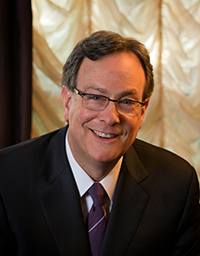 Princeton, NJ. Peter A. Crist, M.D., President of the ACO, moderated the open discussion that followed the presentations. The doctors spoke about their experiences with individual patients, one treated for depression and the other for Tourette’s syndrome. Dr. Rosin shares some insights about his presentation of a patient with depression coming off of medication.
The focus of “There Must be More to Life” was about medical orgone therapy and the positive results patients have achieved with this form of treatment. What can you tell us about your patient presentation and how it relates to finding more to life?
Dr. Rosin: “My presentation was about “Sue,” a patient with depression who was on antidepressant medication for more than two decades and who came to the conclusion that she would never be able to live without her medication. She acknowledged its value in keeping the crushing feelings of depression under control allowing her to function. However, she was also aware of the intolerable price she paid. Side effects of the medication included weight gain, diminished sex drive and an inability to have an orgasm. It was also obvious to her that she went through life with a dulling of emotional intensity. She thought she had no other choice but to accept these side effects. Finally, at age 51 she decided she wanted to try one more time to discontinue the medication.”
Was “Sue” at all familiar with medical orgone therapy?
Dr. Rosin: “No, she wasn’t. I had been recommended to her by someone in the mental health field and she decided to give me a call. She was looking for something different, some different approach as all her other efforts to discontinue medication had not worked. She was afraid that she’d never be able to get off the antidepressant medication and also wanted to avoid the withdrawal symptoms she had experienced before.
The main thing I wanted to get across by talking about “Sue” is that when I work with a patient who has been on antidepressant medication for a long time, we have to work to where the patient can at least feel something that the medication has been suppressing, be it anger or sadness, and express some of it. This is essential because although antidepressants can be a useful tool, they also cover up emotions, some of which the patient might not even be aware. When these emotions arise during therapy especially accompanied by a gradual decrease in the medication dosage, this may allow the person to live their lives through their emotions rather than in spite of them.”
At what point might you start trying to decrease a patient’s medication?
Dr. Rosin: “With medical orgone therapy, once a patient becomes more aware of their emotions and able to express them more fully in the session and in their life, medication can be tapered slowly and carefully. This may, in fact, occur fairly quickly."
Is “Sue’s” story typical of someone who has been diagnosed with depression and treated with antidepressants?
Dr. Rosin: “In my experience with patients like “Sue” who have been on antidepressant medication, there is usually a significant underlying emotional problem that has never been addressed much less brought to light: There is an inability of the individual to tolerate various emotions. It’s as if they’re stuck, as “Sue” felt she was.
I’m not saying that every patient with depression can be treated in the manner I treated “Sue”. However, these days I see people, especially young people, started immediately on an antidepressant for anxiety and/or depression and I certainly wonder how this will impact, even dictate the course of their life. I also see that in psychiatric practice today there is an under-emphasis on how to take people off these medications successfully and permanently. When one can achieve this goal – and I think medical orgone therapy is especially well suited for this – the added benefit to the patient is that the problems that caused them to become depressed in the first place, the problems that led to the use of antidepressants, can be successfully resolved, helping the person to actually change.
Many patients have tried to discontinue antidepressants without success. If their underlying emotional problem is left unaddressed, it makes sense that lowering the medication dosage allows symptoms to re-emerge. Then the person, at some point, returns to the medication. For some, this cycle repeats itself over and over.”
For information about our upcoming events, visit our Events page, call (732) 821-1144 or email aco@orgonomy.org.
May 18, 2014
On Sunday afternoon, May 18, 2014, at the ACO campus in Princeton, NJ, our Spring 2014 Variations on a Theme "Improving Work Relationships" events continued with Peter A. Crist, M.D. leading a small group discussion delving more deeply into his April Social Orgonomy Series presentation, "Are You Satisfied with Your Work Relationships?” Dr. Crist shared some insights about his talk and the upcoming event.
What would you like people to know about your “Conversations with an Orgonomist” event?
Dr. Crist: “I’d like to let people know that this this event was basically a consultation opportunity to look at real problems and get help with situations from the perspective of what I’ve learned using social orgonomy principles in dealing with work relationships. I was also happy to go back to some of the basic principles I spoke about during my presentation about work life last year to help anyone who was interested in understanding what their work nature is – how they view themselves at work - and what would bring them satisfaction. I was excited about the doing this in what was essentially a workshop setting where everyone could learn from seeing these principles applied personally right there in the moment.”
Did people come to the discussion with questions or topics already in mind?
Dr. Crist: “Yes, people had specific work problems and situations in mind that they wanted to discuss. I had a wonderful interaction with a woman at my recent social orgonomy presentation which was an example of what we did in a small group. She had never been to one of our presentations before, and she had the courage to open up and talk about a problem she was having managing conflicts between several of her staff. I was able to give her some different ways of looking at the situation, and during the break her boyfriend came up and told me she was already thinking about it differently than she had been before. Even if she doesn’t use the advice that I gave and is just able to look at it differently, then that was a successful interaction.”
Could you give an example of your work with a younger person’s work situation who might not have much work experience?
Dr. Crist: “I work with a company that has a number of artistically oriented people. One young man was doing very well in the company in sales and so he was promoted to general manager, but he didn’t know how to be effective in this management position since it was so new to him. We talked and he told me that he plays in a rock band on the side, so I asked him if he ever plays where people are dancing. He said yes, and I said that when he’s playing he doesn’t have to get down on the dance floor and show people how to dance. He keeps the beat going and excites them into dancing. I told him that he could use that same basic principle in his general manager position, that he didn’t have to give all of his talents up and be a “corporate guy.” Rather, he could use the natural ability of his work nature to inspire people and get them enthused whether he’s playing in a rock band or doing the business of his company. That really connected with him and he was able not only to do his job better, but he found more enjoyment from it, too.
So I very much enjoyed working with people at our event much in the same way I worked with this young man. This was an opportunity to go beyond just a conversation and really do something practical with this knowledge.”
For information about our upcoming events, visit our Events page, call (732) 821-1144 or email aco@orgonomy.org.
April 26, 2014
 ACO Movie Night featuring the Charlie Chaplin classic silent film "Modern Times" was held on Saturday, April 26, 2014 at the American College of Orgonomy's campus in Princeton, New Jersey. In Chaplin's final outing as the Little Tramp, the iconic character is put to work as a giddily inept factory employee. With its unforgettable gags and sly commentary on the struggles and challenges people faced during the Great Depression, "Modern Times" is a timeless showcase of Chaplin's genius. Orgonomists Philip Heller, M.D. and Susan Marcel, D.O. led the group discussion after the movie. Dr. Heller shares some of his thoughts about the film.
"Modern Times" is unusual because Chaplin chose to make it a silent film even though it was made several years after the advent of "talkies." How did you react to the silence?
Dr. Heller: "The silence actually made it easier to focus on the expressions and physicality of the actors more than if I could hear their voices. This is similar to making contact with a baby before the baby can talk. There were times during the film, however, where voices and sounds emanate from machines and television screens, so it's not completely silent, but rather a transition from silent to talking films.
The music also really captured me. Every time the Tramp is with his love interest (played by his current wife at the time, Paulette Goddard), beautiful, haunting, and emotionally evocative music plays in the background. The song is "Smile," which I found out later was composed by Chaplin himself!"
How does "Modern Times" connect with the ACO's spring events theme of work relationships?
Dr. Heller: "It's important to keep in mind that even though this film was released in 1936 in the midst of a severe economic depression, it still rings true today. It's a very clear and uncomplicated expression of Chaplin's view of work and love. What is your work and how did you arrive at your position? If you're not satisfied with your work, what do you do? Chaplin clearly and simply portrays problems in work that still exist today but which are muddied up by overthinking. He shows us the problems of the individual vs. society, employees vs. employers, and the contactlessness and resultant dehumanization of people on an assembly line.
With regard to work relationships, the only relationship the Tramp has with his employer is being controlled, from his speed on an assembly line to how he eats his lunch. Every aspect of work is mechanical and so regimented that the Tramp has no contact with the actual product of his work, except for barely eking out a living. Satisfaction in work is simply not present. But even the manager of the plant is a victim and we eventually see that all is not well at the top either.
It's interesting to me that "Modern Times" is categorized as a comedy, but the comedy in the film is the Tramp trying to smile in the face of adversity, at work and in life, and making a joke in the face of hard times, which we can all still relate to so many years later."
For information about our next Movie Night featuring "Gravity" visit Events.
April 5, 2014
On Saturday, April 5, 2014, board-certified psychiatrist and President of the American College of Orgonomy, Peter A. Crist, M.D., presented "Are You Satisfied with Your Work Relationships?," a discussion at the Paul Robeson Center for the Arts, Princeton, NJ as part of the ACO's ongoing Social Orgonomy Presentation Series. Dr. Crist shares some insights about his talk.
In 2013 you gave a presentation about work satisfaction. Did you see "Are You Satisfied with Your Work Relationships" as a follow up to that talk?
Dr. Crist: "My previous talk was on the general subject of being satisfied with one's work life, with a focus on people understanding their own work nature and what they need to do to find satisfaction and outlets for their natural work tendencies. Work relationships came up during an exercise on positions, roles, and functions that looked at how a person relates to their place in an organization in relation to others. This time the emphasis was on how to specifically deal with work relationships. I've found that being very clear about people's particular functions or roles and keeping these clearly defined helps work go smoothly. Real-life situations were presented to illustrate the basic principles of work relationships."
What kind of real-life situations have you dealt with?
Dr. Crist: "One of the most important things I do in my business consulting is to help identify destructive behavior in the workplace and address the problem. For example, I've advised employers dealing with destructive employees to try to get those staff members to function in a non-destructive manner, or to let them go. I've also helped employees who report to the "boss from hell" who need to put a protective shield around themselves by building other positive work relationships, finding the courage to stand up for themselves, or getting out of the situation."
With regard to relationships, how did this ACO Social Orgonomy presentation fit in with previous talks in the series?
Dr. Crist: "At the ACO's presentation in February, the topic was pregnancy, birth and emotions, and the focus was on the interactions and relationships between mother and baby, father and baby, mother and ob-gyn doctor, and so forth. This presentation was about people and organizations and the relationships involved.
During my talk I looked at the distinction between love relationships and work relationships. For example, one might love to work with someone and be excited to work with that person, however the focus must still be on the work. During my medical training there was a particular colleague that I hit it off with right away, and it was just fun to work with him in taking care of patients together. Long discussions were unnecessary because we both knew where we were each coming from. On the flip side, I worked with another colleague where the relationship was much more complicated and we had to spend a lot of time explaining things to each other. In both relationships, the work got done, but with one it was simple and with the other not.
Social orgonomy is about relationships between people. In my presentation, I used orgonomic knowledge to focus on work relationships and talked about what can cause trouble and what allows them to be satisfying so we can get more enjoyment out of work and also out of life."
For information about our next Social Orgonomy Presentation and more, visit Events.
Peter Crist, M.D.and Susan Marcel, D.O.
February 22, 2014
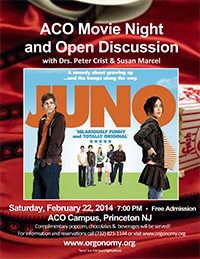 ACO Movie Night featuring Juno was held on Saturday, February 22, 2014 at 7:00PM at the American College of Orgonomy's campus in Princeton, New Jersey. Orgonomists Peter A. Crist, M.D. and Susan Marcel, D.O. led the group discussion after the movie. Dr. Crist shares some of his thoughts about the film.
How does the film Juno connect with orgonomy and the ACO's winter events theme of pregnancy, birth and emotions?
Dr. Crist: "I think there are many connections, but one is clearly Juno (played by Ellen Page), a teenager facing an unplanned pregnancy being very aware of the baby growing inside of her. The main character in the film, she makes the decision to place the child with an adoptive couple. In one particularly telling scene, which Dr. Susan Marcel showed and discussed during her recent social orgonomy series presentation, the adoptive mother (played by Jennifer Garner) wants to feel the baby moving inside of Juno but doesn't feel anything. Juno simply tells her to talk to the baby, and when she does, she finally feels the baby start to kick, and it really gives the sense that there is a perceptive organism growing before birth. The movie also beautifully gets across the idea of emotions and pregnancy, and how feelings are stirred up by a woman becoming pregnant and how charged those feelings can be no matter what the circumstances. These feelings are something Dr. Marcel and I would really like to hear about from mothers and fathers during the discussion following the movie."
How do you feel about the way the subject of adolescent sexuality is portrayed in the film?
Dr. Crist: "Adolescent sexuality is an explosive topic, as Dr. Wilhelm Reich stated decades ago; Dr. Elsworth Baker said the same thing in his book, "Man in the Trap." And I don't think we've come very far in the last few decades in dealing with adolescent sexuality without becoming either permissive or anti-sexual.
I originally viewed Juno for my social orgonomy talk about fathers a few years ago, and I felt that it depicts the struggles of adolescent sexuality and how people deal with it in a way that doesn't become sentimental or moralistic - which are the two sides that people tend to take on the subject instead of addressing the real emotions involved. Juno's father (played by "J. K." Simmons) is a major figure, and although he is perturbed about the pregnancy, he comes through clearly as supportive of his daughter as he really tries to help her find her way through the pregnancy. Ultimately, his character grows more than any other in the film.
Another special element in the movie is the relationship between Juno and her boyfriend, who is the baby's father (played by Michael Cera), which is quite sweet. It's portrayed realistically and shows a very real, emotional love relationship, which is one of the reasons I like the film so much. I'm very much looking forward to seeing it again and discussing it at our next ACO Movie Night."
For more information about our upcoming events please visit our Event page.
Theodota Chasapi, M.D. and Susan Marcel, D.O.
February 1, 2014
Currently in the Public Eye
We are pleased to announce that US1 recently published a major feature story about orgonomy, the ACO, its core functions and our upcoming Social Orgonomy presentation, "Right from the Start: Pregnancy, Birth & Emotions." The lead article in US1's Winter Wellness edition combines an interview with Peter A. Crist, M.D., president of the ACO, with quotes from Theodota Chasapi, M.D. and Susan Marcel, D.O. about their recent Social Orgonomy presentation. The in-depth article, "The American College of Orgonomy: Using Emotions for a More Satisfying Life," appears below and can also be viewed on the US1 website.
Reprinted from the January 22, 2014, issue of U.S. 1 Newspaper - "American College of Orgonomy: Using Emotions for a More Satisfying Life"
The American College of Orgonomy would love for people to know it exists. Orgonomy, an approach to psychiatry originally described by Austrian physician Wilhelm Reich in the 1930s, has a long and at times controversial history. More recently it has found a limited following in the Princeton area, where the ACO has been based since 1986.
Expanding the college’s reach is a main goal going forward, says Dr. Peter Crist, the ACO’s president..Part of that outreach takes the form of free public lectures, the next of which takes place Saturday, February 1, at the Paul Robeson Center for the Arts. The topic: “Right from the Start: Pregnancy, Birth, and Emotions.” Past talks have included “Personal Relationships in the Digital Age,” “Difficult People: Using Gut Feelings as a Guide in Relationships,” and “The Emotional Power of Music.”
All of these talks fall under the umbrella of social orgonomy, which, Crist explains, is “the realm of addressing interactions between people.” Medical orgonomy, on the other hand, targets the individual. It addresses a person’s “problems in terms of expressing themselves emotionally or living in a satisfying way with their emotions.”
The ACO offers training in both areas, Crist explains. To study medical orgonomy one first completes medical school and traditional residency in psychiatry, followed by several years of instruction on the theory and practice of medical orgonomy specifically and regular continuing education seminars. Training in social orgonomy is available to social workers, family therapists, and the like.
The study and practice of orgonomy today is still rooted in the work of Wilhelm Reich. Reich, a student of Sigmund Freud, postulated the existence of a previously undefined form of energy, which he called “orgone” or “life energy.” Orgonomy, then, is the study of orgone energy.
“If there were a one-sentence description,” Crist says, “it’s to help people function with their emotions in a more satisfying way.”
“Emotions result from perception of energy movement in the body,” he explains. “If we’re happy, it’s moving out. If we’re sad or afraid, it’s contractive. Emotions are literally the result of energy moving in the body.”
“Reich understood that one of the basic principles of life energy is that it moves spontaneously,” Crist continues. “So every other approach is looking at how do you get somebody moving, how do you get them feeling something, whereas our approach is, ‘things are going to move if you get out of the way.”
That is not to say that people should let their emotions run wild. “You can’t help what you feel,” Crist says. Emotions are controlled by a person’s autonomic nervous system. “But you can help what you do with what you feel. Actions are voluntary.”
“The broader thing is these principles about how people handle their emotions,” he says. “The way people block their emotions is really what determines their character. How people handle their character will affect how they handle their relations.” An important principle for orgonomists is contact, which, Crist says, is the integration of excitation and perception. Self-perception, or the ability to accurately perceive the energy stirred up in oneself, is critical for the individual. Contact also has implications for emotional relationships between people. “If someone’s not listening to someone else even though they’re all excited, they’re not making contact,” Crist explains.
“One of our important functions is education,” says Crist. “We’re living in an anti-emotional age. People look at emotions as pathological, or we don’t want to deal with them, and we tend to medicate or meditate them away.”
In practice, this means that the principles of medical orgonomy can be applied to individuals of all ages suffering from mental ailments as well as certain physical diseases, such as high blood pressure or asthma, that have more of an emotional component.
“It’s very hard to describe what happens in the therapy in a general way because it is quite individual from person to person,” Crist notes, so each case is approached differently. But, he adds, “because it’s not dependent just on verbal communication, because we’re working on how emotions are held in the body, we can work on pre-verbal children.”
Crist’s youngest patient was a 13-month-old. “The parents were in therapy with one of my colleagues, and they knew their daughter was in trouble when she started hitting herself in the head and saying ‘no.’” It turns out, Crist says, that “she needed to cry but was holding it all in.” Gently holding her jaw open helped her let it all out, and also accelerated her speech development, which had been delayed.
“Because of my work with children I very quickly realized that I couldn’t work with children without working with their parents,” he adds. That resulted in a sideline of work as a business consultant, in which the principles of social orgonomy are applied to improving relationships in the workplace.
In his capacity as a business consultant and medical orgonomist, Crist gave a talk last winter titled “Are You Satisfied With Your Work Life?” and offered several steps for finding an ideal career path (U.S. 1, January 30, 2013). Among them:
Identify your nature, which is inborn. Are you a natural leader or do you prefer to follow others? Do you prefer lots of person-to-person contact, or are you more comfortable behind the scenes.
Then, find work that fits your nature. Someone who is outgoing and enthusiastic might be well suited for a career in sales, for example.
Finally, find satisfaction outside of your day job. While finding a day job that you love is the ideal, it is not always possible. Do something outside of work that brings you satisfaction.
Crist is also a medical orgonomist in private practice in Ringoes. As a child, Crist moved around and ended up in Oregon, where his father retired as a family life and sociology professor from Lewis and Clark College. His mother worked as a secretary and led student groups with Lewis and Clark College and on American Friends Service Committee Projects.
After stints at Lewis and Clark, where he first encountered orgonomy, and San Fernando Valley State, Crist ultimately earned a bachelor’s in zoology from UCLA where he later also completed medical school. He went on to a medical residency at St. Vincent’s in New York, which he completed at Sepulveda VA Hospital in California. He returned to New Jersey for a psychiatry residency at and Rutgers Medical School and stayed in New Jersey, where he has lived ever since.
In 1984 Crist became a member of the American College of Orgonomy, which since its founding by Dr. Elsworth Baker in 1968 had been based in New York City. Baker was a student of Wilhelm Reich, who came to the U.S. in 1939 to escape the Nazis. Reich’s work met with some negative press in the U.S., and he was imprisoned in 1956 after violating an injunction by the Food and Drug Administration to stop the shipment of his orgone accumulators and literature. Reich ultimately died in prison, but he tasked Baker with carrying on the science of orgonomy.
Baker served as the ACO’s president from its founding until his death in 1986. That same year the ACO relocated to the Princeton area, where it acquired a property just north of Kingston at 4419 Route 27. That property is currently undergoing major improvements, fueled by donations from the ACO’s supporters — doctors as well as those who have benefited from therapy — and volunteer labor.
“We’ve raised about half of the $260,000 we need for the major improvements of parking and septic and all that, so we won’t be able to do all of it until we’ve raised the money,” Crist says. “If we succeed in growing then we’d like to build a new building. Our 20 to 30-year grand plan would be to need and afford a new building.”
A key to this growth will be attracting new doctors to orgonomy, and informing potential patients that this form of therapy exists.
The ACO is a one-of-a-kind organization, and since doctors have to return regularly for continuing education seminars, “most of the medical orgonomists are in New Jersey, Pennsylvania, or New York,” Crist says. Some are further afield: one is based in Connecticut, one comes in from Oregon, and a few are based in Europe, including Greek doctor Theodota Chasapi, who will speak at the February 1 event.
“The founder of the whole approach was a controversial figure,” Crist explains, “so during his lifetime there wasn’t any problem with people being known because he kind of stirred up controversy. We need to find ways to inform the public that we even exist.”
One such opportunity will be at the upcoming lecture. Everyone, including expectant new parents, will learn about pregnancy, the mother-fetus relationship, and family.
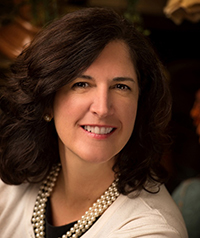 “Orgonomy is the natural science of life energy,” says psychiatrist Susan Marcel, D.O., who is co-presenting with Theodota Chasapi, M.D. “The event is for anyone interested in improving the life of infants and children, including those who are expecting. We will also focus on the importance of relationships during and after pregnancy and how they impact the emotional health of a child.”
Marcel and Chasapi are both clinical associates of the American College of Orgonomy, among other credentials. The lecture will discuss how important it is to consider emotional health starting with conception. According to Chasapi, traumatic experiences that start in the womb and early after birth, while often lost in memory, remain locked deep within the physical structure of the body and affect us throughout our lives. She also emphasizes the critical attachment that forms between mother and child 90 minutes after birth, an extension of the early love relationship that begins in the womb.
Marcel treats pregnant women who talk about their struggles and then helps them discover ways to unblock the natural connection with an unborn child, a partner, a doctor or a midwife — anyone close to the mother.
“We work to find ways to avoid chronic stress and to handle any fears in a healthy way,” Marcel adds. “We want to help the baby come into the world in a warm loving environment, without fear.”
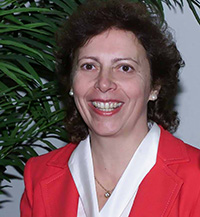 Notes Chasapi: “The need to live in a family is a basic, biological need, and a key way to express love. The mother’s environment greatly influences her emotional health and, by extension, the health of her unborn baby. This means the relationships with the family, caregivers, and others all factor into how the mother feels.”
“The make-up of women and how they handle emotions, impacts the unborn baby,” says Marcel. “If a woman feels cut off, anxious, or depressed, sometimes she doesn’t know where that’s coming from. We help her work through her feelings to release her anger, sadness, or anxiety so that it can be expressed in a healthier way.”
Visit our Events page for information about our upcoming events.
November 10, 2013
The first event in our brand new "Conversations with an Orgonomist" Series was held on Sunday afternoon, November 10 at the ACO campus in Princeton NJ. Continuing our Fall 2013 Variations on a Theme "Difficult People" events, Dr. David Holbrook led a small group discussion delving more deeply into his October 2013 Social Orgonomy Series presentation, "Difficult People: Using Gut Feelings as a Guide in Relationships." Dr. Holbrook shares some insights about his talk and the "Conversations with an Orgonomist" event.
How did this event at the ACO campus in Princeton compare to what you did at the Social Orgonomy Series presentation in early October?
Dr. Holbrook: "I was very excited to get together in the much smaller setting at the ACO because it provided a wonderful opportunity for people to feel more comfortable sharing their thoughts and experiences in their past attempts at communicating with others. As we did at the larger presentation, participants were able to talk about and reflect upon their own physical and emotional experiences trying to interact with others when people are being difficult, and also to recognize when they, themselves, are being difficult. For those who weren't at the presentation, I brought them up to speed and explained that we would be talking about not only what happens in one's conscious mind when interacting with others, but the clues we get in our bodily reactions, be it with a family member, coworker, or during any conversation where people get excited. Those who attended the public presentation had questions and topics they wanted to explore further."
Could you please speak more on what you mean by clues in one's body?
Dr. Holbrook: "A person can learn to tune into what their body is telling them when they react to another person, beyond what they are normally aware of when they are wrapped up in a conversation. Paying attention to one's body can enhance interactions with others and make one better able to tolerate one's own feelings as well as the opinions of others that they disagree with. Some people might notice their neck, shoulders, abdomen and/or buttocks becoming tense, or they might notice that they are holding their breath or breaking out in a sweat. At the Social Orgonomy Series presentation, I asked for two volunteers, a liberal Democrat and a conservative Republican, to come up and have a political conversation in front of the audience about the federal government shutdown. I thought that politics would very reliably stir up strong feelings and conflict between the two volunteers, and also stimulate noticeable bodily reactions in them. They then described to the audience their physical and emotional reactions, and I also asked them to individually reflect on the ways they themselves had been "difficult" toward each other. From the enthusiastic feedback I received from audience members afterward, I would say this part of the presentation was extremely effective in providing a vivid illustration of how polarization - mental and physical - develops between people."
For more information about our upcoming events please visit our Event page.
October 26, 2013
ACO Movie Night featuring "Chocolat" was held on Saturday, October 26, 2013 at the American College of Orgonomy's campus in Princeton, New Jersey. Orgonomists W.B. Apple, Ph.D. and Susan Marcel, D.O. led the group discussion after the movie. Dr. Apple shares some of his thoughts about the film and discussion. 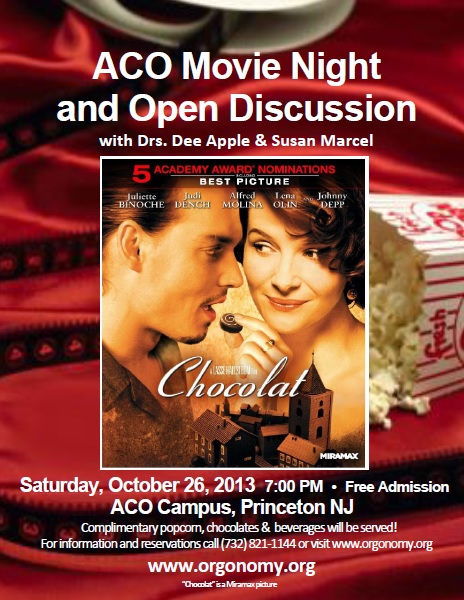
How was your first time leading an ACO Movie Night discussion, and what are your thoughts about "Chocolat"?
Dr. Apple: "I'm was very excited about it. I'm from the South and like to share stories with people in general and on occasion with my patients. They tell me that they remember these stories and that they really get what I'm trying to say. In the same way, we're always trying to find effective ways to inform and educate people about orgonomy. It can be difficult, however, sometimes words actually get in the way. Here's where "Chocolat" fits in. What this movie so beautifully illustrates is what orgonomy is really about: living life to the fullest! Whoever wrote "Chocolat" tells a knowing story about people and life.
I remember first seeing it with my wife and we both really liked it. We found it refreshing and delightful. It has a wonderful plot and really great actors, including Juliette Binoche and Johnny Depp. There aren't people shooting at each other, doing drugs, or any of the other things that are so often found in movies these days. What really hooked me was that it so nicely illustrates many things that we know about as medical and social orgonomists and that we are interested in educating people about."
Could you give an example of how this movie illustrates what orgonomists want to convey?
Dr. Apple: "First, to give a little background, the movie is set in France in the 1950s in a small village that is an example of an old-style, simpler but repressive, authoritarian type of society. By today's standards, it almost seems "sweet." Everyone knows their place, knows right from wrong, and there's a strong social emphasis on doing the right thing in the midst of a quiet village existence. Enter Vianne (played by Juliette Binoche) and her daughter, who live life in a different way, based on enjoyment, the pleasure of the senses, and sharing this socially in a very decent way. She opens a chocolate shop, and the chocolates have almost a magical quality that allows people to open up and live a little. This doesn't sit well with the village mayor, and he takes a stand against her and encourages others to do the same. It illustrates the problems and challenges of dealing with a difficult person. From a broader social perspective, it also shows the interaction between an older, authoritarian-based small village with all of its social customs and armor, and someone who is flowing, moving and emotionally spontaneous. You see the reactions of decent but repressed people to her, but also the more destructive reactions of difficult people who are afflicted with the emotional plague. When the plague attacks, one result is confusion, and we even witness the confusion it causes in Vianne when at one point she seriously doubts herself.
In this movie, and in this story, we get to see how Vianne deals with the attacks and the gossip. Although on the surface "Chocolat" may seem to be a light comedy, there is a lot in it about people and their interactions that made for some very interesting discussion at Movie Night.
In closing, I want to say that Dr. Marcel's development of Movie Night at the ACO is a wonderful public educational opportunity, and a fun night out at the movies, as well!"
For more information about our upcoming events please visit our Event page.
October 5, 2013
On Saturday, October 5, 2013, David Holbrook, M.D., board-certified psychiatrist and Clinical Associate of the American College of Orgonomy, presented "Difficult People: Using Gut Feelings as a Guide in Relationships" at the Paul Robeson Center for the Arts in Princeton, NJ as part of the ACO’s ongoing Social Orgonomy Presentation Series. Dr. Holbrook shares some insights about his presentation.
What types of “difficult” people and situations were discussed at your presentation?
Dr. Holbrook: "First of all, I want to point out that we can all be difficult at times. What I talked about with our audience is how we can recognize when others are being difficult by paying attention to our gut feelings, and also how we can recognize when we, ourselves, are being difficult. Some people may be pushy, or may be overly sensitive to criticism; others may be extraverted in contrast to folks who are introverted. I’m going to address what happens in the mind and body when we’re interacting with others, and how we can use those cues to stay in good emotional contact with the other person, be it in a personal relationship or in a business or social situation."
Could you give an example of the cues you talked about?
Dr. Holbrook: " When you begin to notice tension building in your body when interacting with someone, that’s usually a signal that you’re having difficulty either expressing yourself or tolerating the other person, what they are trying to say or how they’re saying it. Tuning into this bodily signal can provide a clue to looking inward and trying to understand what's getting in the way of communicating and relating to that person – and vice versa. For example, if you become aware that you are starting to hold your breath, sometimes you will find that if you can just let your breath go, you will find it easier to say what you want to say. I often find that if I’m getting upset or annoyed, my body will tell me before my mind is aware by tension building in the back of my neck. I’ve figured out over the years that means there’s something I want to say, but I am feeling inhibited about saying it."
How can orgonomy help in the understanding of these feelings and bodily cues?
Dr. Holbrook: " Orgonomy provides a unique perspective because it focuses on the body and emotion, rather than only on conscious thought. From a physiological perspective, orgonomy focuses on the autonomic nervous system and how that underlies emotions like fear, rage, sadness and love. Through orgone therapy, individuals become more aware of not only their thoughts, but what their body is telling them. It is our hope that every individual in therapy carries what they've learned through that experience into their social relationships. Because patients in medical orgone therapy tend to have an enhanced awareness of their body and what they're feeling, that gives them an added perspective in conflict resolution in both their personal and work lives."
For more information about our upcoming events please visit our Event page.
Salvatore Iacobello, M.D. & Donna Reid
Social Orgonomy Presentation Series
On Saturday, June 1, 2013, board-certified psychiatrist Salvatore Iacobello, M.D. and voice teacher Donna Reid presented "The Emotional Power of Music: at the Paul Robeson Center for the Arts, Princeton, NJ as part of the ACO's ongoing Social Orgonomy Presentation Series. Dr. Iacobello and Ms. Reid share some insights about their presentation.
Dr. Iacobello, as a medical orgone therapist, what is your perspective on music?
“Music goes beyond the spoken word and has the power to move us and our deepest emotions. The science of orgonomy helps to understand that the reason for this is that music moves something real inside of us. That something is the biological energy discovered by Dr. Wilhelm Reich which governs basic living functions. Music can excite this energy inside us, in our living protoplasm. We perceive the excitement and movement as emotions or other more complex feelings. This something I talked about during the presentation.”
Dr. Iacobello, what inspired you to invite voice teacher Donna Reid to join you as a guest speaker for your presentation?
“I love the kind of music that brings up strong emotional responses, and, in particular, singing opera really sets the stage for one to express and feel something truly deep. I asked Ms. Reid to join me because I knew she would be able to speak first-hand about the expression of emotion through music from her perspective as both a voice teacher and vocalist who has sung opera professionally.”
Ms. Reid, how did you approach your part of the presentation?
“I was very excited about demonstrating vocally and having the audience participate in some simple, fun exercises that I hope let them experience music on a new level. For example, I showed them the difference between a sound that comes from the core and one that is superficial. We explored how we feel ourselves when we sing something in different ways; for example, in using a chest voice (a more aggressive sound) or a head voice (more mellow, soft-textured sound). We also talked about how it is that music can bring up deep feelings in our core when we don't even understand the words to the song. For example, I cried deeply when I first heard the duet between tenor and baritone from Bizet’s opera “The Pearl Fishers” even though I didn’t understand a word of French at the time.”
Dr. Iacobello, is there a piece of music that has particularly touched you?
“Yes, when I was a teenager I first heard Joaqin Rodrigo's “Concerto De Aranjuez” for guitar and orchestra which brought about sweet and tender feelings within me. In fact, I shared a short audio sample of that piece with the audience and then asked them how it made them feel. We listened to other samples of music, some that can give people chills as well as music that doesn't, and then we talked about the difference. I also illustrated how great musical pieces build up tension to utmost intensity and then release it to a state of relaxation. This is an example of the orgonomic energetic function; expansion, charge, discharge, relaxation -- the formula of life.”
Ms. Reid, how has your experience with orgonomy influenced your singing and teaching?
“My husband, voice teacher Cornelius Reid, was a patient of Dr. Elsworth Baker who was a student and associate of Reich’s. Because of his therapy and what he learned from Dr. Baker about orgonomy, Cornelius taught voice functionally rather than mechanistically, and this is how I teach as well. Typical mechanistic voice teaching focuses on manipulating how the student breathes and overrides the natural function of breathing. Students are told “pull in your stomach,” “don’t move your chest,” “squeeze your butt as if you have a dime between your cheeks.” Functional teaching, on the other hand, involves carefully observing and listening to a sound and then setting up the conditions in the form of a vocal exercise that will induce the muscles involved in singing to work more efficiently. This allows a sound to emerge that is more in line with the natural movement potential of the student’s vocal mechanism; in other words, one that is freer. I cannot emphasize enough the role that orgone therapy and Reich’s theory of functional thinking have played in my teaching and in my life.”
Dr. Iacobello, why is the topic of music and emotion of great interest to you as an orgonomist?
“Music is a fundamental part of human life and one of the most powerful forms of expression. We all experience the power of music whether singing, playing an instrument, or just listening and enjoying. Orgonomy helps us understand why music affects us so deeply, and that understanding is something I enjoyed sharing with our audience. Music helps the orgonomist to better understand human emotional life and the role played by expressive language. There is even a therapeutic use of music that can help an individual to overcome his/her difficulties and achieve a greater degree of health. Orgonomy helps us to understand how this works, and I am glad to have been able to share this understanding with our audience.”
For more information about our upcoming events please visit our Event page.
On Saturday, April 6, 2013, licensed psychologists Virginia Whitener and W.B. Apple, and board-certified psychiatrist Peter A. Crist, M.D., presented "Personal Relationships in the Digital Age," a discussion at the Paul Robeson Center for the Arts, Princeton, NJ as part of the ACO's ongoing Social Orgonomy Presentation Series. The doctors share some insights about the discussion.
Doctors, why was this topic chosen for a discussion?
Dr. Apple: "Well, it's the rare person these days who doesn't use or depend on some form of social media or digital technology to communicate and stay in touch. A tremendous amount of time and energy goes into texting, e-mailing, researching and playing video games. Some of this is productive, some less so. Whenever a revolutionary form of technology is developed, there are always some really cool and amazing things about it and, at the same time, a lot of things that may not be helpful or healthy - some of which we may not even recognize for some time."
Dr. Crist: "Since our previous presentation on people's work life was well received, we decided to turn to the subject of people's personal life and relationships today. This presentation also followed the discussion format of the last one because we really wanted to hear from our audience about the effects of digital technology, both positive and negative, on their life and personal relationships."
Dr. Apple, can you give an example of digital technology where you see the positives and negatives?
Dr. Apple: "Sure. Video games are a great example. It's a form of entertainment that can be incredibly engaging, but it's a virtual reality. It can have a social aspect when a teenager is playing a game with friends and they're talking to each other at the same time through microphones, but the interaction is limited (like texting), and not the same as face-to-face communication. People can become more engaged with the virtual world and gaming time and less engaged with the real world and real time. Becoming too engrossed in gaming can also lead to problems like sleep deprivation.
Dr. Crist, what do you include in the word, "digital," in the title of the presentation?
Dr. Crist: "By digital technology we are including everything from cell phones to e-mail to texting to social media like Facebook to the Internet to video games and so forth. A number of years ago I first heard the joke, 'You know you've entered the digital age when you go out and go into a panic when you realize you left your cell phone at home.' Who could manage without a cell phone now?"
Dr. Whitener, what do you see as the positives and negatives?
Dr. Whitener: "Digital communication can be used for very quick blasts of communication which promotes dissemination of quick bits of information that might be easily misconstrued, or be taken for researched, thoughtful opinion and valid information - so there's a risk involved there. Cell phones are great for communication, but on the downside some teens can be sleep deprived because they leave their cell phones on all night and are up talking at all hours. On the positive side, people can stay in touch over long distances. Grandparents in California can see their grandkids in New York City take their first steps in real time using Skype. It gives people a sense of connection and quick, real time communication and allows for some people to communicate more than they would be comfortable with otherwise. It facilitates personal and business communication, the sharing of ideas, research, and social efforts."
Dr. Apple, you mentioned texting in the context of being both social yet limited. Could you speak more on that?
Dr. Apple: "In today's fast-paced world, people (especially young people) are mobile, and often not living near friends and family. Digital technology, including texting, can give people a sense of connection. You can be connected with people all day now. In fact, even during therapy sessions, I have kids put me "on pause" so they can look at an incoming text (after that it becomes something to be discussed as part of their therapy!). You can be very "connected" but yet at the same time disconnected from the person sitting right in front of you. An increasing number of people depend on texting to communicate. In fact, I find that teens have basically abandoned e-mail in favor of texting, and many teenagers feel that phone calls take up too much time compared to texting. Some also feel that they are more "intimate" or "intrusive" compared to texting. It used to be that people used phone calls to avoid face-to-face discussion. Now with texting, you have a lot more control over what you reveal because you can edit or delete before you send. The price you pay though for this constant feeling of being connected is that things can be easily misconstrued in a text because the visual and auditory stimulation you experience when you are face-to-face with someone is missing."
Dr. Crist, could you comment on texting?
Dr. Crist: "Communication is more than just words - it's body language, tone of voice, facial expressions - all of that is lost in a text. We talked with our audience about how texting both helps and interferes with relationships."
Doctors, what are your thoughts about Facebook?
Dr. Apple: "Teenagers are at a time of life where they are naturally experimenting and developing their identities, and there are some interesting pros and cons about Facebook in this regard because you can choose your photos, what you tell people about yourself and control how you really want to be perceived. You can try things out on Facebook with your "digital façade" that you wouldn't necessarily try out in person. The other side of the coin is that you can sometimes get into a lot of trouble when interacting with people that you only know on line and not in person. What happened to Manti T'eo, the college football player who got "catfished" into a relationship by a man pretending to be a woman, is an example of this. It can be really hurtful when someone isn't honest, and Facebook and other digital technologies can be used in some extremely deceitful ways."
Dr. Crist: "We've also heard stories about people using Facebook to say derogatory things about others - posting negative comments on other's pages or on their own. There are also stories about people finding each other and renewing relationships from summer camps, high school or college because of Facebook. So again, there are pluses and minuses."
Dr. Whitener: "Society is changing, and therein technology. Social media such as Facebook is not a problem; it's how people are using it that can be a problem. People can present things in provocative ways on Facebook that they wouldn't in person and then get into tight quarters when other people find out about things that they don't want them to know."
Dr. Crist: "From the dawn of Man to the 21st century, communication has evolved in remarkable leaps. I am sure people were bewildered when they first saw a book rather than a parchment scroll. But once they figured out how to open it a whole new world opened with it. As Dr. Whitener said these technologies are merely new tools. What matters is how they are used. We were glad to have the opportunity for an open discussion with our audience about the impact of these tools on personal human relationships."
For more information about our upcoming events please visit our Event page.
Movie Night featuring "The Artist"
March 9, 2013
ACO Movie Night featuring "The Artist" was held on Saturday, March 9, 2013 at the American College of Orgonomy's campus in Princeton, New Jersey. Medical orgonomists Raymond Mero, D.O. and Susan Marcel, D.O. led the group discussion after the movie. Dr. Mero shares some of his thoughts about the film.
"The Artist" is unusual because it's a contemporary silent film. How did you react when you first saw it?
Dr. Mero: "Because the movie is silent and also filmed in black and white, it made me really focus on the actors' emotional expressions. When one sense is eliminated, other senses are naturally heightened. In this case because I couldn't hear the actors' voices, I had to rely on my visual sense to assess what was going on. The musical score helps to convey emotion as well. Nowadays, because we're so used to explosions and other distracting sound effects, this movie is a nice change of pace."
As a therapist what aspects of the movie struck you in particular?
Dr. Mero: "The one aspect of the movie that really hit home with me is that it depicts some excellent examples of healthy vs. unhealthy functioning. I don't want to give away too much of the plot, but the male lead character of George Valentin (played by Jean Dujardin) is a silent film star whose career and ego are adversely affected when the studios start making "talkies." He felt great when things were going well for him and he was in control, but because there is a disturbance in his emotional functioning he goes downhill and just can't adjust to the changes in his career and life. In contrast, the female lead, Peppy Miller (played by Berenice Bejo), is a young, lively, attractive actress whose career is on the rise."
What did you think about the relationship between George and Peppy and how it relates to real life situations?
Dr. Mero: "Peppy puts a great amount of effort into trying to help George with both his career and his life. I see this a lot with couples in therapy where one person is doing all of the work in a relationship by trying to 'save' and take care of the other person. Most often I find that the person doing the saving is the woman, as in this case, but I also see it with men. Either way, people can easily find themselves caught up in this kind of situation, and it's something we talked about during the discussion after the movie."
For more information about our upcoming events please visit our Event page.
Movie Night featuring "The King's Speech"
November 16, 2012
Friday, November 16, 2012 was the premiere of Movie Night featuring "The King's Speech" at the American College of Orgonomy's campus in Princeton, New Jersey. Medical orgonomists Peter Crist, M.D. and Susan Marcel, D.O. led the group discussion after the movie. Dr. Marcel shares some insights about this brand new event.
Movie Night is something different for the ACO. Why Movie Night?
Dr. Marcel: "It's a great way for the College to connect with people in a fun, social way. Who doesn't love a good movie? Sure, we could all just sit around and talk about topics like the importance of relationships, but when we see things in a movie that we also see in ourselves, it allows us to get past our own defenses. We can identify with the very things we struggle with ourselves, and a movie is a more comfortable, more entertaining way to explore them. In my private practice, I often recommend a movie to a patient so we can discuss it in our next session. Cinema is an art form, just like a play on stage, and movies can teach us about aspects of ourselves that are often out of awareness."
Why was "The King's Speech" chosen for the premiere of Movie Night?
Dr. Marcel: "In deciding what movie to show, we polled several young people about the movies they like. Several mentioned "The King's Speech." So in addition to being a truly great movie, we knew it would have wide appeal. Colin Firth, who plays the main character of Prince Albert, delivers one of the most powerful and believable performances I've ever seen. People can identify with Albert, who has a debilitating stutter that affects every aspect of his life. The movie tells the story behind Albert's problem and shows how he courageously tries to overcome it with the support of his wife and speech therapist. We all have our own "stutter," whether it's insecurity, anger, pain, anxiety, or something else.
Is the approach used by the therapist in the movie in any way similar to medical orgone therapy?
Dr. Marcel: "Therapist Lionel Logue, played eloquently by Geoffrey Rush in the movie, looks at Albert's whole functioning, not just that his mouth is stuck but that his heart, mind and entire body are struggling so badly that he can't speak. This is something that a mechanical approach to therapy wouldn't see, much less fix. Just as Logue's approach to Albert's stuttering was very different, medical orgone therapy similarly approaches a person's whole functioning rather than just his or her symptoms. Lionel and Albert make real emotional contact and form a life-long relationship that is mutually satisfying and healing. This is the essence of the doctor-patient relationship."
For those who had already seen "The King's Speech," why did they come to see it again at the ACO Movie Night?
Dr. Marcel: "After the showing, we had a lively discussion led by Dr. Peter Crist, president of the College, and me that offered folks a very unique and different perspective about the movie. People related to Albert, his journey, his courage, and the relationships along the way that both hindered and helped him.
Aren't we all on a journey? Don't we all have problems and relationships? These are things we will be talking about at future Movie Nights and we are very excited to be offering this fun, special, social forum in which to do so."
Visit our Events page for information about our next presentation. Back to top
David Holbrook, M.D. and Susan Marcel, D.O.
More About Movie Night featuring "A Little Romance" - Saturday, July 20, 2013
ACO Movie Night featuring "A Little Romance" was held on Saturday, July 20, 2013 at 7:00PM at the American College of Orgonomy's campus in Princeton, New Jersey. Medical orgonomists David Holbrook, M.D. (a former stage and screen actor) and Susan Marcel, D.O. led the group discussion after the movie. Dr. Marcel shares some of her thoughts about the film.
What is it about "A Little Romance" that inspired you to show it at Movie Night?
Dr. Marcel: "This is a sweet movie about love surviving in a world that is hostile toward the expression of natural young love. Diane Lane debuts as Lauren, a 14-year-old American teen living in Paris, who falls in love with Daniel (Thelonius Bernard), a French student at her school, who falls head over heels for her, too. Both their parents and society around them try to squash their relationship because of their youth and cultural differences. Their natural, healthy teenage love is a normal thing but it stirs up animosity in the uptight adults who become authoritarian and angry, forgetting what it was like to be young and in love."
The movie was originally released in 1979. How does it speak to today's youth?
Dr. Marcel: "The society teens are growing up in now is pretty unhealthy in diverse different ways. Teens have a natural longing for love but these urges are often dehumanized and perverted by the media, music, and the Internet, which inundate teens with gratuitous nudity, violence, and promiscuity and certainly not examples of healthy natural love. In sharp contrast, in "A Little Romance," normal teenage love is championed and by none other than the brilliant actor, Laurence Olivier. His character Julius is something of an old scoundrel, but he enchants the young couple with his story telling, and is the one and only person who says it's ok for them to be in love. He tells them that their love will last forever if they kiss in a gondola under the Bridge of Sighs in Venice, and he helps the kids dash away to commit to their love.
Visually, it's a beautiful movie, filmed in Paris and Venice. You see the immediate "sparkle" between Lauren and Daniel, and you witness it naturally and organically growing deeper and deeper. "A Little Romance" is a very sweet and endearing film, and I was excited to discuss it with our audience and my fellow medical orgonomist, Dr. David Holbrook, both for his perspective as an actor and as an experienced therapist."
For more information about our upcoming events please visit our Event page.
Emotions Speak Louder than Words?
October 6, 2012
On Saturday, October 6, 2012, David Holbrook, M.D., board-certified psychiatrist and Clinical Associate of the American College of Orgonomy, presented "Emotions Speak Louder than Words" at the Paul Robeson Center for the Arts, Princeton, NJ as part of the ACO's ongoing Social Orgonomy Presentation Series. Dr. Holbrook shares some insights about his presentation.
This was your first Social Orgonomy Series presentation. What led you to choose this topic?
Dr. Holbrook: "When I came up with the idea for the presentation, I had been thinking in general about things that are hard to put into words. I saw that words are like the rider on top of a big elephant (emotion), which actually calls the shots.
Where do words really come from? Is it just a metaphor, for example, if we have a "gut feeling" or say, "I feel something in my heart," or is that sort of thing literal? I believe it's literal.
For years I've been thinking about the relationship between the verbal realm and the non-verbal realm, which I explored in an article entitled, "Word Language: Character Analysis in the Early Stages of Medical Orgone Therapy."* In it, I tried to champion the verbal realm and remind us that it arises from the emotional.
My background as an actor definitely influenced my interest in the role of words, and the verbal vs. the non-verbal. The acting experience is about words and touching people emotionally with them. However, I know I react much more to the expression in someone's eyes or face, or their tone of voice, rather than to their actual words -- especially if their words are inconsistent with what their body is saying."
What is the orgonomic view of words and emotion?
Dr. Holbrook: "Word language" is Wilhelm Reich's phrase. Reich talked about how, if words are used in the same direction and spirit of emotion, they can excite emotion; and if words are defensive in nature they can minimize emotion. This is something that is never really talked about, but is right there in front of everyone.
Dr. Charles Konia has pointed out in his article, “For the Record: Orgonotic Functions of the Brain (Part III),”** how the brain perceives and integrates and is not necessarily the source of expression. In contrast, conventional science treats the brain as the center of emotion. Also, evolutionarily, the autonomic nervous system (ANS) is a more recent development and emotion is therefore more highly developed. This is one of the theses in Robert Harman, M.D.’s articles on sleep and the ANS.*** As an example, the brain (central nervous system) of a fish is little different than a human's, but fish have only a rudimentary ANS.
I think the conventional way we view ourselves -- and emotion in general -- does not recognize that emotion is truly the primary force in human life. Everything we do and how we interact with people comes from what I think of as our “emotional well,“ and generally one feels what others feel whether one wants to or not. Emotions have an energetic basis, rather than just anatomy involving neurons. I’m going to show how orgonomy uniquely provides an excellent framework for understanding emotions, each other, and ourselves. Orgonomy highlights the relationship between emotions and the body; emotions are not experienced only in the brain. For example, when a patient has an emotional response to something that happens in therapy or in life – i.e., when someone makes a comment that points out or activates elements of the patient's character, their autonomic system is activated, resulting in changes in skin color, respiration and heart rate, etc. Or, you could just get a look from someone and that will get your heart rate going.
Orgonomy is one of the rare sciences to emphasize the important role of the autonomic system in human life, and the connection between the autonomic system and emotions.
*Holbrook, D., 2009. Journal of Orgonomy 43(1): 33-38.
**Konia, C., 1983. Journal of Orgonomy 17(1): 101-112.
***Harman, R., 2007. The Autonomic Nervous System and the Biology of Sleep (Part 1) Journal of Orgonomy 41(1): 7-49; (Part 2). 2008. Journal of Orgonomy 42(2): 8-28.
Visit our Events page for information about our next presentation. Back to top
Are You Satisfied with Your Work Life?
February 2, 2013
On Saturday, February 2, 2013, board-certified psychiatrist and President of the American College of Orgonomy, Peter A. Crist, M.D., presented "Are You Satisfied with Your Work Life?," a discussion at the Paul Robeson Center for the Arts, Princeton, NJ as part of the ACO's ongoing Social Orgonomy Presentation Series. Dr. Crist was recently interviewed by US1 in connection with the event. The article entitled "Find Work That Fits Your Nature" was published on January 30, 2013, and you can read it by visiting US1 online or in the print newspaper available throughout the Princeton area.
Dr. Crist shares some additional insight about his presentation in the following ACO website interview.
Why did you choose to make this event in the Social Orgonomy Presentation Series a discussion forum?
Dr. Crist: "This is such an everyday and personal subject that I thought it would be an excellent opportunity for people to discuss their own work situations, and then use these real examples in a more general discussion. I asked people their thoughts about satisfaction in their work life. We also did some exercises I created to help people focus on specific aspects of work life satisfaction. Using a functional approach as both an individual therapist and as a business consultant gives me a unique perspective on what's involved in finding satisfying work and the whole range of problems that interfere with work satisfaction ─ from individual personal problems to problems of organizations.
One of the important things we looked at during the discussion is where someone truly fits in a work organization and what may support them in finding satisfaction and what may interfere with it.
We did not only be talk about individual problems, though. We will also discussed what interferes within an organization with work getting done well and with people finding satisfaction."
How do you work with someone who is not finding satisfaction in their work life?
Dr. Crist: "I have found it very helpful to try to identify that person's nature, character and personality as they relate to their work life. Identifying the person's work nature is especially important because with that we can look at the question, 'Are you finding work that suits your true nature?' The distinction that educator John Holt made between jobs (what you do for money), career (a series of such jobs) and work (what you need to do, what is in you to do whether you are paid for it or not) speaks right to this point. The ideal is to find a way to be paid for your work.'"
What other important aspects of work satisfaction did you focus on during the discussion?
Dr. Crist: "Because most work is not done in isolation, we must always consider work relationships. They are vitally significant whether between workers, between a worker and his organization, between a worker and his clients, or between an organization and its customers. The basis of a healthy work relationship is also satisfaction ─ mutual satisfaction in being productive and accomplishing a task."
What if the person or company is being negatively affected by work relationships?
Dr. Crist: "At some time we have all had our work satisfaction dampened by a difficult employee, "the boss from hell," or a person whose destructiveness is largely hidden. It takes only one person to infect the atmosphere of a whole group, an entire organization, and that person does not necessarily have to be the one in charge. I hope that the discussion gave people some perspective on dealing with these kinds of all-too-common problems in the workplace."
What aspects of work organizations did you discuss?
Dr. Crist: "Some of the unique things I brought to this discussion are my experience helping people see and evaluate their positions, roles and functions within an organization and bringing an understanding of the profound importance of organization nature (core function), character (culture) and personality (image) in terms of looking at and working with organizations. This includes, as well, an understanding of the function of the three basic segments of a work organization: executive (what to do), management (how to do it), and staff (doing it)."
Do you have a final comment about the topic of people's work lives?
Dr. Crist: "Each of us spends a major amount of time and energy in our work. It is a vitally important part of everyone's life. One of the greatest satisfactions in my own work life is helping people find more satisfaction in theirs. I hope that people were able to take from this discussion perspectives that will help them experience more satisfaction and even more joy in their work."
Visit our Events page for information about our next presentation. Back to top
Fathers: A Forgotten Natural Role
June 2, 2012
On Saturday, June 2, 2012, board-certified psychiatrist and President of the American College of Orgonomy, Peter Crist, M.D., presented "Fathers: A Forgotten Natural Role" at the Paul Robeson Center for the Arts, Princeton, NJ as part of the ACO’s ongoing Social Orgonomy Presentation Series. Dr. Crist shares some insight about his presentation.
What was the inspiration for your talk about the role of fathers?
“After Dr. Theodota Chasapi’s 2010 social orgonomy presentation, “The Roots of Love and Hate,” in which she detailed the importance of deep emotional contact between mother and infant from the moment of conception, a number of pregnant women came up to speak with her afterwards and had intense conversations with her about the significance of their upcoming births. There were a number of the orgonomists present who said, “Wouldn’t it be good to have a group for mothers at the ACO run by someone like Dr. Chasapi.” I thought that would be a wonderful thing for us to support such an endeavor but at the same time thought to myself, “Yes, mothers are crucial but what about the father factor? We don’t talk much about the importance of fathers. I’d like to do a presentation one of these years during Fathers Day month to talk about that. Fathers and their natural roles seem to have been forgotten.” So, the title, “Fathers: A Forgotten Natural Role,” came to mind.”
What are we seeing in society today that points to how important the role of the father is?
“There is a serious problem and change in the structure of our society in which increasing numbers of homes literally do not have a father in them either because the child was born to a single mother or because the mother and father are divorced and the mother has sole or primary physical custody. Nearly two of our every five children in the U.S. do not live with their fathers1, and there is a significant body of research showing devastatingly disturbing statistics related to fatherless homes. The percentages are staggering. According to the U.S. Census Bureau, 63% of youth suicides are from fatherless homes, as are 90% of all homeless and runaway children and 85% of all children that exhibit behavioral disorders 2. 71% of all high school dropouts also come from fatherless homes3 as do 85% of all children that exhibit behavioral disorders 2. According to the U.S. Dept. of Justice Special Report going back to 1988, 70% of juveniles in state operated institutions come from fatherless homes.
Such research from a mechanistic, quantitative, statistical approach is disturbing and telling. While this is an aspect of what I am going to talk about on June 2nd it is only one reflection of the even more important deeper and subtler aspect of the problems that such gross statistics with a literal fatherless situation can show. I also addressed the functional loss of the role of the father even when he is present physically. This is far more pervasive in our society.”
What is meant by the term functional loss?
“It’s not that we don’t see “fathers” around but often they are not functioning in a truly distinct role as father. They are often relegated (or relegate themselves) to a generic caregiver role or fail to make real genuine emotional contact with their children from their natural role as a father. A father has a natural role as an authority that is not the same as authoritarian and certainly not the abdicated role of the permissive, anti-authoritarian, “buddy to his children” type “father.” Authoritarian fathers indulge their own neurotic impulses while anti-authoritarian, permissive fathers indulge their children’s neurotic impulses. Now we must try to identify the natural healthy role of the father.”
How can this problem be viewed in the political sense?
“On the political left, a “let’s not look at it” attitude is evident because it has become politically incorrect to challenge the view that “parenting is parenting” as if any person can be a generic “caregiver” without consideration of whether the “caregiver” is mother, father, female or male. Even statistical research suggests otherwise. To consider that there are distinct natural roles for mothers and fathers let alone women and men flies in the face of the tenants of the feminist movement that gender differences are purely socially, i.e., culturally, determined and are taboo to talk about.
On the right is a moralistic upholding of the importance of the father as prescribed by Biblical teaching. And the only solution seems to be to try to morally prescribe the importance of the sanctity of marriage and following the teaching of the Bible.
Once again, we are lost in the quagmire in which neither left nor right can solve a basic human problem because the solutions offered are either political or moralistic.”
What does orgonomic perspective tell us about the role of the father, and how did you demonstrate it?
“One of our basic principles in social orgonomy is that the particular function of a relationship (in this case the natural healthy function of the father) needs to be understood in terms of how the members of a relationship (in this case the father and his child) make (or fail to make) contact with each other in terms of that specific function. This principle can help bring a new way of looking at the role of the father that is such a vital aspect of human life.
I illustrated these points by using specific examples from popular culture such as TV and movies as well as from my clinical practice, personal life and stories I have heard from others.
A functional understanding of the natural role of the father can shine a new light on a serious and basic social problem that is affecting not just our country but also many parts of the world at large. The loss of the natural role of the father is a major aspect of the breakdown and dysfunction in human society in the transformation of an authoritarian to an anti-authoritarian society. In fact I prefer to call it a transformation to an “anti-authority” society because in the process what has happened is that any natural healthy authority has also been thrown out the window.
There were (and are) serious problems with the patriarchal authoritarian social structure but a moral/political rebellion against it has not only failed to solve those problems but has created new ones because the real problems were not address but covered over or evaded with a façade of false freedom.”
1US News and World Report, February 27, 1995, p.39
2Center for Disease Control
3 National Principals Association Report on the State of High Schools
Follow Up from Dr. Crist about Fathers: A Forgotten Natural Role - "At the presentation I conducted an impromptu audience survey that demonstrated and confirmed among the audience members the concept that during the period from 1960 to 1980 there has been a shift in our culture from authoritarian fathers to anti-authoritarian fathers, a term unique to social orgonomy.”
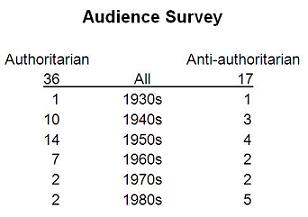
“This survey also had the unintended benefit of anonymously revealing the decade of birth of all of the audience members. The largest number of participants was born in the 1950s; they are now in their 50s and early 60s. There was then declining participation into the birth decade of the 1970s (30s and early 40s). Encouragingly, however, this was followed by a somewhat larger number in the birth decade of the 1980s (20s and early 30s). This is the core age of the target group the ACO wants to reach.
The numbers are not large but are certainly encouraging.”
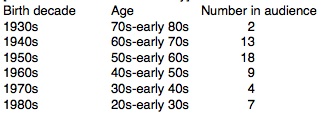
Clearing the Air: Facts & Fictions about Marijuana
March 26, 2012
On Saturday, March 31, 2012, nationally recognized substance abuse expert Richard Ryan and psychologist Dee Apple, Ph.D., board-certified psychologist and member of the Board of Regents and Clinical Associate of the American College of Orgonomy l presented "Clearing the Air: Facts & Fictions about Marijuana" at the Paul Robeson Center for the Arts, Princeton, NJ. Mr. Ryan shares some insight about the presentation.
What inspired you to work in field of substance abuse education?
Richard Ryan: "While I came to this specific work because of what I experienced as a child with an alcoholic father, and my own personal struggles with addictions and dependencies, I have always had an interest in working with adolescents in some capacity of education. The melding of the two seemed to be a natural fit--educating for the prevention of substance abuse, with a focus on awareness. This was the impetus for my having co-founded Creative Drug Education in the early 1980’s.
The founding of Center for Personal Responsibility in the mid-90’s was a natural evolution moving from an educational perspective to working directly with individuals, who suffered from chemical dependency, and their respective families."
Would you please share with us a case of teen who overcame addiction to marijuana?
Richard Ryan: "There are so many instances in which the young people with whom I have worked have overcome their addiction to and/or dependency on marijuana, it is difficult to pick one. It is easier for me to address some of the specific challenges some of them have faced and overcome. A couple of these come to mind:
I sometimes refer to pot as “the dream-breaker.” Here is a drug that provides an altered perception that includes a short but pronounced expansion of the imagination, and then prevents the user from fulfilling its vision, through the drug’s propensity to increase apathy. Many of my clients fulfill the ambitions they once had because they were successful in overcoming their addictions and dependencies.
Another significant achievement is far more organic in nature. A number of individuals with whom I have worked reported a reduction in anxiety when they are under the influence of pot. The problem with this is fairly complex.
I have come to believe that relatively normal levels of anxiety are actually necessary for fulfillment and achievement. When pot is used by many of its practitioners, it reduces this (normal) level of anxiety, redefining for the user a new baseline of acceptable anxiety. For this population, then, what was once experienced as normal is now perceived as unacceptable. When marijuana is used to ameliorate this change, anxiety is, in fact, increased if marijuana is not used on a regular basis. This is how dependence on marijuana can occur. When many clients have succeeded in breaking their addiction and /or dependency on marijuana, they find other ways to reduce excessive anxiety -- yoga seems to work for a number of clients; other forms of meditation seem to work as well, as does moderate to rigorous physical exercise. Clients also are able to learn to direct normal levels of anxiety toward creative and fulfillment-centered endeavors."
Why do you think marijuana use has risen so much over the years?
Richard Ryan: "Comparing marijuana to alcohol, cocaine, amphetamine and opiates, proponents can build a case for marijuana without much effort, and--sadly--without much thoughtfulness.
The fact that marijuana has found favor selectively (which I support) within the medical community has given the impression that it must be safer than once thought. However, as we find out more and more about long-term effects, the opposite appears to be true. Depression, short term memory interference, and psychosis are all common experiences shared by chronic users of pot.
Whenever we discuss the legalization of a drug for common usage, as has recently been the case in the state of California, people assume the drug in question must be safe. We have learned little from our checkered, and sometimes sordid, social/cultural/medical histories with alcohol and nicotine.
The current population of adults, who are now parenting the preadolescent and adolescent populations, is comprised of a greater number of individuals who themselves have used pot on an occasional if not regular basis. These parents are making assumptions that the drug itself has changed little, in either potency or effect. Unfortunately, these assumptions are erroneous (at best) and dangerously ignorant, in the worst case scenarios."
What did teens learn from your talk? What did parents learn from your talk?
Richard Ryan: " Teens learned that selective research on drugs via the internet is wholly inadequate to the task of facilitating their decision-making as to whether to include marijuana into their lifestyle choices or not.
They learned that the only real measure of a drug’s safety is determined by comparing it to itself, considering such dimensions as changes in potency and how those changes translate into the differences of the effects of those drugs (on the biochemical system, brain functions, and personalities of the users). Teens also learned that legalization of any drug needs to take into account far more than merely the principles of pleasure it will provide.
Parents learned that marijuana is a not a drug that can be used without the risk of consequences--mental, physical, social, (and dare I say, spiritual?). They learned that “parenting for safety” is a model that will ease the way for them to be more responsible adults and parents."
Visit our Events page for information about our next presentation. Back to top
Clearing the Air: Facts & Fictions about Marijuana
March 13, 2012
On Saturday, March 31, 2012, nationally recognized substance abuse expert Richard Ryan and psychologist Dee Apple, Ph.D., board-certified psychologist and member of the Board of Regents and Clinical Associate of the American College of Orgonomy, presented "Clearing the Air: Facts & Fictions about Marijuana" at the Paul Robeson Center for the Arts, Princeton, NJ. Dr. Apple shares some insight about the presentation.
The focus of your talk was specifically about teens and marijuana. Why marijuana?
"About half of my patients are teens, and marijuana use is often a focus of discussion, and I find marijuana use uniquely fascinating and disturbing. I think of it as being the most dangerous drug because many teens (and adults) think it’s not dangerous at all. They are wrong.
First, years of experience and research proves that marijuana use eventually disrupts attention and causes memory problems, and therefore disturbs concentration and comprehension. This can spell disaster for teens who are in the midst of some of the most important years of their lives - when they are developing biologically and psychologically, getting their formal education, and forming their values, goals, and identities. All of this is especially serious because of the cumulative negative effects that accrue as young people are using marijuana at younger and younger ages.
Second, one of the most disturbing effects of marijuana is that it affects self-perception, so that frequent users become increasingly unable to see the effects it is having on their functioning. Just think about that for a moment: They are unable to see what it is doing to them. That is frightening! And these effects can persist long after the person has stopped smoking marijuana, continuing to disrupt development.
Third, whether or not you think marijuana is a "gateway drug," someone using marijuana is more likely to come into contact and possibly experiment with other drugs than someone who doesn't use marijuana. (Think of it like this: If you are willing to try vanilla ice cream, you might be more willing to try chocolate ice cream.) Someone who is frequently using marijuana can become chemically and emotionally dependent on the subjective "high," and there is little doubt they may also start looking for other ways to get that high, and other drugs will provide that."
What is the most common fiction about marijuana?
"I would say that it is the misconception that it is harmless because it’s “natural” and “just a plant, not a chemical." Of course, there are some species of mushrooms that grow in the woods that will kill you, and they are natural plants too. Another fiction is that teenagers often state, and want to believe, that marijuana is not addictive, but that is not true, as I will explain in our presentation. Two current social processes that are contributing to the perception among teens that marijuana is harmless are the advocating of so-called "medicinal marijuana," and efforts by some groups to legalize or decriminalize use of marijuana. Many adolescents think that since doctors (supposedly) prescribe it as a medicine, and it’s being legalized, how can it be harmful? We know that it is the perception that a drug can be harmful that makes the most difference in deterring its use by adolescents."
How does marijuana use compare to alcohol use among teens?
"Certainly we all know that abusive use of alcohol can be destructive and dangerous. But what is incredible to me is to sit with someone whose life is going to hell in a hand basket and see that they are not at all aware that smoking pot is part of that process, and to hear them rationalize their use of pot by saying that alcohol is a lot more dangerous than marijuana. This may be an unintended artifact of all of the education in schools about the real dangers of alcohol, such as binge drinking and driving drunk. The fact is that during the last several years binge drinking has been on the decrease, while marijuana use is on the increase and is at a 30-year peak among high school seniors. And the research data shows that drivers who are using marijuana are more than twice as likely to be involved in traffic accidents as nonusers."
In your opinion, how has marijuana use affected society in general?
"Luckily, I am old enough to be able to say that when I was in high school there was no widespread drug use, and no marijuana. So I grew up in a period when no one even knew what marijuana was, and very few people even drank. One student to whom I told this responded with, "Damn, what did you guys do for fun?" How sad is that?
Consequently, I have been witness to the incredible, profound changes in our society, occurring over the last 40 to 45 years in which marijuana played a huge part. We now have two generations for which exposure to marijuana is a given, a regular part of their lives. Marijuana use has not only contributed to pervasive confusion and unhappiness in individuals over the years but it has been a major contributor to the destructive change of our society from a predominantly authoritarian culture to an anti-authoritarian one."
What can you say about marijuana use from the orgonomic perspective?
"I find the orgonomic perspective extremely helpful in making sense all of the various effects of marijuana use. Consider the concept of pulsation. Smoking pot causes a temporary and artificially induced “overexpansion,” where the user often experiences intensified and altered sensations and perceptions, and often a sense of well-being. Afterwards, there is an energetic contraction. The user feels tired and dulled, "laid back and chilled out," and becomes less motivated to do things they might otherwise be interested in doing. Over time they tend to lose their "sparkle" and to become emotionally dulled. And since marijuana use disturbs both one's level of excitation and clarity of perception, people become less in contact with themselves and therefore with the people around them. As I mentioned earlier, marijuana use changes one’s state of consciousness and one’s ability for self-perception.
Along with its effects on other emotions, marijuana effectively deadens anxiety, at least temporarily. This is one reason people like the effect, but it comes at a very steep and usually unknown (to the user) price. Some degree of anxiety is a natural and necessary part of life, and you have to learn how to tolerate that in order to develop and grow up. This includes mastering important things such as how to have a serious relationship and really become intimate with people, and how to be truly independent and live responsibly."
This was the first time in the Social Orgonomy presentation series that there will be a guest speaker.
"Richard Ryan is a drug educator who works professionally with private clients and families of people who have drug problems, most of them with marijuana. He travels the country all year working at private and public schools where his focus is drug education. For the past seven or eight years he has been coming to The Lawrenceville School where I work and because he talks about something so important I have always made time to sit in on some of his classes. Although we’re coming from slightly different orientations, we speak much the same language and I have learned a lot from him. I have found him to be an incredibly knowledgeable and caring person. He has tons of experience and stories to share and most teens respect him and are really open to his message."
Visit our Events page for information about our next presentation. Back to top
Medical Orgone Therapy for Children and Teens: Treating Emotional and Behavioral Problems
February 6, 2012
On Saturday, February 4, 2012, Dale Rosin, D.O., a board-certified psychiatrist and member of the Board of Regents and Clinical Associate of the American College of Orgonomy, presented "Medical Orgone Therapy for Children and Teens: Treating Emotional and Behavioral Problems" at the Paul Robeson Center for the Arts, Princeton, NJ. Dr. Rosin shares some insight about his presentation.
Why is medical orgone therapy useful in treating children and teens?
Dr. Rosin: "Medical orgone therapy encompasses many kinds of therapies from behavioral to psychodynamic to play therapy to family therapy. The advantage and benefit for the psychiatrist who practices medical orgone therapy is the understanding of emotional functioning that allows for more specific use of various options to effectively treat problems in children and adults, often without medication."
Does medication have a role in treatment?
Dr. Rosin: "A medical orgone therapist may prescribe medication but will always look for a way to lessen the dosage or eventually discontinue it. Also, a psychiatrist should be able to tell you if you need medication, and likewise, be able to tell you if you don't need it. For example, I treated a child who had previously been given the diagnosis of Attention Deficit Disorder (ADD). After the child was actively able to get a lot of feeling and emotion out during his sessions with me, there was never any need to use medication."
When treating children and teens, do you see the parents as well?
Dr. Rosin: "Yes. Always. A child can never be treated without working with the parents. Parents are an integral part of a child's life."
What types of case histories did you present?
Dr. Rosin: "The case histories I chose to discuss illustrated behavioral problems, attention difficulties, grief, and parenting matters in dealing with young people today. These cases showed that there is an effective therapy that helps both parents and children to function in a better way in everyday life."
Dr. Rosin received his medical degree from the Des Moines University School of Osteopathic Medicine in Des Moines, Iowa and completed his residency in general psychiatry and fellowship in child and adolescent psychiatry at the University of Medicine & Dentistry of New Jersey. Dr. Rosin maintains private practices in Somerville, New Jersey and the Lehigh Valley, Pennsylvania where he treats children and adults. Dr. Rosin has authored numerous articles on the treatment of children and adults in the Journal of Orgonomy.
Visit our Events page for information about our next presentation. Back to top
November 11, 2011
The ACO Press is proud to announce it has published My Eleven Years with Wilhelm Reich by Dr. Elsworth F. Baker. This limited, special edition was released in conjunction with the American College of Orgonomy's public presentation, "Burned but Not Forgotten: U.S. Government Suppression of Wilhelm Reich's Work," on October 1, 2011 in Princeton, NJ. Originally appearing as a series of 17 articles in the Journal of Orgonomy from 1976 to 1984, this is a well-documented account of Dr. Baker's personal experience with Reich from someone who was a student, patient and colleague, who worked closely with Reich but remained objective about him and did not idolize him. In light of recent distortions about Reich and his work, this book shines as a first-hand, historically accurate account about Reich, his work and medical orgone therapy. Visit our online store today to look inside the book or place your order.
Burned But Not Forgotten Event and Banned Books Week
October 4, 2011
On October 1st, 2011 the ACO’s Social Orgonomy presentation event, “Burned But Not Forgotten: U.S. Government Suppression of Wilhelm Reich’s Work,” coincided with the American Library Association’s Banned Books Week. Presenter Dr. Peter Crist tells how learning about Banned Books Week inspired this presentation.
“So few people know that the US government not only banned but also burned Wilhelm Reich’s books. It is truly an astounding historical fact. Ever since the 50th anniversary of Reich’s death a few years ago, I thought that we really should do something to let people know about it, and considered it a perfect topic for one of our social orgonomy presentations. When I also discovered that the ALA’s Banned Books Week would fall in the last week of September, so close to the date of our usual scheduled presentation on October 1st, I thought this would be a perfect time.”
Multiple presenters at the October 1st event spoke about the impact Reich’s ideas and books have had on their lives. When did you first learn about Reich and his work?
Dr. Crist: “I first heard about Wilhelm Reich when I was 16. One of the things that the person who introduced me to Reich said, was that in the Eisenhower administration Reich’s books were burned and he was put in prison. As a teenager, the idea that the authorities could do such a thing captured me. One student in our recent laboratory course also said that as soon as he heard that the books were burned he knew he had to read them. There is something about ideas being suppressed that effects people tremendously.”
What did attendees hear about at the presentation?
Dr. Crist: “I wanted to make a very personal impact by having numerous people who are continuing Reich’s work talk about the books that affected them. Reich is not well known in the popular sense but this has not stopped people from making use of the knowledge he left us or from his still having a profound effect on their lives and careers and the work that they do.”
What was the first book by Reich that you read?
Dr. Crist: “I was exposed early on to all of Reich’s books that were available in print at the time. However, the first book that impacted me most was The Murder of Christ.”
Who were the other presenters?
Dr. Crist: “Presenters were primarily medical orgonomists, both from the U.S. and Europe, but there were also others participating. Some ACO Board of Regents members who spoke included Drs. Dee Apple, Dale Rosin and Virginia Whitener. Many of our Clinical Associates also spoke including Drs. Edward Chastka, David Holbrook, Salvatore Iacobello and Susan Marcel, as well as two from Europe: Drs. Alberto Foglia and Vittorio Nicola. One of our social orgonomy trainees, Carol Freund, MSW also participated.” (See presenter quotes below.)
In your opinion, why did the government burn Reich’s books?
Dr. Crist: “I believe it had a lot to do with how Reich viewed sex and sexuality at a time when such things were repressed. I also think it had to do with his revolutionary, functional approach. In addition to people’s personal reactions to Reich’s works, I described the situation that led to the burning of his books and detailed how this was just one example of multiple attempts in this country and abroad to suppress his work. In this regard, our government was in league with the communists and the Nazis.” Back to top
For more information about our upcoming events please visit our Event page.
Burned But Not Forgotten Event
September 19, 2011
At our Social Orgonomy series presentation, "Burned But Not Forgotten: U.S. Government Suppression of Wilhelm Reich's Work," led by Peter A. Crist, M.D. on October 1st in Princeton, NJ, numerous professionals and students of Wilhelm Reich's work from the U.S. and abroad discussed the profound impact of Reich's ideas and books on their lives and careers. Below, we share a small sampling of some of their thoughts.
Susan Marcel, D.O., ACO Clinical Associate
"When I read The Murder of Christ, I felt, for the first time, I had found a voice -- Reich's voice, as a clear thinking and feeling, serious guide to the outrageous murder of such a loving, alive human being."
Alberto Foglia, M.D., ACO Clinical Associate
"During the years 1977 and 1978 I was a young, unhappy and miserable man after I was left by my girlfriend. I was looking for something but I didn't know what...Then my brother and I read our first book written by Wilhelm Reich, The Mass Psychology of Fascism, translated into Italian...We had found what we were looking for: the solution for human and our private misery was not in politics but in the loosening of armor."
For more information about our Social Orgonomy presentation series, please visit our Events page or call (732) 821-1144. Back to top
New Attacks on Wilhelm Reich and Orgonomy
August 5, 2011
Read the book review by Virginia L. Whitener, Ph.D.
They just can’t leave Reich alone. There is something about Reich’s work and his story that seems to affect people profoundly. They either attack him or idolize him. Either way, people often lose contact with their better judgment and professionalism. It also appears much easier to focus on Reich the man than to critically investigate the merits of his discoveries.
For years a problem for those of us who take Reich’s work seriously and try to develop, as well as find, practical applications for it has been that orgonomy and Reich have been given the silent treatment. We welcome the press bringing Reich and his work “out into the light of day” for a new appraisal in the 21st century, but only ask for decent, serious scrutiny with genuine, honest journalism.
The Wall Street Journal (WSJ) took the opportunity of a recent book’s publication -- purported to be a well-researched biographical work about Reich by Christopher Turner -- to hire a reviewer, Henry Allen, who rather than assess the book, attacked Reich and perpetuated numerous old rumors, false attitudes and distortions about the man and his work. (Read more about Turner’s and Allen’s “qualifications”…)
Within a few days of the alleged “review,” which, incidentally, appeared on the front page of the WSJ book review section, the president of the ACO, Peter Crist, M.D. submitted a letter to the editor of the WSJ by both e-mail and postal mail to address our concerns about the distortions and poor journalistic standards so evident in the piece. Unfortunately, the WSJ did not publish that letter. Although some key points are mentioned here, you can read Dr. Crist’s letter to the WSJ in full…
In the face of the old and renewed distortions with their typical smutty and salacious attitude toward Reich, we feel it is especially important for those who have a deep appreciation for the value of Reich and orgonomy to simply continue the work of developing and using this new science, and convey undistorted views of Reich and orgonomy to the public. That is the goal of all our work at the ACO including our training programs, public presentations, laboratory courses, and publications.
It is ironic as well as fitting and perhaps fortuitous that prior to this recent attack we already scheduled our next public presentation to be on the subject of the burning of Reich’s books. Set for October 1, 2011 so that it would coincide with “Banned Book Week (also read), this presentation will look at various aspects related to this attempt to silence a scientist who did not follow the accepted views of life and science. It is remarkable how few people even know that Reich is the only person to have his books burned under the authority of the U.S. government. In addition, he is the only person whose books were also burned by the Nazis and banned by the communists.
If others want to make Reich better known to the public, let us use this as an opportunity to set the record straight with accurate information. Back to top
"Whenever you interact with another human being, we're talking about social orgonomy."
Dee Apple, Ph.D.
In 2006, psychologist Dee Apple, Ph.D. began the American College of Orgonomy's Social Orgonomy Series with a presentation entitled, "Social Orgonomy in the 21st Century." On Saturday, June 4th at the Princeton Public Library, he presented again with, "A New View of Society & How We Relate: What is Social Orgonomy?" Dr. Apple saw his 2011 presentation as the series coming full circle.
How was this presentation different from what you talked about in 2006?
Dr. Apple: First I want to say how honored I was to give the very first presentation in this series, and it's been exciting to see how much it has grown in five years. My June 2011 presentation was both a reprise and an update -- a chance to present information from a different perspective because I could speak with even greater depth and understanding from my own work and personal life about applying orgonomic principals to the social realm.
What makes your perspective as a psychologist and social orgonomist different from some of the other speakers who have been psychiatrists and medical orgonomists?
Dr. Apple: As a psychologist, I'm very tuned into the social realm, meaning that I tend to focus on the contact -- awareness and perception -- individuals have with themselves, with me in sessions, and in their interactions with others in their lives. It's primarily where I work and think. I consider myself extremely lucky to be working in my field with an orgonomic perspective. The work we do in social orgonomy is not just one other way of addressing the social realm; it's a very unique and powerful perspective based on biological and energetic functions. The concept, "making genuine contact," for instance, is relevant wherever there is an interaction, whether in business, with children, in a marriage, between friends or in organizations.
What exactly does "contact" mean from the orgonomic perspective?
Dr. Apple: Contact is first your awareness of yourself, which requires the sensitivity to be able to be aware of your feelings and sensations, and then to clearly and accurately perceive yourself and the environment around you.
How did you demonstrate the concepts you will be talking about?
Dr. Apple: I put together compelling examples from my practice, daily life, and video clips of current media. One television show I will talked about is Kitchen Nightmares, where a famous chef visits failing restaurants around the country and tries to turn them around. In one episode, a totally dysfunctional family restaurant owned by a mother and two sons was going out of business because of complete disorganization and a lack of contact between the manager and the cooks. The chef broke through their contactlessness by literally grabbing the manager and yelling at him to stop what he was doing. This one interaction changed the whole restaurant for the better. Without knowing anything about social orgonomy, the chef was utilizing the idea of contact and excitation.
I also discussed how people have become dependent on "substitute contact" including video games, cell phones, texting, and the social media such as Facebook. There was a great article in the New York Times titled, "Quality Time Redefined." It talked about how even when families are together in one room, dad is watching TV, mom is on her iPad, and the kids are playing a video game: They are physically all in one room, but they are not together. And the people featured in the article actually thought of this as quality family time!
Social orgonomy is obviously far-reaching. If you could sum up what social orgonomy means in one brief sentence, what would you say?
Dr. Apple: I would say that whenever you interact with another human being, we're talking about social orgonomy.
For more information about our Social Orgonomy presentation series, please visit our Events page or call (732) 821-1144. Back to top
If, as children, we had adults in our lives who loved books and wanted us to feel the same way about them, they read to us; and as adults who care about children, we read to our own young ones. But do we actually recognize what even simple children’s books have to offer? In his presentation, “Are Children’s Books Just for Kids?,” board-certified psychiatrist, Howard Chavis, M.D., discussed what we might be missing. The talk took place on April 2, 2011 at the Friend Center at Princeton University as part of the ACO’s ongoing Social Orgonomy Presentation Series. Dr. Chavis offers his take:
What inspired you to want to talk about children’s books?
Dr. Chavis: My children, who are two-and-a-half and four-years old, inspired me. In reading to them, I’ve come to realize that there is so much more to children’s books than just a simple story. Nestling with them while reading is so pleasurable and the emotional contact so extraordinary that my thoughts and ideas simply flowed from there.
What do you think attendees discovered from your talk?
Dr. Chavis: I showed the audience what has been hiding in plain sight. Hopefully they became aware of things they haven’t routinely recognized in even the most simple of books. These include parenting practices and life lessons that are right there in the pages in front of them.
For example, some parents may not realize that they have difficulty making emotional contact, and that this can have an adverse effect on their children. There are, in fact, books that can help parents make a better connection with their children, such as Marjorie Newman’s “Mole and the Baby Bird” and “Kitten’s First Full Moon” by Kevin Henkes. I also showed how some children’s books can offer lessons about such sophisticated topics as the fundamentals of economics, as in “What Do People Do All Day” by Richard Scarry.
Are the books you talked about all books you read to your own children?
Dr. Chavis: Yes, they are. Many of the books are current but I also discussed a few of the classics that offer the same types of lessons as well, although from a simpler time. The important message is that no matter when a book was written, there are certain timeless lessons to be learned that most adults miss when they read to their children. I greatly enjoyed reading some of these books aloud, and was excited to share some of the exciting things inside them with the audience.
For more information about our Social Orgonomy presentation series, please visit our Events page or call (732) 821-1144. Back to top
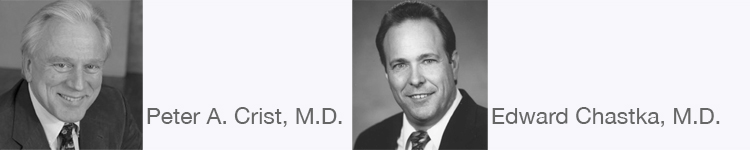
For several thousand years the doctor/patient relationship has been one of the most significant as well as intensely emotional and intimate of all human bonds. In recent history, however, this connection has deteriorated. What goes on in the doctor's office has become a major source of stress for all. Both patients and doctors feel rushed during appointments, burdened by skyrocketing expenses and frustrated and aggravated by having to deal with insurance company and government bureaucracies. On February 5, 2011 at the Paul Robeson Center for the Arts in Princeton, New Jersey, Board certified psychiatrists Peter Crist, M.D. and Edward Chastka, M.D. focused on this very compelling situation, leading an open discussion entitled "Is the Doctor Really In? - Making Each Visit Count," as part of the ACO's ongoing Social Orgonomy Presentation Series. Their approach:
This presentation was different from past events in that it was an open discussion with the audience. Why did you make that change?
Dr. Crist: "We decided to experiment with this format so that we could engage the audience in a more informal discussion and focus on what matters most to them. We wanted to make a real connection with everyone who attended in as direct a way as possible."
Dr. Chastka: "And we wanted to listen to what people, both doctors and patients, had to say, not just talk to them."
What do you see as the primary cause of the lack of a genuine connection between doctor and patient?
Dr. Crist: "The doctor/patient relationship has been undermined by many different forces in recent years. The toughest change is that doctors have to deal with patients in a more mechanical way just to get paid. Because of insurance and government regulations, doctors are seeing more patients for shorter visits in order to make a living. The threat of malpractice suits has also been very destructive, and now most doctors have a figurative lawyer sitting in with them when they see patients and make medical decisions.
I want to be clear that this is not the doctor's fault. We're not blaming anyone, but rather focusing on what the problem is and what we can do about it. Both doctors and patients need to work together to make better contact. Doctors have become health care providers, and are no longer healers. A different kind of contact is essential for healing to happen, and we hope people left the discussion with new tools to help make that a reality."
Dr. Chastka: "Over the last, say, 100 years, people have been looked upon more and more as a biochemical machine, and the idea that there is a healing relationship between doctor and patient has lost its popularity even though there is a lot of information supporting its effectiveness. For example, studies in psychiatry with a control group of patients merely coming in and meeting with someone and talking, found that that alone was beneficial to the patient. However, because of health insurance, seeing a doctor is now more like dropping your car off at the mechanic, and that's not a relationship.
How has medical insurance contributed to the deterioration of the doctor/patient relationship?
Dr. Chastka: When health insurance first came about in the 1940s, 50s, and 60s there were no restraints - doctors no longer had to think about what it actually cost the patient, and the patient no longer had to worry about paying the doctor. This resulted in an explosion in medical costs -- not only in doctor and hospital fees but also with pharmaceutical and medical equipment companies. Since then we have gone even further down that road. People don't pay for their own regular medical care anymore and so prices are set in order to get the maximum amount from the insurance companies. The cost of medical care has lost any connection with reality, and the insurance companies decide whether the patient gets something or not. All of these things have contributed toward destroying the doctor/patient relationship and the true healing that it can bring about."
For more information about our Social Orgonomy presentation series, please visit our Events page or call (732) 821-1144. Back to top